Rising Costs and No Farm Bill Split Kansas Farmers in Tight Senate Race
One family says it cost $737,375 more to run its farm this year than last. Republican Sen. Roger Marshall now faces Democrat Adam Hamilton in a race few expected to be close.
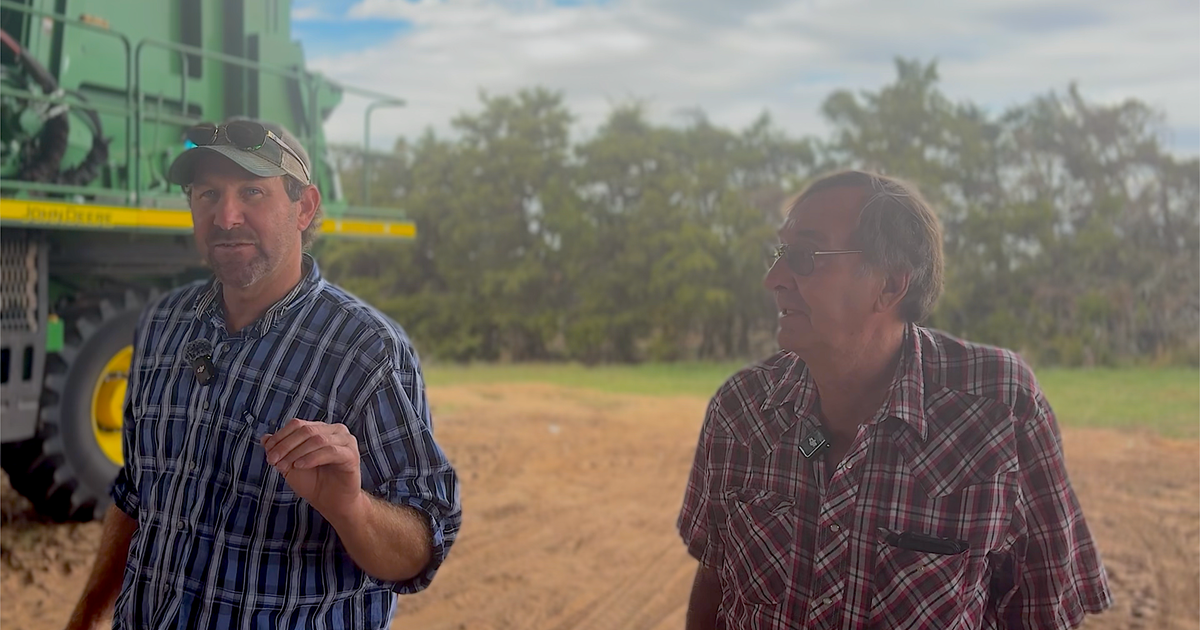
"There's a lot of pissed-off farmers right now at Trump and Marshall, because you see the situation we're in," said Kansas farmer Jeff Preisser, speaking to CBS News in the closing days of an unexpectedly competitive Senate race between Republican Sen. Roger Marshall and Democrat Adam Hamilton.
The Preisser family handed over a sheet of paper detailing their costs. It cost them $737,375 more to run their farm in 2026 than in 2025. That included $514,625 more for fertilizer and $187,000 more for diesel, expenses that have climbed during the Iran war, and $10,000 more for parts, which they tied to steel tariffs. Drought cut their crop yields by 20%, commodity prices are low and trade wars have shrunk farm exports, leaving the family with $325,000 less in revenue than last year. Jeff Preisser said he is not sure his 6,500-acre corn, cotton, soybean and wheat farm in Sylvia, Kansas, will survive through next year.
The pressure is widespread. Kansas lost 700 farms between 2024 and 2025, and farm bankruptcies across the Midwest rose 70% over the same period, CBS News reported. Congress has not passed a new farm bill since 2018, and the most recent extension officially expired last month. The bill covers crop insurance, prices and rural development programs.
That failure is pushing some lifelong Republicans away. Larry Preisser, who started the farm, plans to vote for a Democrat for the first time. He said he was promised that once Republicans held power under President Trump, Marshall would fight to pass the farm bill. "Two years [later], we got no farm bill, nothing," he said. He plans to vote for Hamilton, a pastor who is trying to become the first Democrat to represent Kansas in the Senate since the 1930s. Larry Preisser said he and neighbor Tracy Chambers were drawn to Hamilton after seeing him at the Kansas State Fair because he seemed like a moderate who could bring the parties together. "He wants to work with the Republicans, too," Larry Preisser said.
His son Jeff was not sure he would vote at all, but said it would not be for the Republican: "We need someone who's not Roger Marshall." Jeff's sister, Mandi Sieren, said she does not "trust anybody at this point enough to vote for them." The family argued Marshall had not stood up for farmers against decisions that hurt the industry, from the Iran war and tariffs to recent Immigration and Customs Enforcement raids in southwest Kansas that left ranchers short-staffed during harvest.
Not every farmer agrees. About an hour away, soybean farmer Mick Roush said he also may not be able to hold on to his land much longer, but he is sticking with Marshall because Hamilton seems "too liberal" and because Marshall is "from farm country." Roush and others see the strain of the Iran war as temporary, and some say the war is justified to keep Iran from building a nuclear weapon. Others plan to vote Republican because they fear farmers would fare worse if Democrats control Congress.
An April survey sponsored by Farm Journal found that more farmers and ranchers trust Republicans than Democrats to handle issues important to agriculture. But it also found that 73% believe their elected officials understand the realities they face "not very well" or "not at all," and that on every economic issue tested at least one in five said they trusted neither party.
That distrust is the opening Hamilton is trying to use. With the election Nov. 3, the question in Kansas is whether farm-country frustration is enough to flip a seat Republicans have held for generations, or whether loyalty to the party and fear of Democratic control will hold the line.