The Solar Wind Is Rolling Giant Waves Across the Top of Mars' Atmosphere and Peeling It Away
Two spacecraft — NASA's MAVEN and China's Tianwen-1 — watched at the same time and caught Kelvin-Helmholtz waves dumping bulk plasma into space.
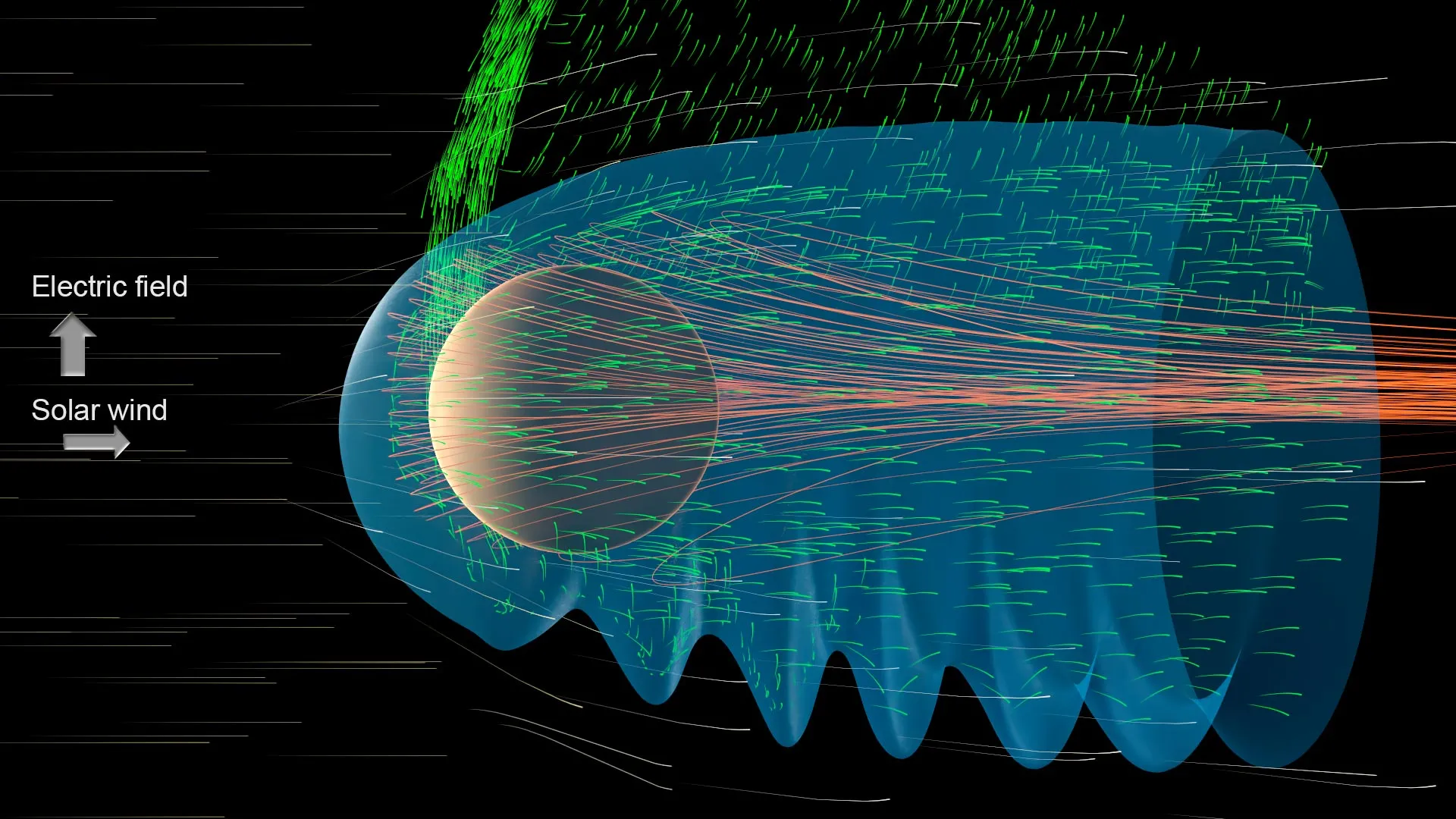
Mars is losing its atmosphere in gulps, not in a steady trickle, and a study published August 1 in Science Advances identifies the mechanism: enormous rolling plasma waves that the solar wind whips up along the boundary of the planet's upper atmosphere.
The waves are a textbook fluid instability called Kelvin-Helmholtz, and the everyday version is easy to picture. When wind blows across the surface of a lake, it does not simply push the water forward — it generates rolling waves and curling vortices at the interface between the two fluids. The same thing happens at Mars, except the wind is a supersonic stream of charged particles from the Sun and the lake is the planet's ionosphere. The solar wind stirs the boundary, the boundary curls, and the curls tear off chunks of Martian atmosphere.
Earth is mostly spared this because it has a global magnetic field that deflects the solar wind well above the atmosphere. Mars lost its internally generated field billions of years ago and has nothing comparable. Its upper atmosphere sits directly exposed to the stream.
What makes the new result different from earlier work on Martian atmospheric loss is that the researchers had two spacecraft on the problem at once. China's Tianwen-1 orbiter acted as an upstream solar wind monitor, recording exactly what was arriving at the planet. NASA's MAVEN spacecraft simultaneously measured atmospheric ions escaping near Mars. That pairing let the team link specific solar wind conditions directly to specific escape events, rather than inferring the connection statistically after the fact.
The escaping material does not leave uniformly. "Instead, it is mainly observed on one side of the planet, depending on the direction of the solar wind electric field," said Chi Zhang of Boston University, the study's lead author. The waves build large plasma clouds that carry ions away in bulk — a lumpy, one-sided process rather than the smooth global leak often assumed in models.
The paper, by Zhang, Chuanfei Dong, Gangkai Poh and colleagues, is titled "Simultaneous Mars-orbit observations reveal Kelvin-Helmholtz instability–driven bulk atmospheric ion escape."
The stakes go beyond current-day space weather. Mars once had liquid water on its surface, which required a far thicker atmosphere and the warmth that came with it. Understanding how much mass this mechanism can strip, and how often, feeds directly into reconstructing when the planet went from wet to cold and dry.
"We want to know when these waves are most likely to form, how they evolve, and how strongly they can drive atmospheric escape," said Chuanfei Dong of Boston University's Center for Space Physics. That is the next phase of the work — turning individual caught-in-the-act events into a rate that can be integrated over billions of years.
Originally reported by ScienceDaily.