Cold Atoms in a Laser Trap Mimic Matter and Antimatter Springing From Empty Space
A Chinese team used rubidium atoms in an optical lattice to simulate the Schwinger effect, a decades-old prediction that no laboratory has directly observed.

Physicists in China have used ultracold atoms held by laser light to simulate one of quantum physics' most elusive processes: a strong electric field turning empty space into pairs of particles and antiparticles. The experiment, from the University of Science and Technology of China and partner institutions, appears in Physical Review Letters.
According to quantum electrodynamics, the theory of light and electrically charged particles, a strong enough electric field can convert some of its energy into a particle and its antimatter partner. An antiparticle has the same mass as its partner and, for charged particles, the opposite charge. This pair creation from the vacuum is known as the Schwinger effect. At electric field strengths achievable in a laboratory it is so strongly suppressed that no one has observed it directly.
"We were inspired by the Schwinger effect, the prediction that a strong electric field can spontaneously create electron-positron pairs from the vacuum," co-senior author Zhen-Sheng Yuan told Phys.org. "This is an example of 'false vacuum decay,' and in its original form it has never been observed directly. Our goal was to build a simple, controllable laboratory model with cold atoms."
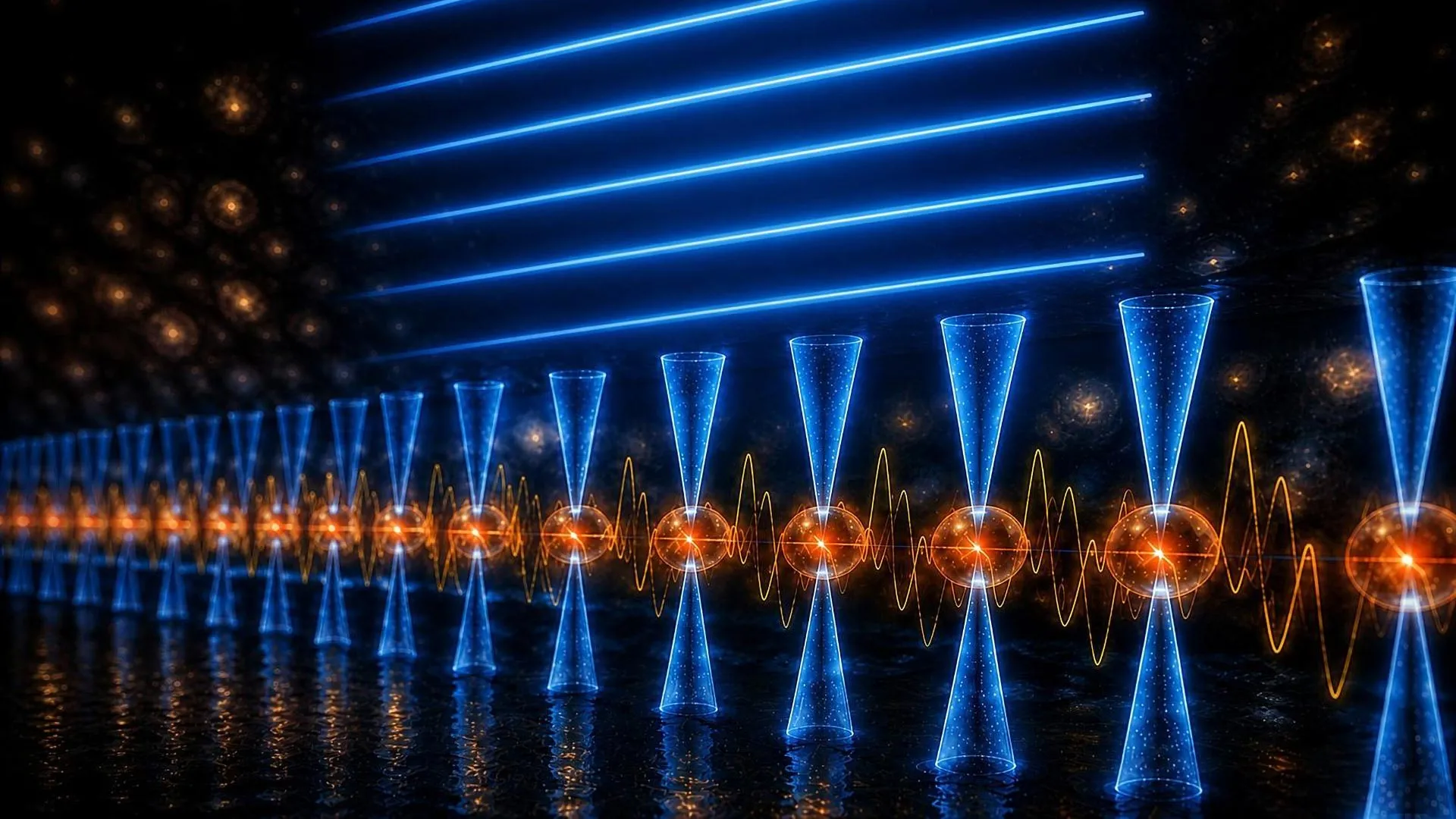
The team trapped ultracold rubidium atoms in a one-dimensional chain of optical traps, with every second trap holding two atoms and the traps between them empty. Yuan called this arrangement a false vacuum, a state that can release energy by creating particle-antiparticle pairs. The researchers then adjusted the settings so atoms could hop between neighboring sites in a way that mimics pair creation, tuning a simulated background electric field to control the process. A quantum gas microscope imaged the atoms at different moments, so they could watch pairs form.
They varied the mass of the simulated particles and the strength of the field. Heavier particles, or a field that dominated the other interactions in the model, produced fewer pairs. The team also tied pair production to the vacuum persistence amplitude, whose squared magnitude gives the probability that the initial vacuum survives, and saw long-lived oscillations in some limits. With the simulated particle mass set to zero, they observed oscillations resembling the collective excitations predicted by the Schwinger model.
The experiment is a simulation, not a direct observation of real electrons and positrons, but it offers a controlled way to study processes that are extremely difficult to see otherwise. The team plans to study what happens when the simulated particles meet, collide and scatter. They also hope to extend the setup from one dimension to two and to other gauge theories, where richer phenomena such as string breaking become accessible.