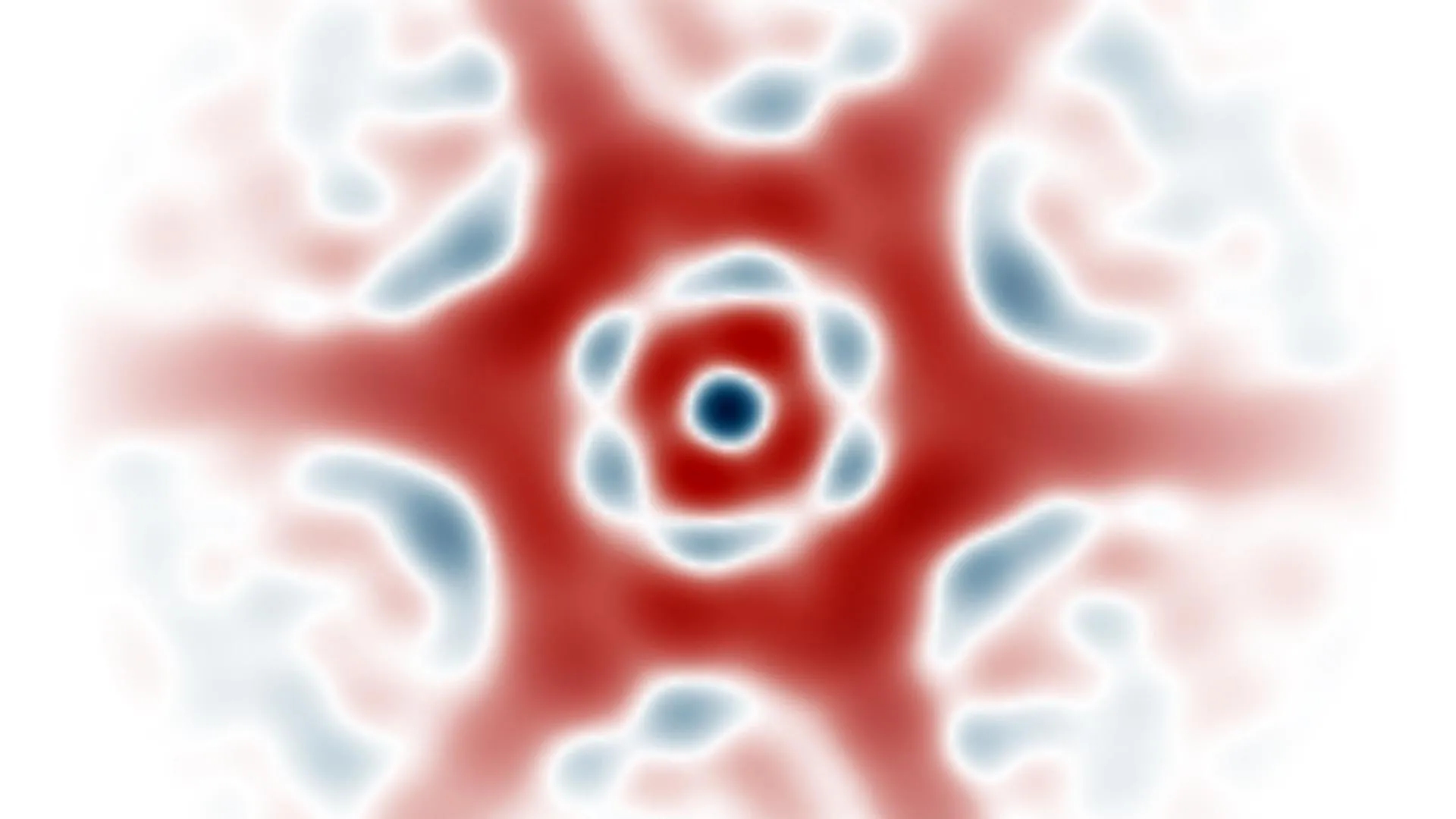
Quantum Simulator Made of 13 Trapped Ions Watches Matter Pop Into Existence From Energy
Duke-led physicists recreated 'string breaking,' the process that turns stretched-out energy into particle pairs. Google and QuEra teams reached similar results on different hardware.
Physicists have used a chain of 13 trapped atoms to reproduce one of the strangest events in particle physics: matter appearing out of pure energy. The experiment, led by the Duke Quantum Center and published Sept. 23 in Nature Physics, simulated a process called string breaking.
In the theory of the strong nuclear force, quarks are bound together by a stretchy "string" of force field. Pull two quarks apart and the string stores more and more energy. At some point it becomes cheaper for the string to snap, and the energy turns into a new quark and antiquark pair that cap each broken end. It is why no one has ever seen a free quark, and it is a small-scale version of how particles were made in the hot early universe and in collisions at machines like the Large Hadron Collider.
Simulating that snapping on an ordinary computer is brutally hard, because the calculation involves quantum states that change over time and the difficulty grows explosively with size. A quantum simulator sidesteps the problem by being quantum itself. The Duke team, led by Christopher Monroe, encoded a string-breaking model into 13 trapped ions held in a line and used laser beams to control how the ions interact.
They prepared the chain in an out-of-equilibrium state and watched it evolve. The team saw effective charges appear as the simulated string reached its breaking point, reconstructing the process of new matter forming from stored energy. The collaboration included researchers from the University of Maryland, Oxford University, Caltech, Cornell University and KU Leuven.
The result was not alone. Two other groups, one at Google and one at QuEra Computing, independently reached similar results on different quantum hardware. Three platforms agreeing on the same physics gives confidence that the simulators are behaving like the theory says they should, rather than reflecting quirks of one machine.
"Quantum computer simulations provide the best platform to investigate complex questions like matter formation, short of having witnessed the Big Bang itself," Monroe said. The current experiments use a simplified model in a single spatial dimension, far from the full theory of quarks and gluons. The goal is to scale up to richer models that classical supercomputers cannot handle, and eventually to study how matter formed and evolved after the Big Bang.
Trapped-ion machines are well suited to this kind of work because their qubits are identical atoms held in place by electric fields, so every ion behaves the same way and errors are easier to control. The three-way agreement among ion, superconducting and neutral-atom-style platforms is a sign that quantum simulation of particle physics is moving from concept to routine tool.