Trapped Ions Simulate Aharonov-Bohm Interference in a 2D Gauge Theory
Oxford researchers used strontium ions in a hybrid qubit-oscillator system to watch a particle's tunneling switch off completely when magnetic-like flux is present.

Physicists at the University of Oxford have used trapped ions to simulate a quantum effect that normally appears when a charged particle circles a region of magnetic flux, and they have shown it working inside a lattice gauge theory, the kind of model that underlies the forces of nature. The work was published in Nature Physics under the title "Aharonov-Bohm interference in a Z2 lattice gauge theory on a hybrid qubit-oscillator quantum computer." The lead author is Sebastian Saner.
The Aharonov-Bohm effect is a staple of quantum mechanics. A particle can travel along two paths around a flux, and the paths interfere with each other, even though the particle never touches the field. Simulating that behavior in a gauge theory has been hard, because earlier quantum simulations of this class of models were mostly one-dimensional or left out the matter particles that move through the field.
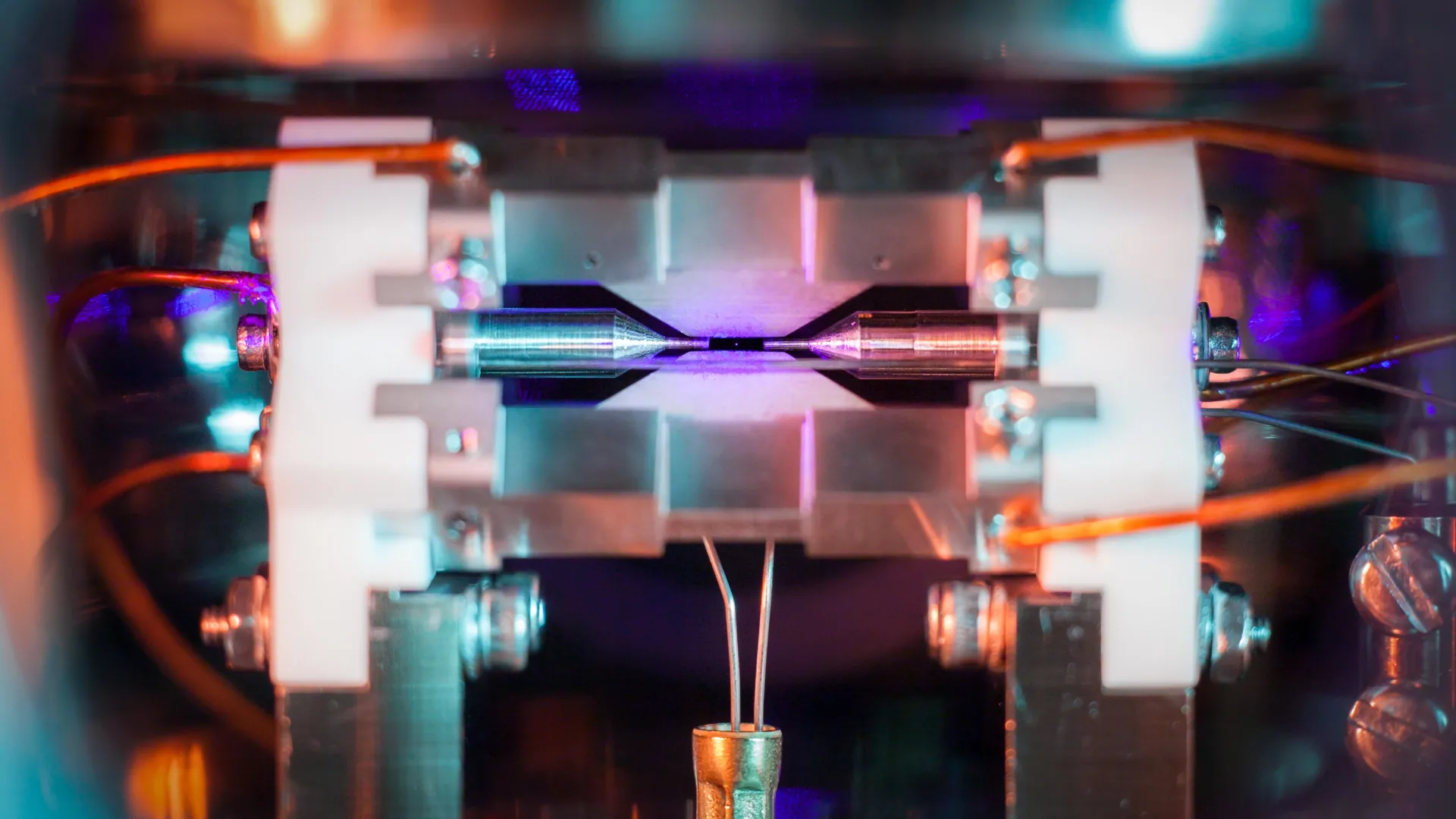
The Oxford team solved this with a hybrid design. Two electronic levels of a strontium ion form a qubit that encodes the gauge field on a single link of the lattice. The ion's vibrational modes behave like harmonic oscillators, and they encode matter, with one vibrational quantum, a phonon, standing in for one matter particle. A laser applies two forces, each acting on a different vibrational mode and pushing in a direction set by the qubit state. Each hop of the particle flips the field line on that link, as the model's version of Gauss's law requires.
To build a loop, the team used two ions, giving two links between the same pair of matter sites. That creates two possible paths for the particle. The two link qubits are entangled, and one entangled state corresponds to zero flux while the other corresponds to a nonzero flux, known as a vison. The two-dimensional geometry is synthetic, set by which qubits and modes are coupled rather than by where the ions physically sit.
The results matched the theory. With a single ion, the particle tunneled back and forth while the field line switched on and off. When the team added an energy cost to the field line, the oscillations became faster but smaller, and the particle no longer moved fully between sites. The authors describe this suppression as a precursor to confinement in larger systems.
The loop showed the interference clearly. With zero flux, the two paths interfered constructively, and the particle tunneled about twice as fast as it did on a single link. With a vison present, the paths interfered destructively and the tunneling was suppressed completely. The flux stayed constant apart from a slow decay caused by decoherence, and simulations that included noise sources, such as heating of the vibrational modes, matched the data.
The approach captures how flux affects the motion of matter, which earlier simulations without matter fields could not do. The researchers say the next steps are larger lattices, where classical computers may eventually struggle to keep up, and an extension to more complex Z_N gauge theories, with the long-term aim of reaching the N-to-infinity limit. The article does not give detailed error budgets, which are in the paper itself.