Oxford Physicists Use a Hybrid Quantum Computer to Watch the Aharonov-Bohm Effect Freeze a Particle
Qubits stood in for a magnetic field and ion vibrations for matter, in a Nature Physics experiment that simulates lattice gauge theory, the framework used in particle physics.

Physicists at the University of Oxford have used a hybrid quantum computer, built from qubits and quantum oscillators, to observe the Aharonov-Bohm effect inside a quantum simulation. The result, published in Nature Physics, shows that such machines can model interactions between matter and the force fields of particle physics, problems that grow too hard for ordinary computers as they get bigger.
The Aharonov-Bohm effect is one of quantum mechanics' stranger predictions. In 1959, Yakir Aharonov and David Bohm showed that a charged particle traveling around a region containing a magnetic field, rather than through it, still picks up a measurable phase from the field. The particle never touches the field, yet it leaves a trace. The effect was later confirmed in experiments with real electrons.
The Oxford team wanted to see it appear in a different setting, a lattice gauge theory. These mathematical frameworks describe how matter interacts with gauge fields, which underpin important models in particle and high-energy physics. In such a theory, matter sits at the points of a grid and the fields live on the links between them. As the grid grows, the calculations quickly outrun classical computers. The alternative is quantum simulation, where researchers build a physical system that obeys the same rules and watch what it does.
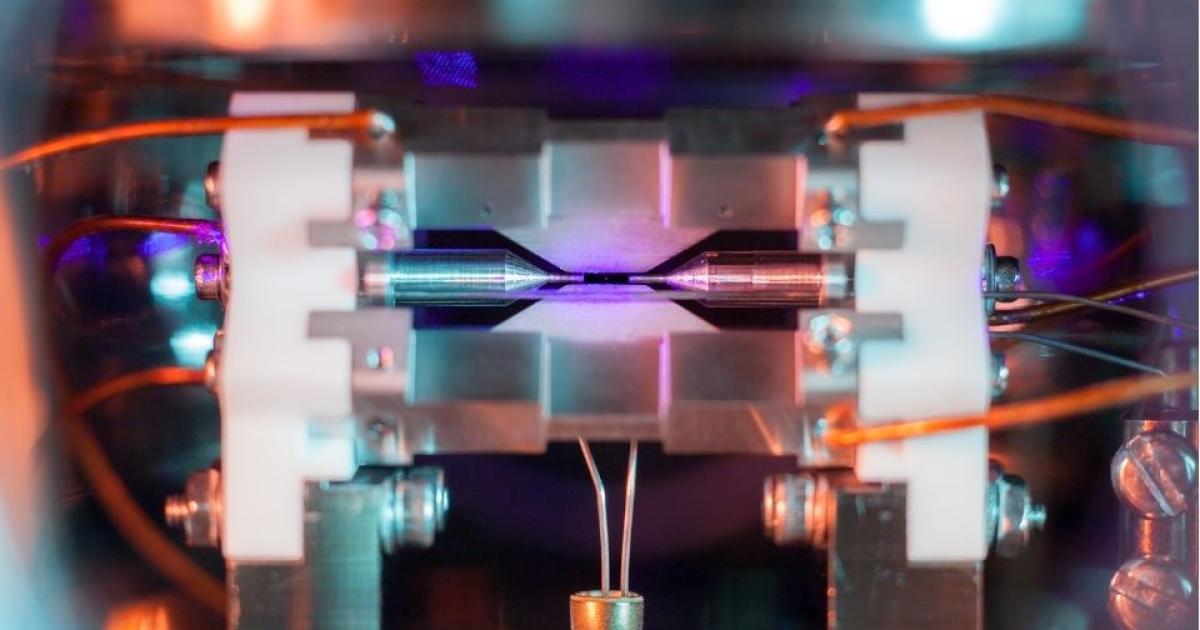
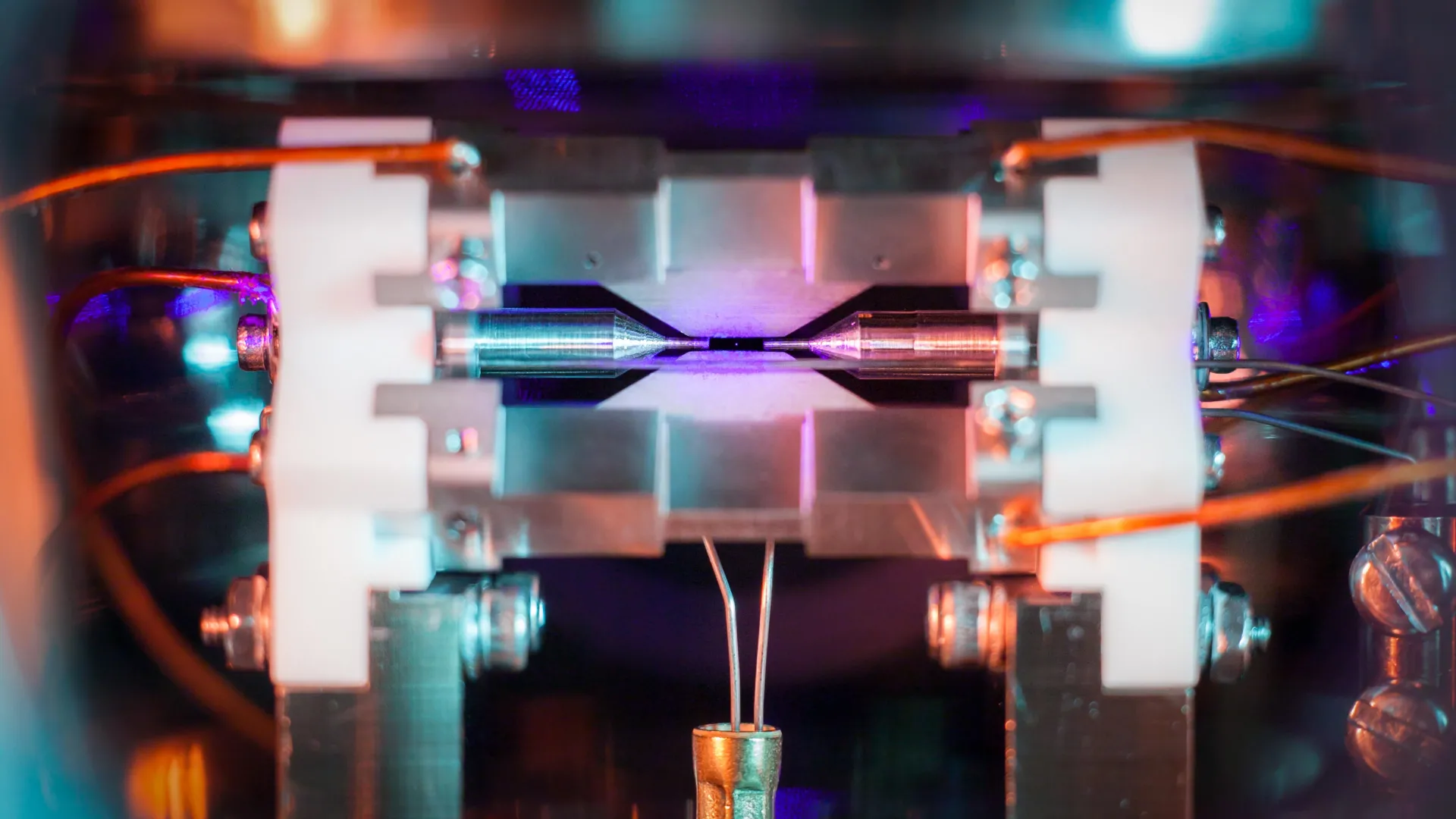
Lead author Sebastian Saner, Oana Bazavan and colleagues in Oxford's physics department, working with Alejandro Bermudez of the Instituto de Fisica Teorica in Madrid, began developing the experiment in 2022. They used trapped ions. Qubits, encoded in the ions' internal states, represented the gauge fields. Quantum oscillators, the vibrations of those same ions, represented the matter.
With that encoding they built the elementary unit of the theory, a loop. Two oscillators standing for matter at two points were connected by two qubits standing for the field between them. The team put the two qubits into an entangled state, which in the language of the theory corresponds to a magnetic flux piercing the loop. Producing that flux as a fixed background would have needed an interaction the hardware could not supply, so encoding it in the qubits began as a workaround.
"For us, the exciting step was to encode the magnetic flux in a gauge field that was itself dynamical," Saner said. "Rather than having matter evolve in a fixed background, the matter and gauge field become part of the same quantum dynamics." The workaround, he suggested, turned out to be the more interesting route.
The researchers then watched a matter particle tunnel around the loop. With no flux present, it tunneled freely. With the flux present, the two paths around the loop interfered destructively and the tunneling stopped completely, leaving the system frozen in its starting state. That is the Aharonov-Bohm effect, shown for the first time in a dynamical lattice gauge theory on this kind of hardware.
The paper appears alongside related work from a group at the University of Maryland led by Norbert Linke, which used a hybrid quantum system to simulate the Yukawa potential, an interaction relevant to nuclear and particle physics. The two groups developed their approaches independently and then coordinated their submissions to Nature Physics. Together, the studies point to hybrid qubit-oscillator machines as a way to tackle fundamental interactions that are out of reach for classical computers.