Oxford Physicists Achieve "Quadsqueezing," a Long-Sought Fourth-Order Quantum Effect, Using a Single Trapped Ion
The Nature Physics paper demonstrates an interaction 100 times faster than conventional approaches and opens a new toolkit for quantum simulation, sensing and computing.
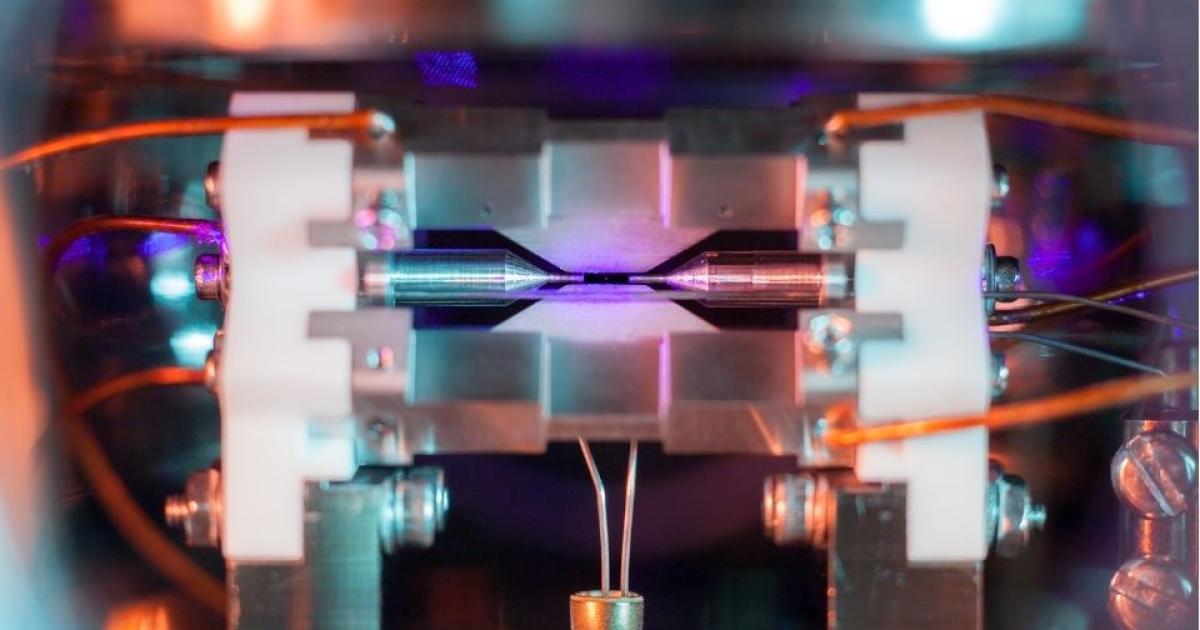
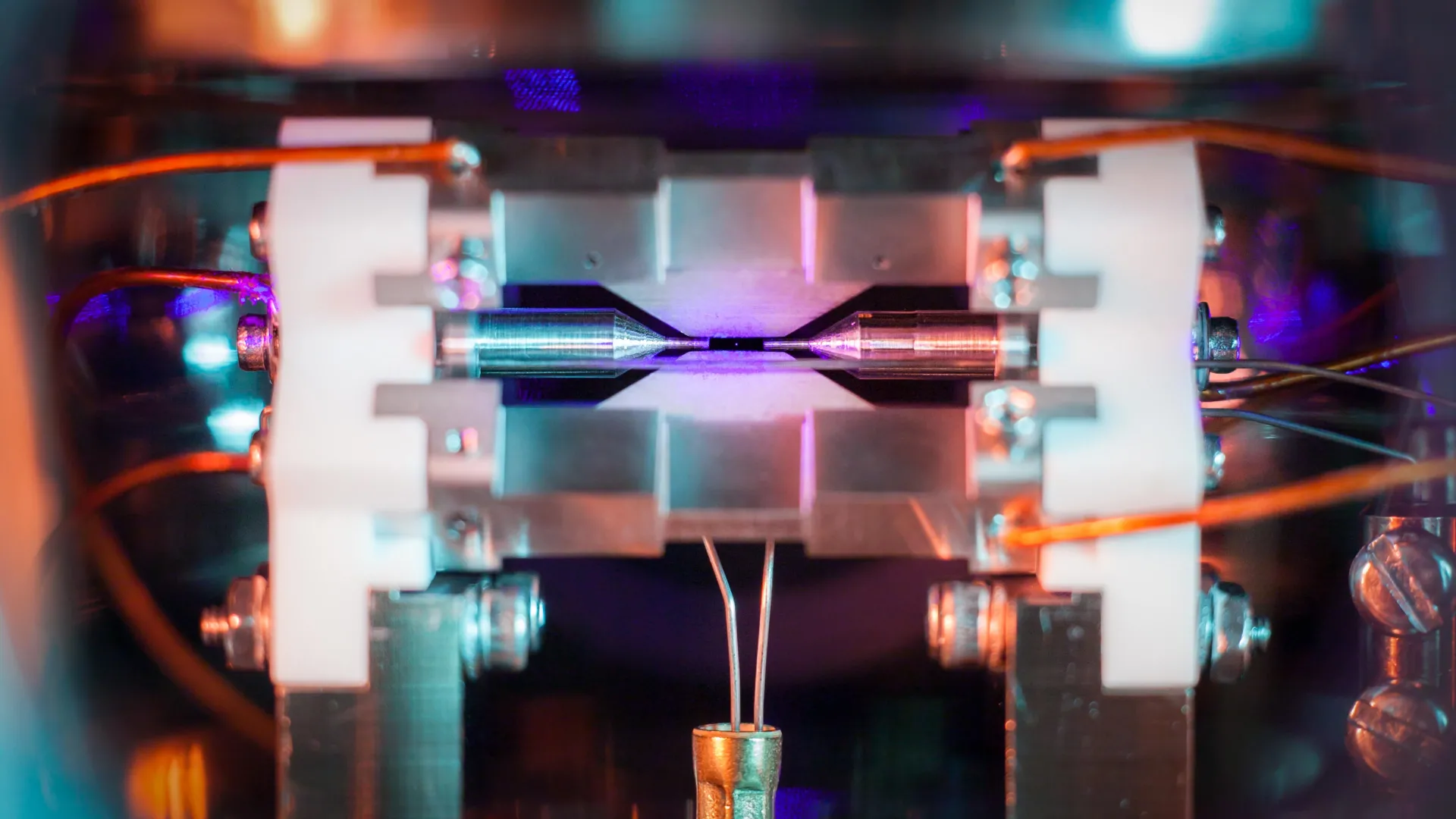
Physicists at the University of Oxford have for the first time generated a quantum effect known as "quadsqueezing" — a fourth-order squeezing of a single trapped ion's motional state that theorists have predicted for nearly four decades but no experiment had ever produced. The result, published Friday in Nature Physics, was achieved using a single calcium ion held in an ion trap and manipulated with two precisely timed laser fields, and it produced the elusive interaction more than 100 times faster than conventional approaches had estimated would be possible.
In quantum mechanics, "squeezing" refers to the redistribution of uncertainty between two complementary properties of a system — for instance, position and momentum — so that uncertainty in one is reduced below the standard quantum limit at the cost of greater uncertainty in the other. Squeezed light has been used since the 1980s to improve the sensitivity of devices ranging from gravitational-wave detectors at LIGO to atomic clocks. But all of those applications use second-order squeezing, which is mathematically the simplest form. Higher-order squeezing — third-, fourth- or fifth-order — would in principle expose richer quantum behaviors, but generating it has required physically nonlinear interactions that, until now, no laboratory had been able to engineer cleanly.
The Oxford group, led by Professor David Lucas and senior research fellow Dr. Christophe Valahu of the university's Beecroft Building ion-trap quantum-computing lab, exploited a quantum subtlety called non-commutativity. By driving a single ion with two simple, individually well-understood laser fields whose ordering matters at the quantum level, the experiment effectively built a fourth-order interaction out of two pairs of second-order ones. "It is a bit like discovering that two violinists playing in a particular order produce a chord that neither could play alone," Valahu said in a statement.
The paper's lead author, doctoral student Olivia Naroditsky, said the team observed quadsqueezing in roughly 30 microseconds — a timescale comparable to the gate operations of state-of-the-art trapped-ion quantum computers, and far short of the millisecond regime that earlier theory had suggested. That speed is critical because it means the effect can in principle be incorporated into useful quantum algorithms before decoherence — the loss of fragile quantum information to the environment — destroys the state.
The implications stretch well beyond a single elegant experiment. Quadsqueezing is a building block for so-called bosonic quantum codes, a class of error-correction schemes in which quantum information is encoded in the vibrational modes of a single ion or photon rather than in many entangled qubits. If the Oxford technique can be scaled, it could dramatically reduce the qubit overhead required for fault-tolerant quantum computing. The paper is also expected to find immediate use in quantum sensing, where higher-order squeezing should allow detectors to push past the so-called Heisenberg limit on measurement precision. "We have only scratched the surface," Lucas told the Oxford press office. "We now have a recipe for creating arbitrarily high-order squeezing on demand."