A Rock Found in Algeria Fills a 1.8-Billion-Year Hole in Mars' History — and Its Insides Never Changed
NWA 13441 dates to 1.273 billion years, an age no other Martian meteorite occupies. Its chemistry says it came from a piece of Mars that has sat untouched since the solar system formed.
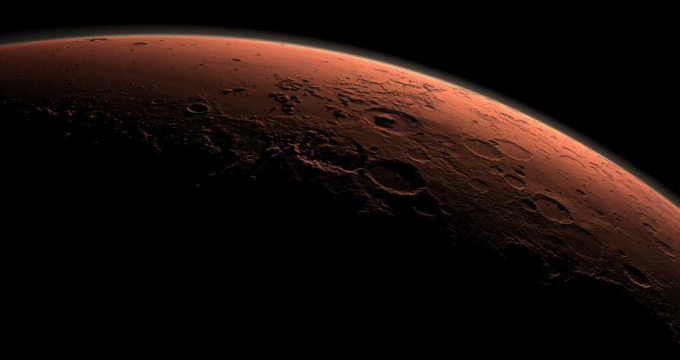
Roughly 400 Martian meteorites have been catalogued on Earth — rocks blasted off Mars by impacts, thrown across interplanetary space and eventually landing here. For all that variety, their ages cluster oddly. Most of the shergottites, the largest group, are under 600 million years old. A handful are around 2.4 billion. Between those two populations sits a gap of about 1.8 billion years in which nothing has been found, covering more than a third of the planet's history.
A meteorite picked up in Algeria in 2019, designated Northwest Africa 13441, falls squarely in the middle of it. A team led by Boston College geochemist Ethan Baxter dated the rock to 1.273 billion years and published the result in Geochimica et Cosmochimica Acta. "No other Martian meteorite like this is 1.27 billion years old," Baxter said.
The age alone would make it useful. What the team found in its chemistry makes it more so. Working with high-precision radiogenic isotope techniques, the researchers measured neodymium — an element with seven naturally occurring isotopic variants whose relative abundances shift over billions of years as other elements decay into them. The ratios in NWA 13441 came out chondritic, meaning they match the composition the solar system started with 4.56 billion years ago.
That is a strong statement about where the rock came from. A planet's interior normally does not stay pristine. Melting, crystallization and convection sort elements by how readily they enter a melt, and after billions of years of that churning, most reservoirs carry an isotopic fingerprint of having been processed. A chondritic signature means this magma came from a part of the Martian mantle that escaped it — a deep reservoir that has been sitting essentially unaltered since the planet formed, sampled and delivered to Earth by an impact.
The comparison to Earth is instructive. Plate tectonics recycles our crust continuously, dragging surface material back into the mantle and stirring the whole system, which is why unmodified primordial reservoirs are so difficult to find here and why Earth's oldest rocks are rare and heavily altered. Mars shut down tectonically early and has been geologically quiet ever since, which preserves things. The meteorite is, in effect, a sample of the Martian interior that no spacecraft has been able to obtain.
The Boston College team included doctoral candidate Dylan M. Seal, undergraduate researcher Melody Z. Chen and former postdoctoral scholar Robert W. Nicklas, now at the Lunar and Planetary Institute, with collaborators at the Scripps Institution of Oceanography and The Open University. Baxter founded Boston College's Center for Isotope Geochemistry, where the measurements were made.
There is a practical dimension to results like this. NASA's Perseverance rover has been caching samples in Jezero Crater for eventual return to Earth, a mission whose cost and schedule have been in question for years. Meteorites are a free and uncontrolled version of the same thing: no context, no known landing site on Mars, no ability to choose what arrives — but no launch cost either. NWA 13441 delivered a piece of the deep Martian mantle and a date from the middle of a blank stretch of the planet's record, for the price of finding it in the desert.