A Decade of Curiosity Data Hints at Thin Films of Water on Mars' Surface
Heavy oxygen in Mars' carbon dioxide rises in spring and summer in a way that known processes cannot explain, and the best fit is exchange with water in soil or liquid-like layers, a PNAS study says.

NASA's Curiosity rover has been sampling Mars' thin, carbon dioxide-rich atmosphere since 2012. A new study in the Proceedings of the National Academy of Sciences has now analyzed more than a decade of that data to ask whether the daily and seasonal changes in the atmosphere can be explained by known processes, such as carbon dioxide freezing at the poles and being released again. The answer points to something involving water, either attached to soil grains or in extremely thin, liquid-like films at the surface.
About 95 percent of the Martian atmosphere is carbon dioxide, so much of the analysis looks at the structure of that molecule. The team tracked isotopes, which are versions of an element with different weights, including heavier oxygen-18 and heavier carbon-13. Earlier missions and telescope observations found Mars' atmosphere is enriched in heavy carbon and oxygen isotopes, generally linked to lighter atoms escaping into space over geological time.
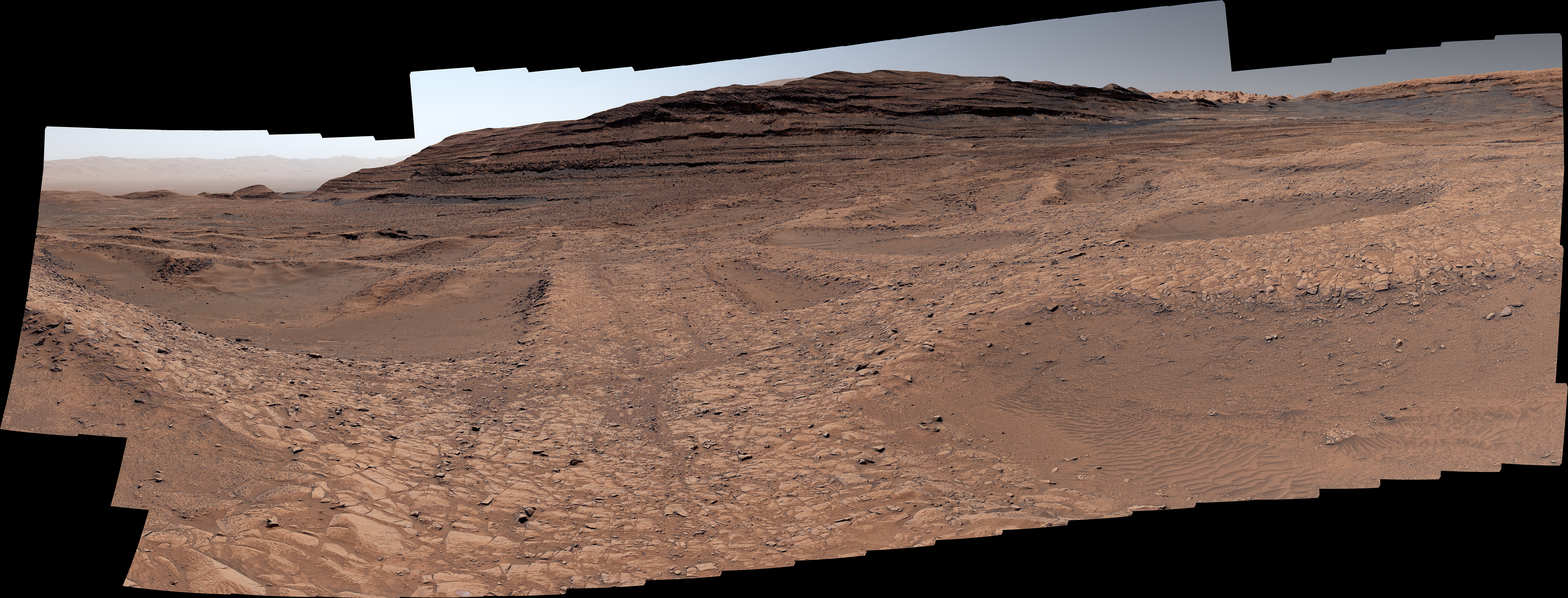
The researchers assembled what they describe as the first long-term, on-site record of atmospheric carbon dioxide isotopes on Mars, covering 2012 to 2025 at Gale Crater. They analyzed repeated atmospheric samples from two instruments in Curiosity's Sample Analysis at Mars suite, emphasizing results from its laser instrument. They compared isotope patterns across seasons and tested possible explanations using models of atmospheric circulation, gas mixing and water-carbon dioxide exchange.
Heavy oxygen became more abundant in the carbon dioxide during spring and summer, with stronger enrichment during southern spring and summer, when Mars is near its closest approach to the sun. Seasonal changes in carbon isotopes were smaller, which may mean different processes control the two elements. Daily isotope changes were largely insignificant at Curiosity's location.
The team tested several explanations for the seasonal rise in heavy oxygen, including polar freezing and release of carbon dioxide, attachment to and release from surfaces, and sunlight-driven breakdown of the gas. None of those, modeled alone, was enough to explain the oxygen changes. The authors instead proposed oxygen isotope exchange between carbon dioxide and water, a process seen in carbon dioxide trapped in Antarctic ice at temperatures as low as minus 35 degrees Celsius. They note that such exchange is thought to occur in liquid-like layers that develop at air-ice interfaces, where the surface lattice becomes disordered, a state known as premelting.
When they modeled that scenario, the results suggested exchange might occur with water attached to soil grains at or near the surface or with extremely thin liquid-like films, and the patterns matched what Curiosity saw. The researchers say local or regional exchange looks more feasible than a planet-wide explanation.
The caveats are significant. All the samples came from one near-equatorial crater, so the findings cannot establish a global pattern, and the exchange is a plausible explanation rather than a directly observed reaction or confirmation of liquid-like water films. Continued Curiosity measurements could show whether the seasonal pattern persists and whether it shifts after major dust storms, which may explain year-to-year swings in isotope abundance. Measurements elsewhere on Mars could one day separate local crater chemistry from broader atmospheric cycles.