A Researcher Stacked 2,062 Days of Old Spirit Rover Data and Found Signs Mars Was Far Wetter
Individual readings from the rover's Mössbauer spectrometer were too noisy to show it. Combined into one composite spectrum, they revealed crystalline hematite sitting in ordinary Martian soil.
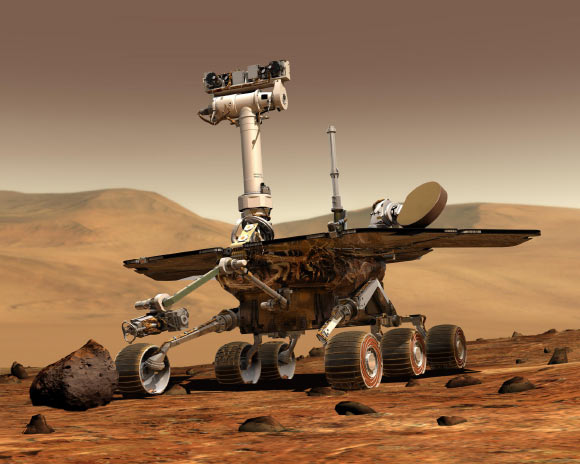
NASA's Spirit rover stopped communicating with Earth in 2010. Sixteen years later, a researcher who worked on the mission has pulled a finding out of its archive that nobody could see while the rover was still driving: signs that liquid water may once have covered large parts of Mars.
Paulo de Souza, a professor at Edith Cowan University in Australia and a member of the original Mars Exploration Rover science team, went back to data from MIMOS II, the miniaturized Mössbauer spectrometer Spirit carried to Gusev crater. The instrument identifies iron-bearing minerals by measuring how iron atoms in a sample absorb gamma rays — a powerful capability, and a slow one.
"From early 2004, Spirit Rover explored the surface of Gusev crater on Mars carrying a suite of scientific instruments to perform geological and mineralogical analysis on soils, rocks, meteorites, and dust collected by magnets," de Souza said. "Among these instruments, a miniaturized Mössbauer spectrometer named MIMOS II was extensively used." The rovers spent the following 2,062 sols — Martian days — working toward a single objective: determining whether Mars was once wet.
The limitation was never the instrument's sensitivity. It was time. Spirit had to divide scarce power, memory and daylight hours among a full suite of instruments, so individual Mössbauer measurements tended to be short, and short measurements produce spectra with poor counting statistics. Minor iron phases making up only a small fraction of a soil sample simply disappeared into the noise. Each reading was analyzed on its own, and on its own, each reading was inconclusive.
De Souza's workaround was to stop treating them separately. He combined readings from 32 undisturbed soil targets that Spirit examined at Gusev over those 2,062 sols, spanning temperatures from 180 to 300 kelvin. Because temperature swings within about a 10-kelvin range do not meaningfully distort the spectra of basaltic material, he merged the data inside those narrow windows first, then combined all the windows into a single composite spectrum. The result packed the equivalent of roughly six days of continuous measurement into one dataset — an exposure no single observation on Mars could ever have afforded.
The consolidated spectrum showed the expected staples of Martian soil, olivine and pyroxene, along with a poorly crystalline, paramagnetic iron-bearing phase. It also showed something the individual analyses had missed: far clearer signatures of magnetite and crystalline hematite. Both minerals can form when rock interacts with water, and hematite in particular has long been treated as a marker of a wet past.
"One of the most important discoveries was finding crystalline hematite in ordinary Martian soil," de Souza said. "This mineral's widespread presence suggests not only that water was present, but that significant areas of Mars may have once been covered by water."
The distinction matters. Previous evidence for water at Gusev came largely from specific outcrops and altered rocks — particular places with particular histories. Finding the same watery fingerprint distributed through undisturbed, everyday soil implies a process that operated broadly across the landscape rather than in isolated pockets. The study, "A consolidated Mössbauer spectrum for undisturbed soils from Gusev Crater, Mars," was published this year in the journal Interactions. No new spacecraft, instrument or launch was required — only a decision to read two decades of old measurements as one.
Originally reported by Sci.News.