Mars Valley Reveals Dramatic Clues About Planet's Watery Past
Shalbatana Vallis stretches 1,300 kilometers across Mars, carved by ancient floods that may hint at a lost ocean near the planet's equator.
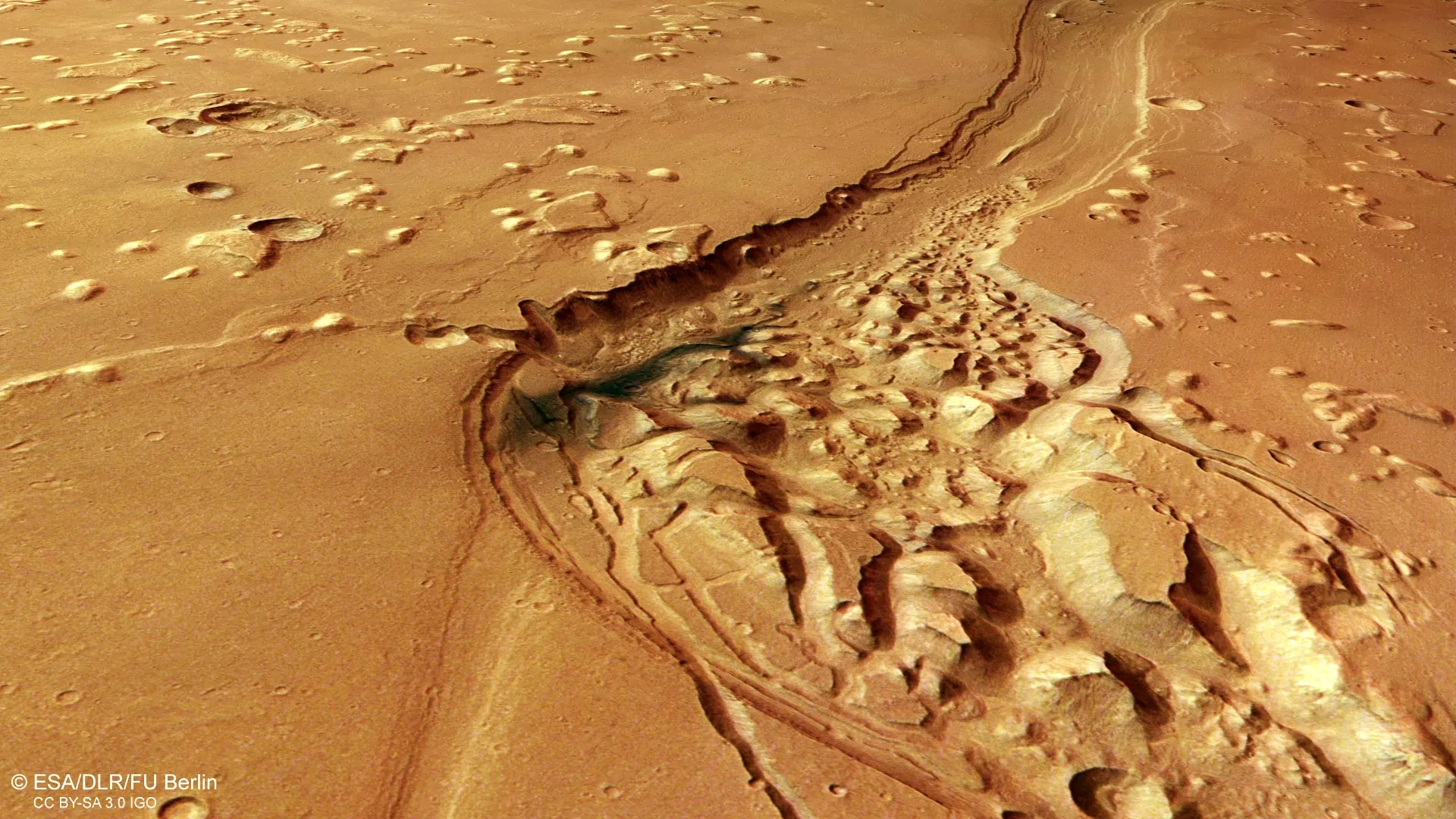
A colossal valley near Mars's equator is revealing dramatic clues about the Red Planet's watery and volcanic past. Stretching roughly 1,300 kilometers, Shalbatana Vallis was carved billions of years ago when enormous floods of groundwater burst onto the surface, gouging deep winding channels across the landscape. Today, the region displays a striking mix of ancient flood scars, collapsed terrain, lava-smoothed plains, volcanic ash, and battered impact craters.
ESA's Mars Express mission has captured detailed images of this remarkable Martian valley using its High Resolution Stereo Camera. The latest observations focus on the northern section of the valley as it winds across the planet's surface from the highlands of Xanthe Terra to the smoother terrain of Chryse Planitia. Scientists believe Shalbatana Vallis formed around 3.5 billion years ago after vast amounts of groundwater burst onto the surface, creating massive floods that tore through the landscape and carved channels roughly 10 kilometers wide and 500 meters deep.
The valley was likely even deeper originally, but various materials have gradually filled parts of the channel over billions of years. One especially noticeable feature is a blue-black patch of volcanic ash that was later redistributed by Martian winds. This ash deposit sits within the rougher section of the valley and provides evidence of the region's complex geological history involving both water and volcanic activity.
Shalbatana Vallis is one of many outflow channels in this transitional region of Mars, which marks the boundary between the heavily cratered southern highlands and the smoother northern lowlands. Many of the planet's major outflow channels end at nearby Chryse Planitia, one of the lowest regions on Mars. This convergence has led some scientists to suggest that the area may once have contained a large ocean during a warmer and wetter period in Mars's history.
The surrounding landscape contains chaotic terrain filled with broken blocks, ridges, and irregular mounds of rock. Scientists believe this type of terrain formed when underground ice began melting, causing the ground above to shift and collapse. The presence of numerous impact craters throughout the region provides additional evidence of the area's ancient age and the dramatic geological processes that have shaped this part of Mars over billions of years.