Bennu's Surface Is 50 Times Weaker Than Ground Coffee. That Matters If We Ever Have to Move One
Working from OSIRIS-REx samples, researchers measured the asteroid's surface strength at under one pascal and built a framework linking that strength to the size and shape of individual grains.

When NASA's OSIRIS-REx spacecraft touched asteroid Bennu in 2020 to collect a sample, it sank into the surface farther than anyone expected. New work published in Nature Communications puts a number on why: the strength of Bennu's surface is below one pascal.
For scale, Paul Sánchez of the University of Colorado Boulder, the paper's first author, reaches for the kitchen. "If you form a small cylinder with freshly ground coffee, its strength is about 50 Pa and you can still poke" a hole in it with a finger. Bennu's surface is roughly 50 times weaker than that. It is less a rock than a loosely stacked pile of gravel held together by almost nothing.
Sánchez and Michael R. Swift of the University of Nottingham built a framework that predicts how strong such a pile should be from two properties of the grains making it up: their size and their sphericity — how far each particle departs from being a perfect sphere. They tested it against grains 2 to 5 centimeters across, roughly 0.8 to 2 inches, in both uniform batches and mixed ones. Irregular grains interlock; round ones roll past one another. Size and shape, not chemistry, set the cohesion.
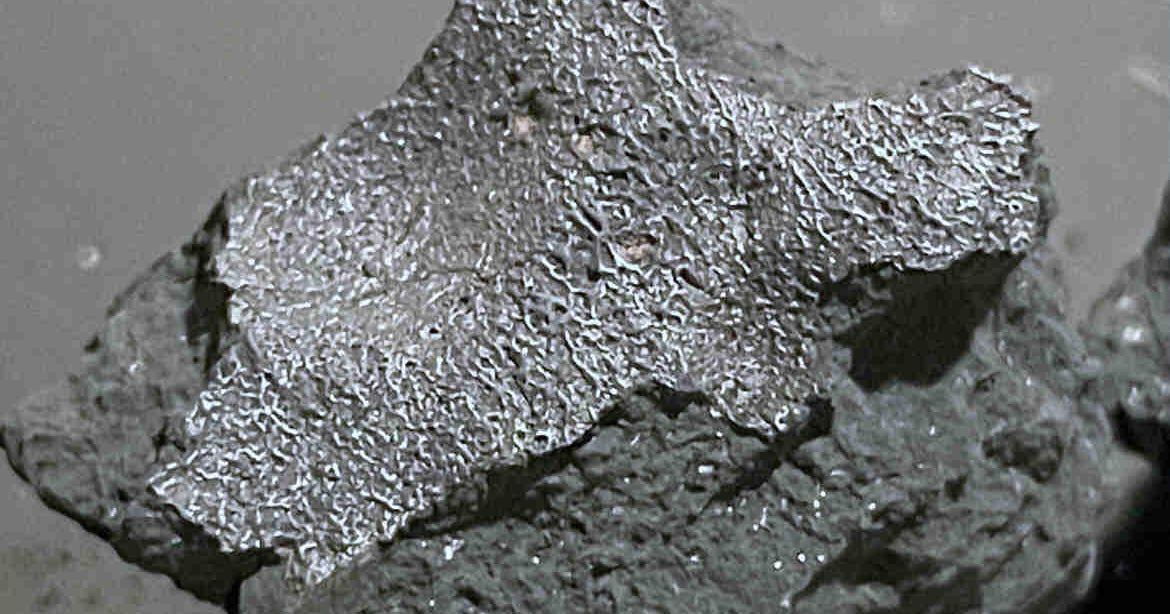
The measurement is possible because OSIRIS-REx brought material home. The capsule returned to Earth in 2023 carrying the largest sample ever collected from an asteroid, and having the actual grains in hand means the model can be calibrated against real particles rather than assumptions about what an asteroid surface is made of.
The reason to care is planetary defense. Every calculation of how to deflect an incoming asteroid runs through impact simulation codes, and those codes need a value for the target's tensile and cohesive strength. Get it wrong and the prediction of what a kinetic impactor does is wrong too. Hit a solid body with a spacecraft and you transfer momentum in a predictable way. Hit a rubble pile with essentially no cohesion and the impactor may punch through, splash material outward, or reshape the object rather than shove it — all with different consequences for where the asteroid ends up.
NASA's DART mission, which struck the small moon Dimorphos in 2022, demonstrated that a deflection can work, and the deflection it achieved was substantially larger than a simple momentum transfer would predict — a sign that ejecta thrown off the surface did much of the work. That effect depends directly on how weakly the surface is bound.
The authors present their framework as an initial approximation to asteroid tensile and cohesive strengths rather than a final answer. But it is the kind of number that has to exist before a deflection mission can be planned against a real threat with a real deadline, and it is now grounded in grains that came home in a capsule. The paper is DOI 10.1038/s41467-026-75169-4.