The Meteorite That Crashed Through a New Jersey Roof Had Been Soaked in Salty Brine Before It Ever Left Its Asteroid
A homeowner sealed the fragments in glass jars with gloves and foil. That one decision preserved amino acids, phosphates and evidence of liquid water on the parent asteroid.
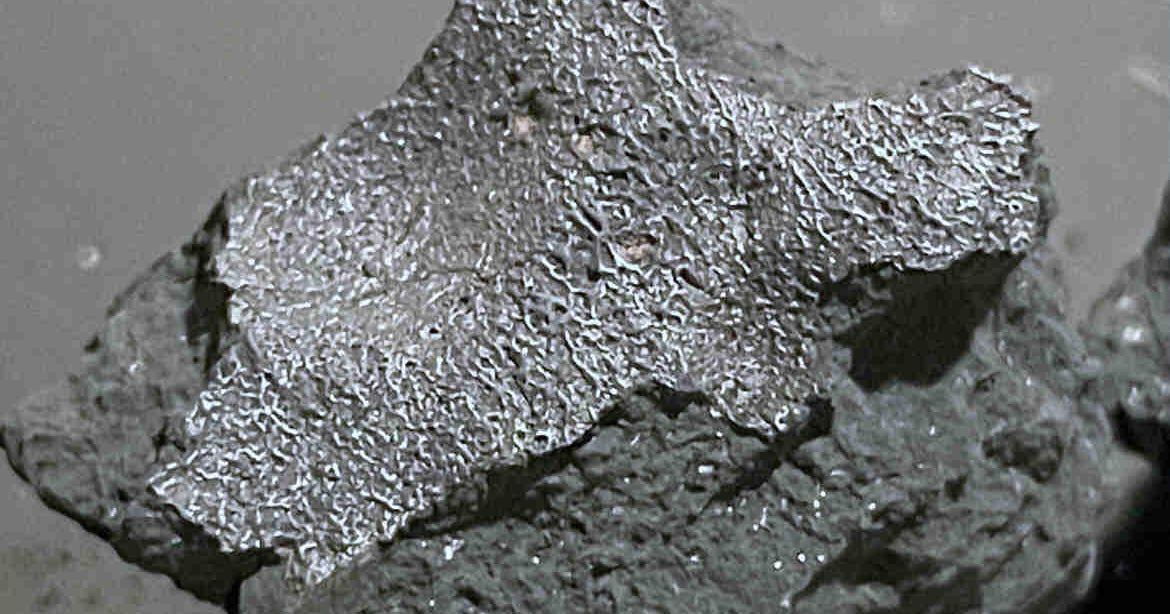
In July 2024, a rock from space punched through the roof of a house in Hillsborough, New Jersey. What happened next is the reason scientists are now describing its contents as "alien world chemistry."
The homeowner, rather than handling the fragments bare-handed, put on disposable gloves, wrapped the pieces in aluminum foil and sealed them in glass jars. That kept terrestrial contamination — skin oils, moisture, airborne organics — off a sample whose entire scientific value lies in what it carried before it arrived. An international team was then able to run a forensic analysis on effectively pristine material, and published the results Wednesday in the journal Science Advances.
The rock turned out to be CM1/2 carbonaceous chondrite, a rare and primitive material that has been recovered from an observed fall only once before. The SETI Institute, the California nonprofit that coordinated much of the work, called it "one of the most scientifically valuable meteorites ever recovered."
The central finding is about water. Before this rock broke away from its parent asteroid, it had been coated in concentrated salty fluids — a brine. "That had never been seen before on this kind of object," said meteor astronomer and study author Peter Jenniskens, whose team read the chemistry as a record of liquid water that sat on the parent body and then evaporated away, leaving its dissolved salts behind.
Brines are not a side detail. Highly concentrated salt solutions do specific chemical work: they keep phosphate suspended rather than locking it into insoluble minerals, and they can drive reactions between compounds that would otherwise sit inert. Phosphate is a component of DNA, RNA and the molecule cells use to move energy around. A brine on an asteroid is, in effect, a small reactor for the kind of chemistry that has to happen somewhere before biology can start.
The fragments also held a range of soluble organic compounds. Some are magnesium organic compounds of the sort found in blood and used in photosynthesis. Others are amino acids, the units proteins are built from. Researchers said the compounds may have been produced by the brine itself or generated by earlier impacts on the parent asteroid, and that the combination supports a long-argued idea: that CM-type carbonaceous chondrites delivered organic material to the early Earth. "It's possible that other asteroids made of carbonaceous chondrite delivered organic matter to the early Earth," cosmochemist Queenie Chan said.
None of this is evidence of life beyond Earth. It is evidence that the ingredient list and at least one plausible mixing environment existed on asteroids in the early solar system, and that they survived the fall to the ground intact enough to read.
The meteorite passed over New York City before landing in New Jersey. Now that the forensic work is finished, some of the fragments are going to the American Museum of Natural History in Manhattan. "We are thrilled that nature delivered such a precious asteroid sample on our doorstep," said museum curator Denton Ebel.
Originally reported by CBS News.