Two Grains of Ryugu Dust Held Ammonium, Nitrate and Carbon-Nitrogen Bonds — All Clustered Around Dried-Up Salt
Kyoto University researchers say the asteroid's parent body concentrated nitrogen as its briny water froze or evaporated, acting as a slow chemical reactor.

Nitrogen is in every protein and every strand of DNA, and nobody has been able to explain properly how it got to Earth. As a loose gas it drifts off into space rather than binding into solids, which makes its history almost impossible to trace. A team led by Toru Matsumoto at Kyoto University now says the answer is written inside two specks of dust from an asteroid, in research published in Nature Astronomy.
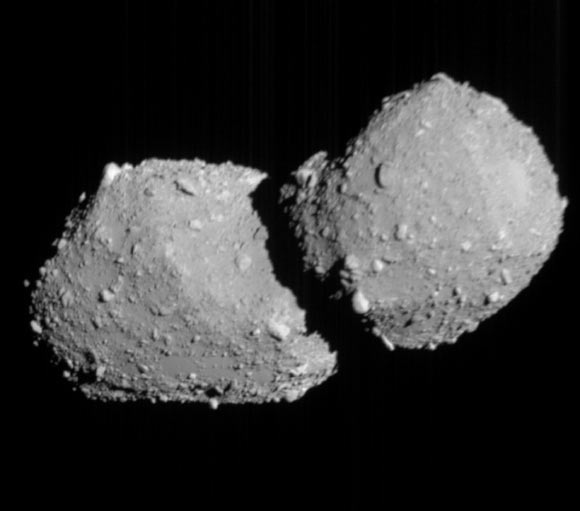
The specks came from Ryugu, the near-Earth asteroid that Japan's Hayabusa2 mission sampled and returned to Earth in 2020. That provenance is the whole point. Meteorites that fall naturally are heated and chemically scrambled on the way down, and they arrive with very little nitrogen preserved — which has left astronomers puzzled, because ammonia appears to be everywhere else in the solar system. It has been detected on the dwarf planet Ceres and on several carbon-rich asteroids, suggesting large ammonia reservoirs are common. The rocks that reach the ground just do not show it.
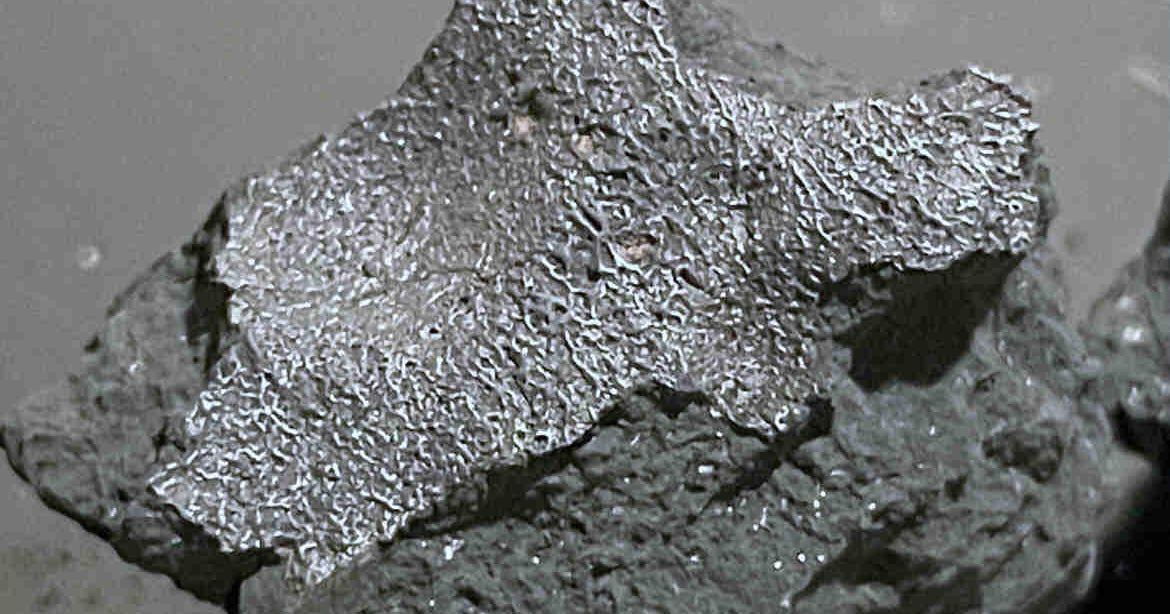
Matsumoto's team examined two tiny Ryugu grains with a combination of infrared spectroscopy, X-ray spectroscopy and electron microscopy — techniques precise enough to identify individual chemical bonds and map where each one sits inside the rock. They found several distinct nitrogen-bearing compounds at once: ammonium locked inside clay minerals, molecules containing carbon-nitrogen bonds, and crystals of sodium nitrate.
What matters is where those compounds sat. All of them clustered around sodium carbonate, a mineral that forms at one very specific moment — when the last of a body's salty water freezes or evaporates away. That arrangement implies the nitrogen compounds survived for millions of years while water moved through Ryugu's parent body, and grew steadily more concentrated as the water disappeared. Concentration is what chemistry needs. Squeezing dissolved molecules into a shrinking volume of brine is exactly the condition under which small molecules assemble into larger, more complex ones, and it may echo what happens on icy, salty worlds like Ceres.
The team is careful about how far to push this. They cannot watch the reaction sequence happen; they are reading it backward from where the minerals ended up. But independent support has already arrived from a different asteroid: analysis of the sample NASA's OSIRIS-REx mission returned from Bennu has turned up similar ammonium-bearing clays. That does not confirm Matsumoto's proposed order of events, but it does suggest the broader pattern is real rather than a quirk of one rock.
If the picture holds, it changes what asteroids were. Not inert leftovers, and not simply delivery vehicles, but slow-cooking chemical reactors — bodies that spent millions of years concentrating nitrogen in evaporating brine before delivering the product to newly forming planets. On that reading, some of the nitrogen in the reader's own cells spent a long stretch of the early solar system dissolved in salty water inside a rock, waiting for it to dry out.
The paper is "Ammonium-bearing clays and multiple nitrogen species linked to the late-stage brines of Ryugu's parent body," Nature Astronomy (2026), DOI 10.1038/s41550-026-02962-y.