RNA Can Fold Into Giant Cages and Filaments, a Discovery That Rewrites Ideas About Life's Origins
Scientists found that ordinary RNA can self-assemble into large, intricate 3D architectures once thought impossible, hinting the molecule played a bigger role at the dawn of life.
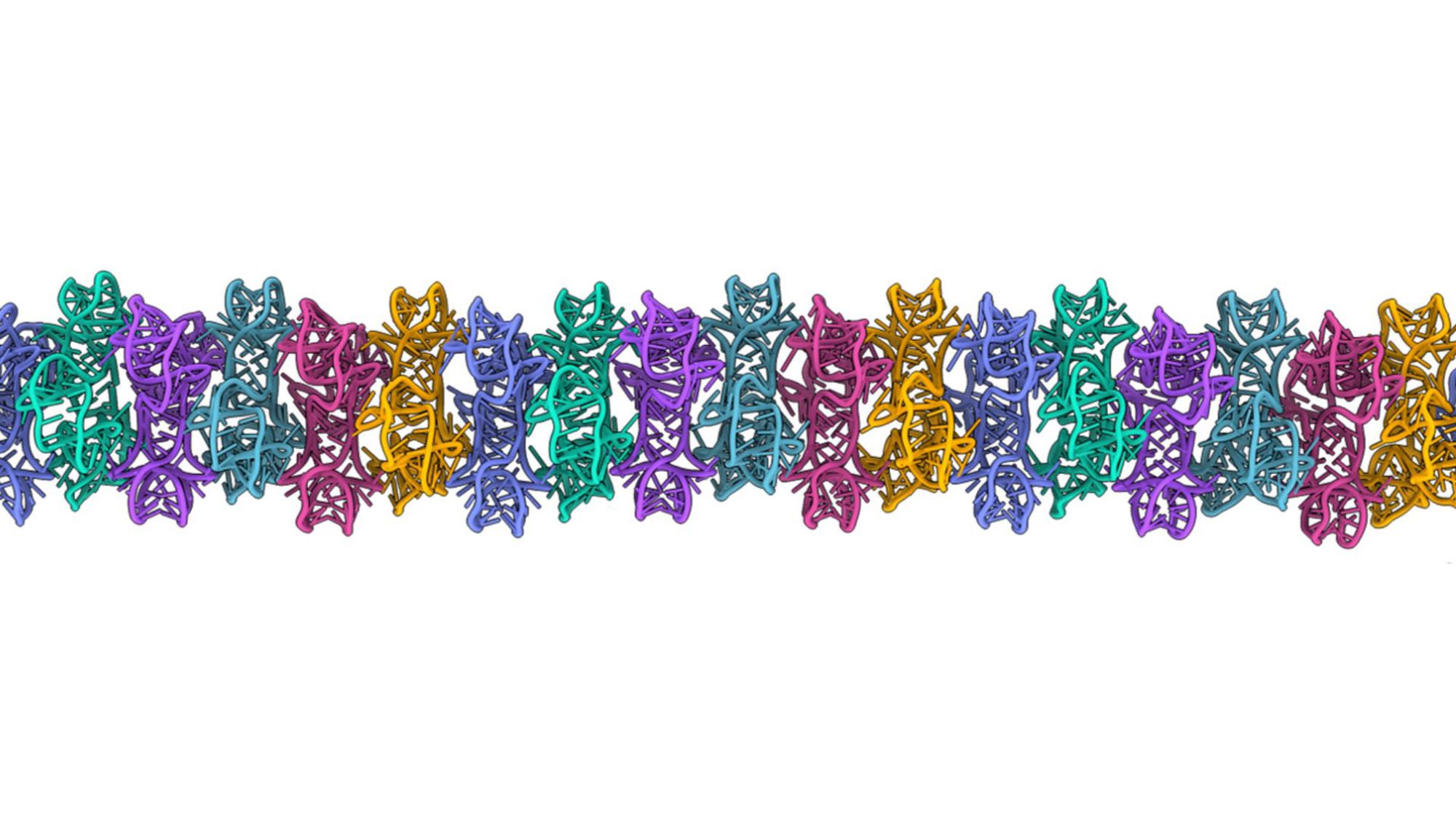
RNA, the workhorse molecule that carries genetic instructions and helps build proteins, may be far more architecturally ambitious than scientists ever suspected. In new research, researchers report that ordinary RNA can spontaneously assemble into large, elaborate three-dimensional structures, including long filaments and hollow cages, a behavior long assumed to be beyond its reach.
The finding challenges a foundational assumption about the earliest chapter of life on Earth. For decades, the leading "RNA world" hypothesis has held that some four billion years ago, before DNA and proteins took over, RNA both stored information and catalyzed reactions. But that picture assumed early RNA could form only small, simple shapes. The discovery that RNA can build sprawling, ordered geometries reopens the question of what the molecule was actually capable of at life's beginning.
At the heart of the process is a folding trick known as "kissing stem loops." When a single strand of RNA doubles back on itself, part of the strand can form a loop, and those loops can lock together with matching loops on other strands. Chained across many molecules, the interactions knit individual RNA strands into much larger assemblies, self-organizing into filaments and cage-like enclosures without any help from proteins or enzymes.
Scientists say the implications cut in two directions. If such structures could form under the chaotic conditions of the early Earth, they might have provided scaffolding, compartments or protective shells that helped primitive chemistry organize itself into something resembling life. That would hand RNA an even more central role in the origin-of-life story than the classic hypothesis grants it.
The researchers caution that, so far, the cages and filaments have been observed only in a laboratory dish. A crucial next step is to determine whether the crowded interior of a living cell, packed with proteins and other molecules, would disrupt the delicate folding or, conversely, help it along. Only then can scientists judge how relevant the structures are to real biology, ancient or modern.
Beyond the deep questions about how life started, the work points toward practical payoffs. Engineers are already exploring ways to use folded DNA, so-called DNA origami, to deliver drugs into cells with precision. RNA cages that self-assemble into custom shapes could offer a similar, and potentially more versatile, toolkit for medicine and nanotechnology, because RNA can both carry information and act on it. That dual nature, the researchers note, is exactly what made the molecule such a compelling candidate for life's first building block, turning an insight about life's distant past into a platform for its future.