Scientists Resurrect a 3.2-Billion-Year-Old Enzyme That Made Life on Earth Possible
By rebuilding an ancient version of nitrogenase, researchers reopened a window on how microbes fed themselves before oxygen — and handed astrobiologists a chemical fingerprint to hunt for life beyond Earth.
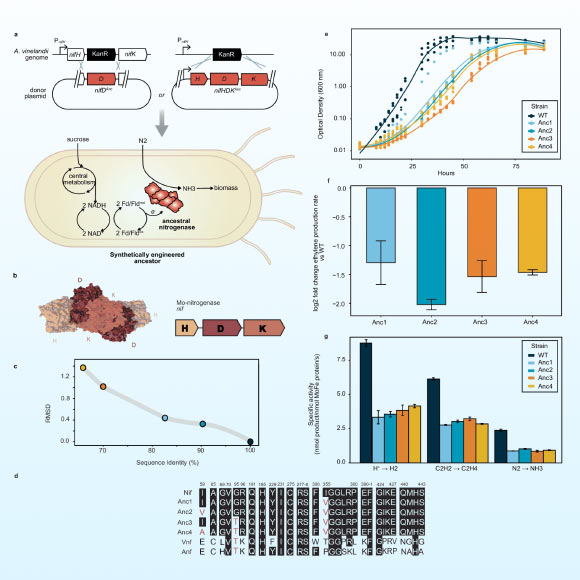
Scientists have reverse-engineered a 3.2-billion-year-old version of one of biology's most important enzymes, effectively resurrecting a molecular machine that helped make life on early Earth possible and, in the process, giving researchers a new way to search for life on other worlds.
The enzyme is nitrogenase, which performs a job so fundamental that without it life as we know it could not exist. Nitrogen makes up most of the air, but in its ordinary form it is inert and useless to organisms. Nitrogenase cracks that atmospheric nitrogen and converts it into a form living things can build into proteins and DNA. "Without nitrogenase, there would be no life as we know it," said Professor Betul Kacar of the University of Wisconsin-Madison, who led the work with Ph.D. candidate Holly Rucker.
Using synthetic biology, the team reconstructed likely ancestors of modern nitrogenase and studied how the enzyme behaved deep in Earth's past. They found that although the ancient versions carry different DNA sequences than today's enzymes, they leave behind the same distinctive isotopic signature — a subtle imprint in the ratio of nitrogen isotopes that gets locked into rock. That signature has remained remarkably consistent across billions of years, meaning the chemical fingerprint preserved in ancient stone can be trusted as a genuine marker of biological nitrogen fixation.
The result matters because it reaches back to a pivotal chapter in the planet's history. Before the Great Oxidation Event, when photosynthesis flooded the atmosphere with oxygen, Earth was dominated by anaerobic microbes living in a world rich in carbon dioxide and methane. Understanding how those early organisms captured nitrogen helps explain how life not only survived but flourished during that transformative period, and the findings point to molybdenum-based nitrogen fixation emerging earlier than many scientists had assumed.
The study, part of a NASA-funded effort to trace how life has used metals across geological time, also carries a forward-looking payoff. Because the nitrogen isotope signature is a reliable calling card of life, it gives astrobiologists a concrete target to look for in the search for organisms beyond Earth. A telltale isotopic pattern in a Martian rock or a sample returned from elsewhere in the solar system could, in principle, hint at biology at work.
There are practical stakes on Earth, too. Biological nitrogen fixation underpins the planet's food supply, and a deeper understanding of how the enzyme evolved could inform efforts to engineer crops or microbes that pull their own nitrogen from the air, easing reliance on energy-hungry synthetic fertilizers. In short, researchers rebuilt an ancient protein to read a story written more than three billion years ago — and to help write the next chapter of the search for life.