AlphaFold Gives You One Shape of a Protein
Japanese Chemists Made It Show the Rest by Pushing Its Own Answers Apart.
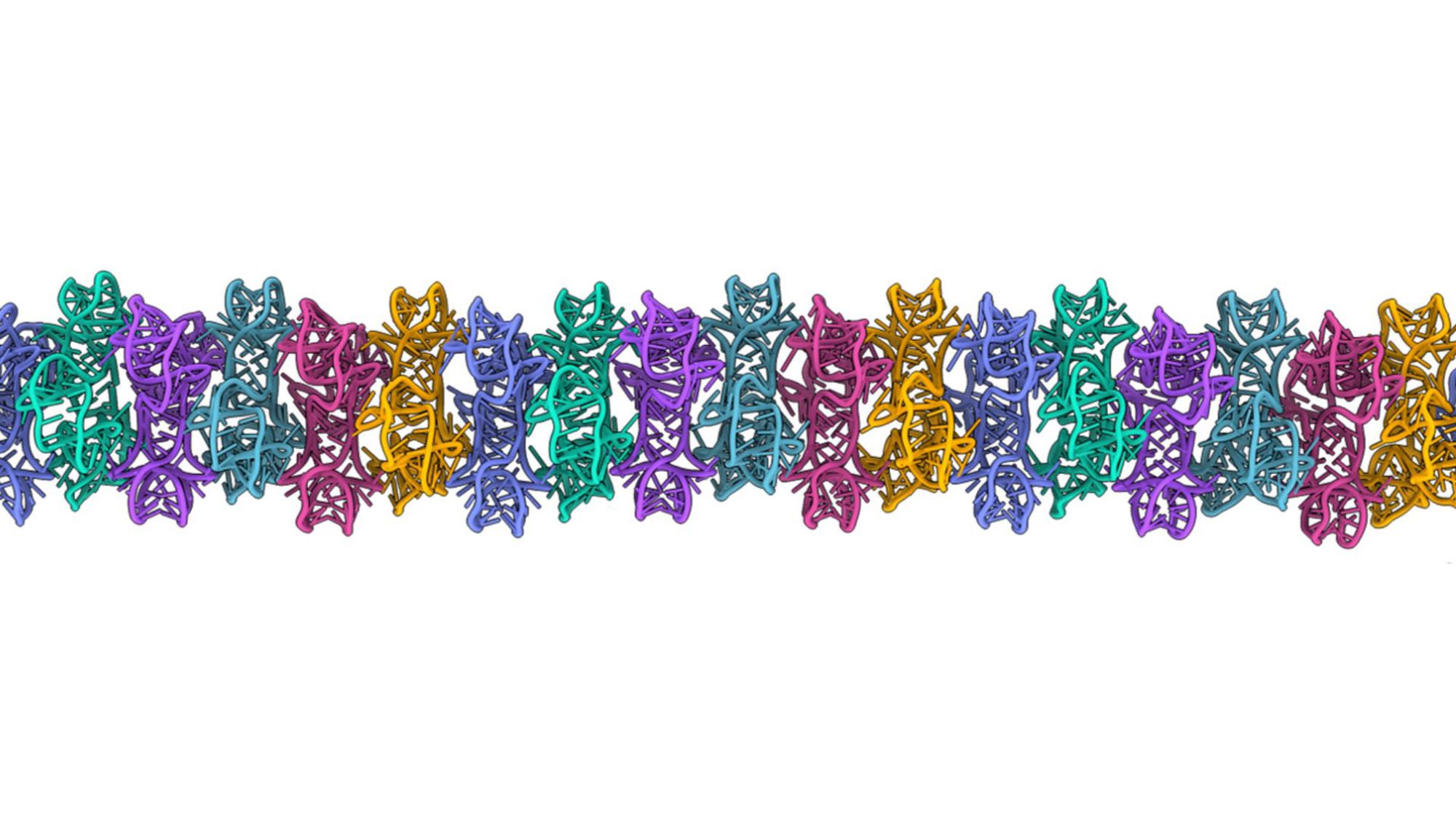
AF3-ReD adds a repulsive term between successive AlphaFold3 predictions so the model cannot keep returning the same structure. On ATP synthase's F1-beta subunit it recovered the open state, the closed state, and the intermediates between them.

AlphaFold solved a problem that had defeated structural biology for fifty years, and in doing so it created a narrower one that has been quietly limiting its usefulness: ask it about a protein and it hands back a single structure, confidently, even when the protein in question spends its life switching between several.
Jun Ohnuki and Kei-ichi Okazaki at the Institute for Molecular Science, part of Japan's National Institutes of Natural Sciences and the graduate university SOKENDAI, have published a method that gets around it without retraining anything. They call it AF3-ReD.
The trick is to make the model disagree with itself. AF3-ReD runs AlphaFold3 repeatedly on the same protein, but each run carries a bias energy term that acts as a repulsive force pushing the new prediction away from the structures already generated. The model is still doing what it does; it is simply penalized for converging on the answer it has already given. Successive runs are driven into different regions of the protein's conformational space.
The test case was the F1-beta subunit of ATP synthase, the rotary enzyme that manufactures most of the ATP in every cell in your body. F1-beta is a textbook example of a protein that works by changing shape: it opens and closes as ATP binds and releases, and the cycling is the mechanism, not an incidental detail. Standard AlphaFold3, given ATP-bound F1-beta, returns only the open conformation. AF3-ReD sampled what the authors describe as a far wider range, reaching both the open and the closed conformations and the intermediate structures in between.
That gap matters well beyond one enzyme. A large share of drug targets — receptors, transporters, kinases — are functional precisely because they move, and a drug candidate designed against a single frozen snapshot may bind a state the protein rarely occupies in a cell. Molecular dynamics simulations can explore those motions, but they are computationally expensive, often prohibitively so for large proteins over biologically relevant timescales. A method that gets a spread of plausible conformations out of an existing prediction pipeline, cheaply, sits in a useful gap.
The paper appeared in JACS Au on September 5, 2026, under DOI 10.1021/jacsau.6c00596.
The approach has an appealing generality to it. Nothing in the repulsive-bias idea is specific to AlphaFold3 or to ATP synthase — it is a way of interrogating any predictor that has learned a distribution but reports only its mode. What it cannot do is tell you which of the sampled structures a real protein actually visits, or how often. That still takes an experiment.