Rubin Observatory Discovers 11,000 New Asteroids in Six Weeks — Including Two Objects 1,000 Times Earth's Distance from the Sun
In its first 1.5 months of operation, the Vera C. Rubin Observatory catalogued more asteroids in a single submission than any telescope has in the past year, with the full survey not yet begun.

The Vera C. Rubin Observatory, perched atop Cerro Pachón in the Chilean Andes, has delivered its first major scientific results — and they are staggering. In just six weeks of early operations, the telescope submitted approximately one million observations to the International Astronomical Union's Minor Planet Center, yielding more than 11,000 newly catalogued asteroids, 33 near-Earth objects, and roughly 380 trans-Neptunian objects lurking in the outer reaches of the solar system.
The discovery batch is the largest single submission to the Minor Planet Center in the past year, and it comes before the telescope's flagship scientific program — the Legacy Survey of Space and Time, or LSST — has even formally begun. The results represent what astronomers describe as an early preview of a discovery machine that is expected to fundamentally transform humanity's knowledge of the solar system over the next decade.
"What used to take years or decades to discover, Rubin will unearth in months," said Mario Jurić, a University of Washington astronomer and Rubin's solar system science lead.
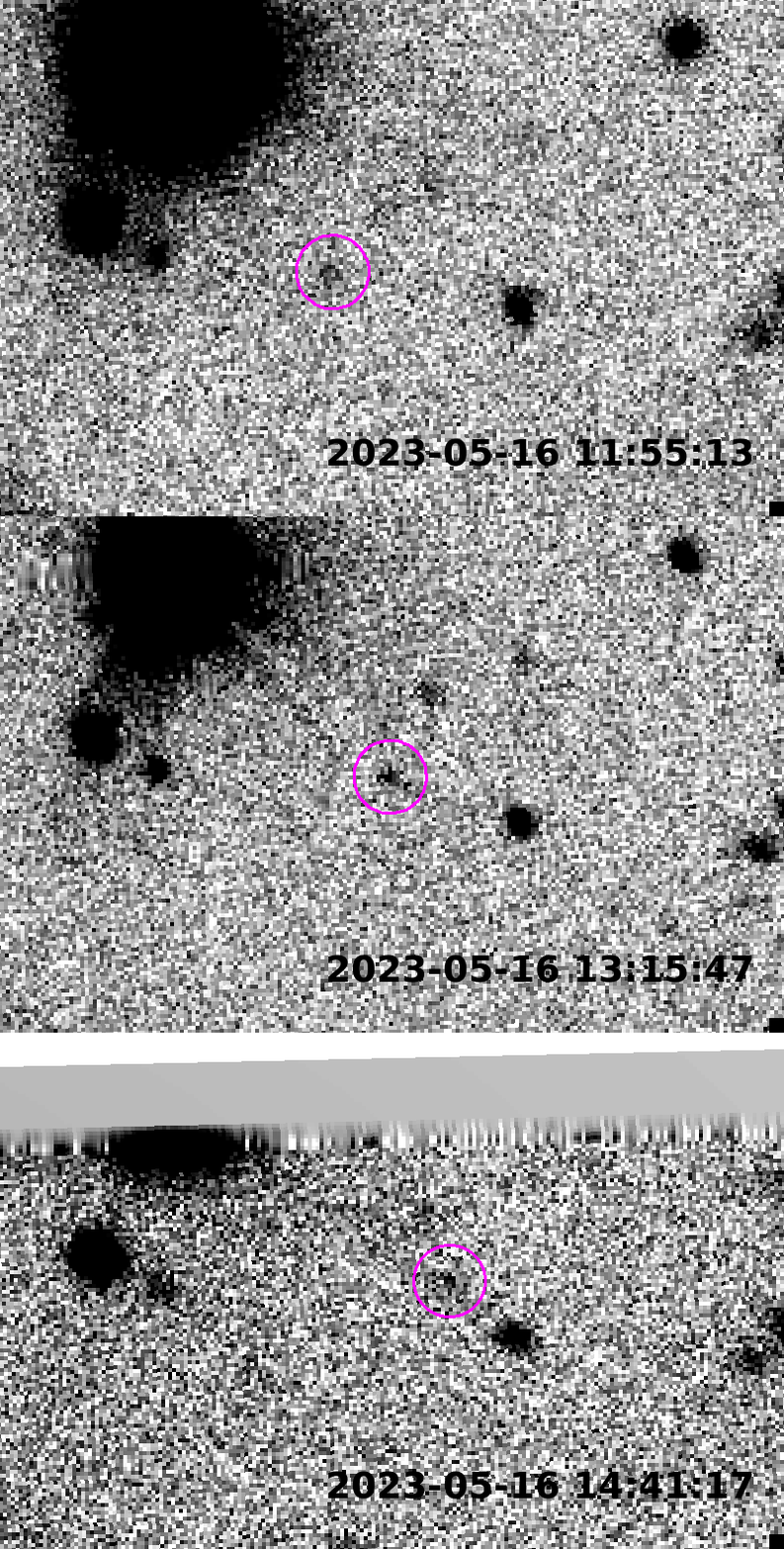
Among the most remarkable finds are two trans-Neptunian objects — designated 2025 LS2 and 2025 MX348 — whose orbits carry them to distances of approximately 1,000 astronomical units from the Sun, placing them among the 30 most distant known minor planets ever catalogued. An astronomical unit is defined as the average distance between Earth and the Sun; at 1,000 AU, these objects orbit in a region of the solar system so remote that sunlight takes nearly six days to reach them. Their extreme orbits have already attracted theoretical attention: some planetary scientists believe that populations of distant trans-Neptunian objects may be gravitationally influenced by an as-yet-undiscovered ninth planet lurking in the outer solar system.
Kevin Napier, a Harvard-Smithsonian Center for Astrophysics scientist who developed detection algorithms for the survey, said identifying trans-Neptunian objects is "like searching for a needle in a field of haystacks." Matthew Holman, also of Harvard-Smithsonian and the TNO pipeline lead, said that Rubin's extraordinary imaging depth — the telescope can detect objects roughly 100 times fainter than those visible with smaller survey telescopes — makes it uniquely suited to revealing these remote bodies.
Among the 33 new near-Earth objects discovered, the largest is approximately 500 meters wide. None of the newly identified objects poses any threat to Earth, scientists confirmed. But the discovery rate has significant implications for planetary defense planning: current surveys have identified only about 40 percent of mid-sized near-Earth objects — those larger than 140 meters, the threshold above which an impact could devastate a major metropolitan area. Rubin is expected to push that fraction to roughly 70 percent over the coming years, dramatically improving the world's ability to identify potential threats in time to develop countermeasures.
The telescope's speed and sensitivity are what make these results possible. Rubin is designed to image the entire observable sky visible from the Southern Hemisphere every few nights, generating roughly 20 terabytes of raw data per observing session. A sophisticated automated pipeline, developed in part by University of Washington graduate student Jacob Kurlander and research scientist Ari Heinze, sifts through those images to identify moving objects — distinguishing genuine solar system bodies from image artifacts, cosmic rays, and background galaxies.
When the full Legacy Survey of Space and Time begins later in 2026, astronomers project that Rubin will discover 11,000 new asteroids every two to three nights under optimal conditions. Over its 10-year planned operational lifetime, the survey is expected to triple the total number of known asteroids and increase the known trans-Neptunian object catalog by nearly tenfold — a transformation in scale comparable to what the Sloan Digital Sky Survey did for extragalactic astronomy in the early 2000s.
For scientists studying the origins and evolution of the solar system, the treasure chest Rubin is opening could answer fundamental questions about how the planets formed, how the outer solar system was shaped by early migrations of Jupiter and Saturn, and whether the distribution of distant objects carries the gravitational fingerprint of an undiscovered world.