The Ground Under the World's Coastal Cities Is Dropping Faster Than the Sea Is Rising
In densely populated coastal areas the water is gaining on the land at 6 millimeters a year — nearly double the rate driven by climate alone. In Jakarta, parts of the city are sinking 42 millimeters a year.
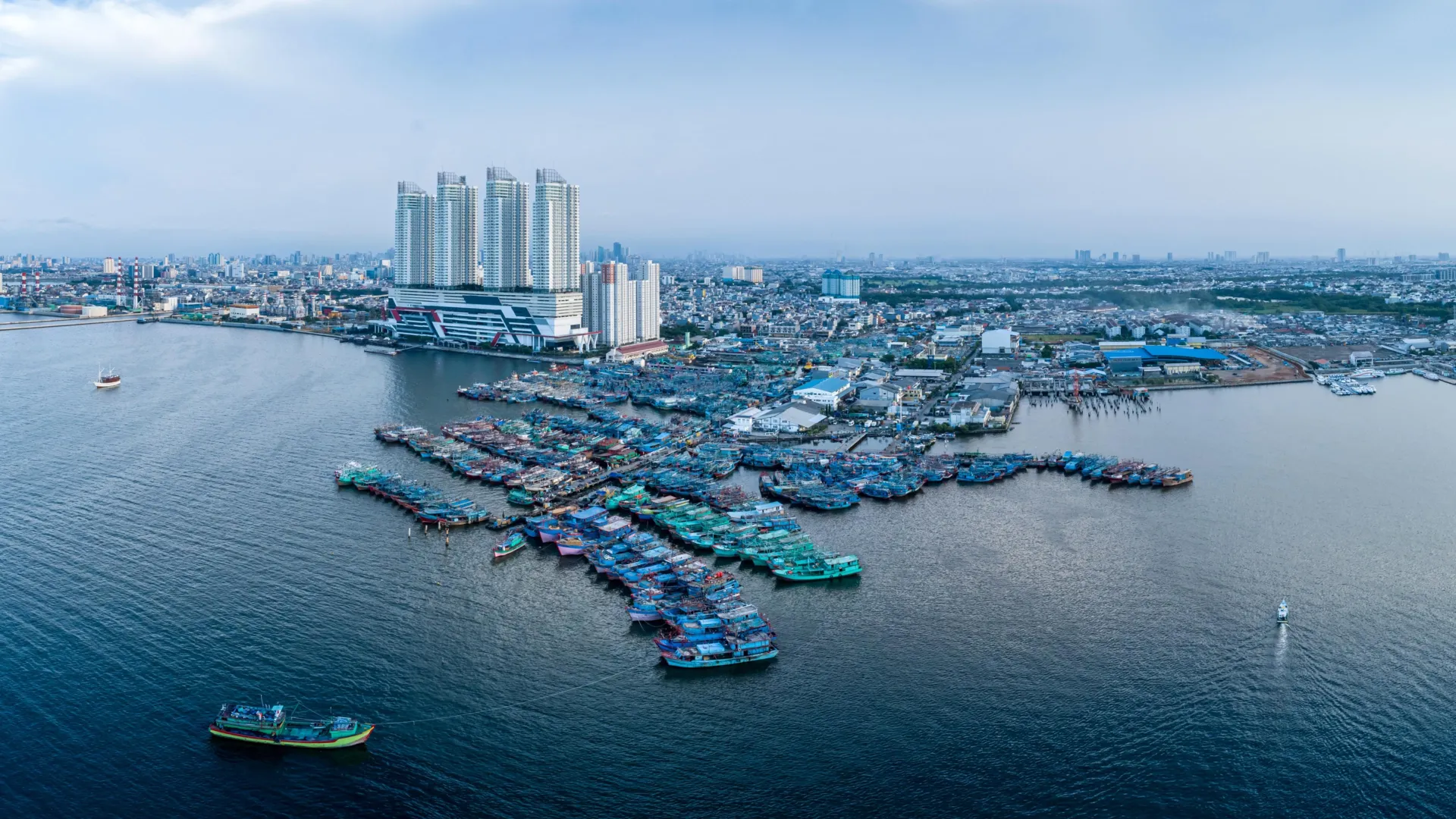
The standard number for global sea-level rise — a little over 3 millimeters a year — turns out to badly understate what is happening in the places where people actually live. In densely populated coastal regions, the sea is gaining on the land at an average of 6 millimeters a year, according to research published in Nature Communications, and most of that extra is not the ocean rising. It is the ground going down.
The study, led by Dr. Julius Oelsmann of the German Geodetic Research Institute at the Technical University of Munich, with collaborators at Tulane University in New Orleans, separated the two components of what coastal engineers call relative sea-level rise: how much the water surface climbs, and how much the land beneath a city subsides. The climate-driven absolute rise is 3.15 millimeters a year. The average across all coastlines is 2.1 millimeters. But weight the measurement by where people live, and the figure nearly triples, because human settlement concentrates precisely on the deltas, floodplains and reclaimed ground that sink fastest.
The city-level numbers are stark. Jakarta is going down at 13.7 millimeters a year on average, with some districts dropping 42 millimeters annually — more than four centimeters, every year. Tianjin is sinking at 13.5 millimeters, Bangkok at 8.5, Lagos at 6.7, and Alexandria at 4. Thailand, Bangladesh, Nigeria, Egypt, China and Indonesia sit in the 7-to-10-millimeter range. Even the United States, the Netherlands and Italy register 4 to 5 millimeters a year.
The causes are mostly local and mostly human. Pumping groundwater out from beneath a city removes the fluid that holds the pore space in sediments open, and the ground compacts. Oil and gas extraction does the same thing deeper down. Young delta sediments compress under their own weight, and the sheer mass of a built city — concrete, steel, fill — accelerates the process. Natural geological adjustment, including the slow rebound and sagging of crust left over from the last ice age, adds a background rate on top.
"If we want to understand sea-level rise along coastlines and respond effectively, we must not only observe the ocean but also the land itself," Oelsmann said.
That distinction matters for policy in a way that is easy to miss. Slowing subsidence is often achievable within a single city's authority and on a timescale of years: Tokyo largely stopped its own sinking in the 1970s by restricting groundwater pumping, and Shanghai has slowed its rate through similar controls. Cutting global emissions is neither local nor fast.
More than half a billion people live in the coastal zones the study examined. The research, directed by Professor Florian Seitz of TUM, appears under DOI 10.1038/s41467-026-72293-z.
Originally reported by ScienceDaily.