Astronomers Catch a Star Slowly Eating a Brown Dwarf 300 Light-Years Away
The system ZTF J0440+2325, reported in Nature Astronomy, is the first caught with one low-mass object steadily feeding on another, and it could last for billions of years.

Astronomers have caught a star in the act of slowly eating a brown dwarf, a planet-like object heavier than a planet but too small to be a star. The system, named ZTF J0440+2325, lies in the Milky Way about 300 light-years from Earth. In a paper published this week in Nature Astronomy, a team at MIT and other institutions describes it as the first observation of a low-mass object steadily consuming material from another low-mass object.
Most planetary bodies circle their stars in stable, detached orbits, and astronomers have also seen a handful of stars quickly engulfing their planets. This system sits between the extremes. "When we think of stars interacting with planets or brown dwarfs, the picture is always that the star eventually swallows the other thing," said Kevin Burdge, assistant professor of physics at MIT. "This is what will happen to the Earth when the sun becomes a red giant. But here, we've found an alternative: Instead of swallowing the thing up, the star can gradually eat it, for billions of years."
The signal first turned up in data from the Zwicky Transient Facility, a camera on a telescope at Palomar Observatory in California that scans the sky for sudden brightness changes from events such as supernovae. Burdge noticed a strange light curve. Supernovae brighten and fade in a bell shape, but this one looked like a triangle that repeated over and over. "I remember first looking at this and thinking: Stars don't make triangular waveforms like this," he said.
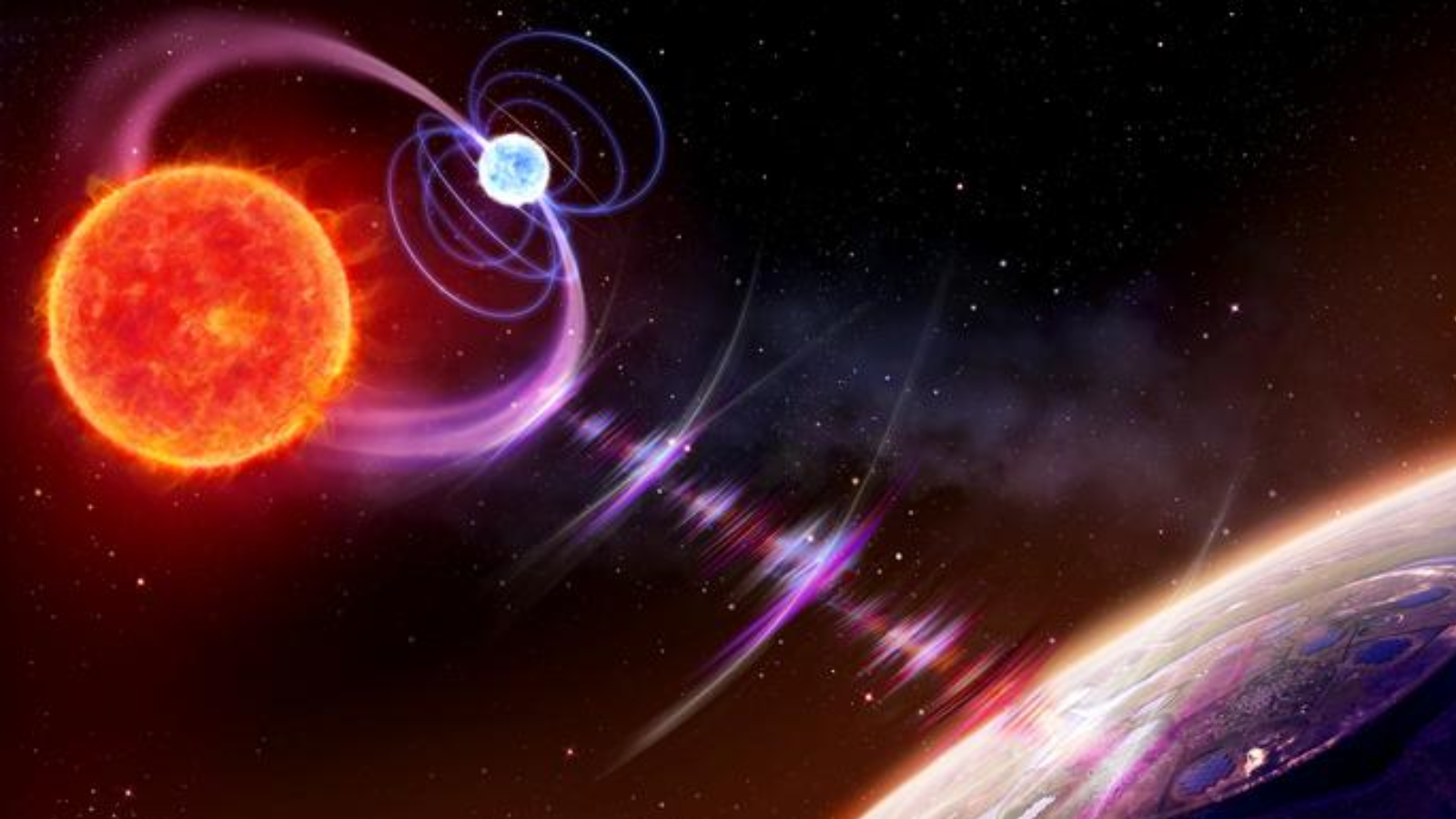
At first he suspected a black widow binary, in which a dense, spinning neutron star slowly consumes a smaller companion. But the light did not wobble the way those systems do, because a very light object whipping around a heavy one tugs its partner back and forth. "We weren't seeing that whipping back and forth here," Burdge said. He wondered whether the signal came from a more balanced pair of low-mass objects that orbit gently without much wobble, but for years he had no proof.
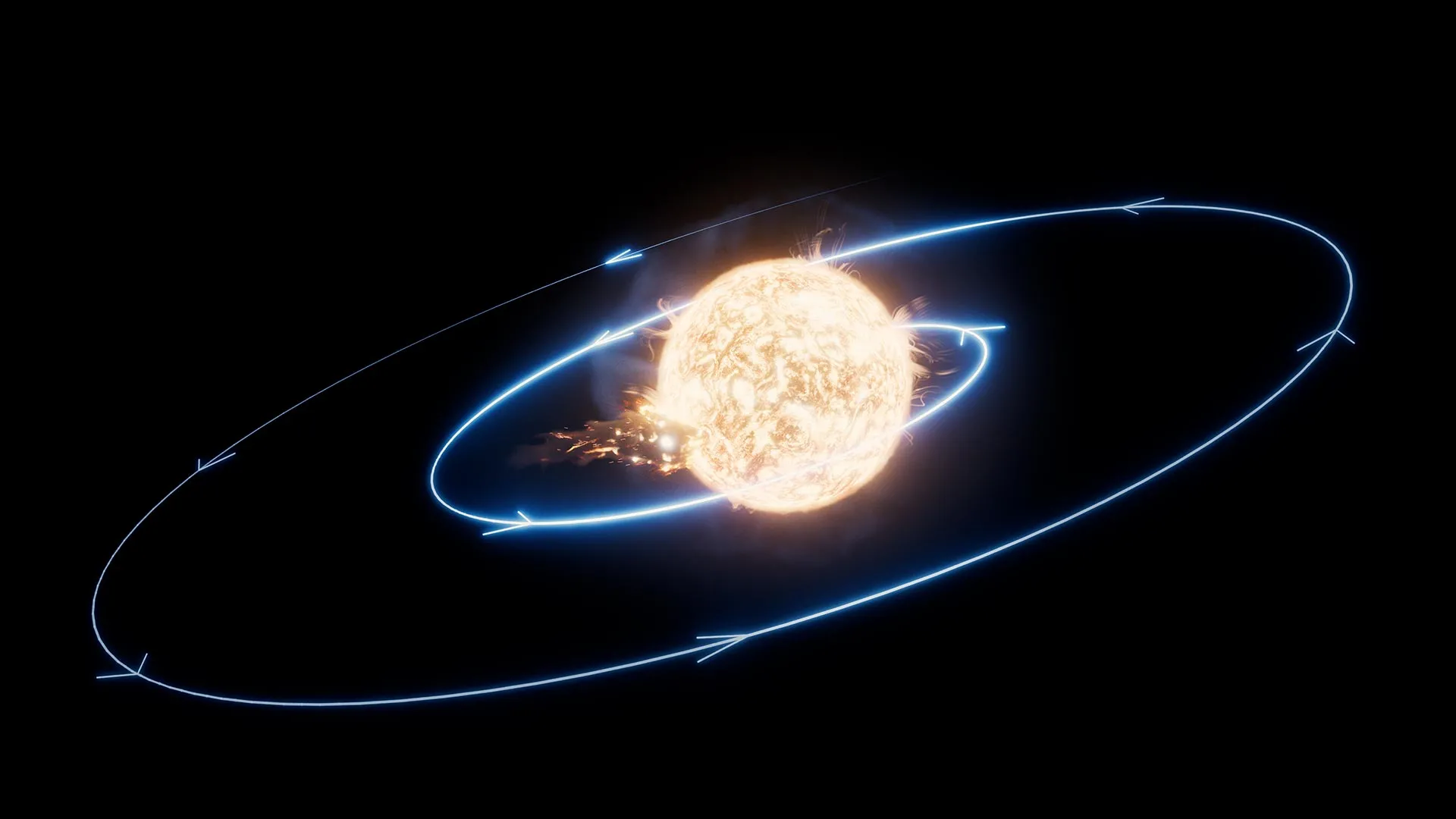
Follow-up observations with multiple telescopes by Burdge and graduate student Aaron Householder measured a wobble that was small but not zero. "The wobble was too small in amplitude to be anything else," Householder said. The star is about 85 times the mass of Jupiter and the brown dwarf about 25 times. They circle each other every 86.65 minutes, in an orbit small enough to fit inside the diameter of the Sun.
The brown dwarf is feeding the star at a rate of about one hundred-thousandth of Earth's mass per year. Simulations of test particles showed that the stream does not form a disk. It falls directly onto the star's surface. "So matter just pummels directly onto the surface, at very high speeds, like an asteroid hitting the moon," Burdge said. The impact heats a large hot spot that moves in and out of view as the pair orbit, and the light curve peaks when that fireball faces Earth. That explains the triangle. "It's like you've got this continuous fireball onto one of the objects," he said.
Because the transfer is so slow, the researchers estimate it could continue for billions of years. "This is the first time we've caught a low-mass star actively accreting from another low-mass object," Householder said. The MIT team worked with collaborators from Caltech, the University of Hawaii, the Instituto de Astrofísica de Canarias and the Universidad de La Laguna in Spain, and the Harvard-Smithsonian Center for Astrophysics.