Strange Winds on Scorching 'Hot Jupiters' Yield the Strongest Evidence Yet of Magnetic Fields on Alien Worlds
By clocking iron-laced winds screaming across seven ultra-hot gas giants, astronomers found a pattern that ordinary weather physics can't explain — but magnetism can.
Astronomers have found the strongest evidence yet that planets beyond our solar system can possess their own magnetic fields — and they found it hidden in the howling winds of some of the hottest worlds ever studied. The discovery, published June 2 in the journal Nature Astronomy, suggests that magnetism may quietly shape the weather on distant gas giants in ways nothing on Earth prepares us for.
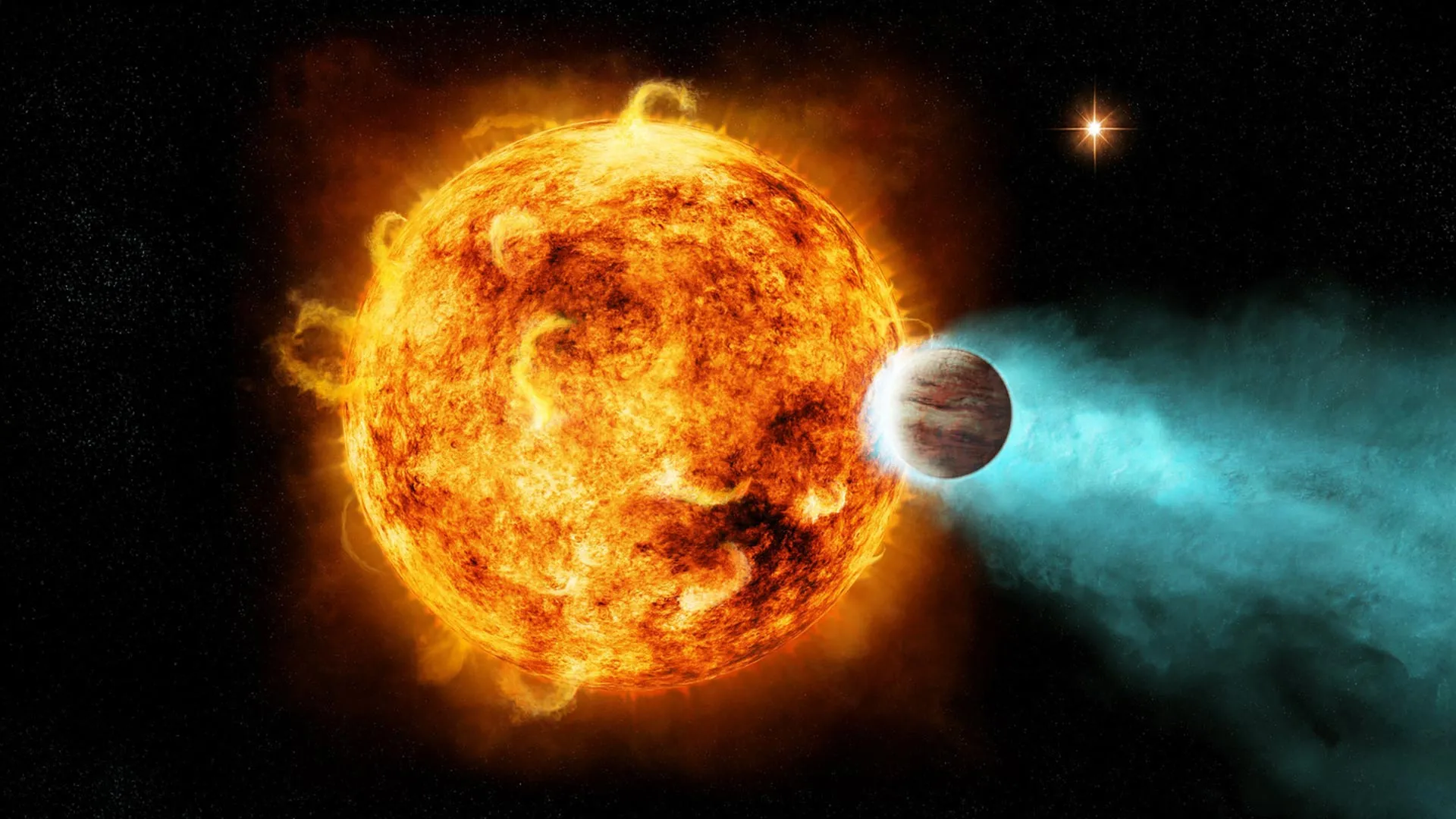
The team trained two of the world's most powerful instruments — the European Southern Observatory's Very Large Telescope in Chile and the Gemini North telescope in Hawai'i, part of the U.S. National Science Foundation's NOIRLab — on seven "ultra-hot Jupiters." These are massive gas giants orbiting so close to their stars that their atmospheres are vaporized to thousands of degrees. Because they are tidally locked, the same blistering hemisphere always faces the star while the other side remains in perpetual night.
To measure the winds, researchers dissected the planets' starlight for the fingerprint of vaporized iron atoms drifting in the atmosphere, then tracked how that signature was Doppler-shifted as the gas raced around the planet. The technique let them clock wind speeds streaming from the dayside to the nightside at staggering velocities — in some cases more than 15,000 miles per hour.
The puzzle emerged when the team compared the planets. Standard atmospheric physics, which treats a planet's air like a simple fluid driven by heat, predicts that hotter worlds should whip up faster winds. Instead, the astronomers found the opposite: the hottest planets had the slowest winds, a temperature-dependent pattern that purely hydrodynamic models simply cannot reproduce.
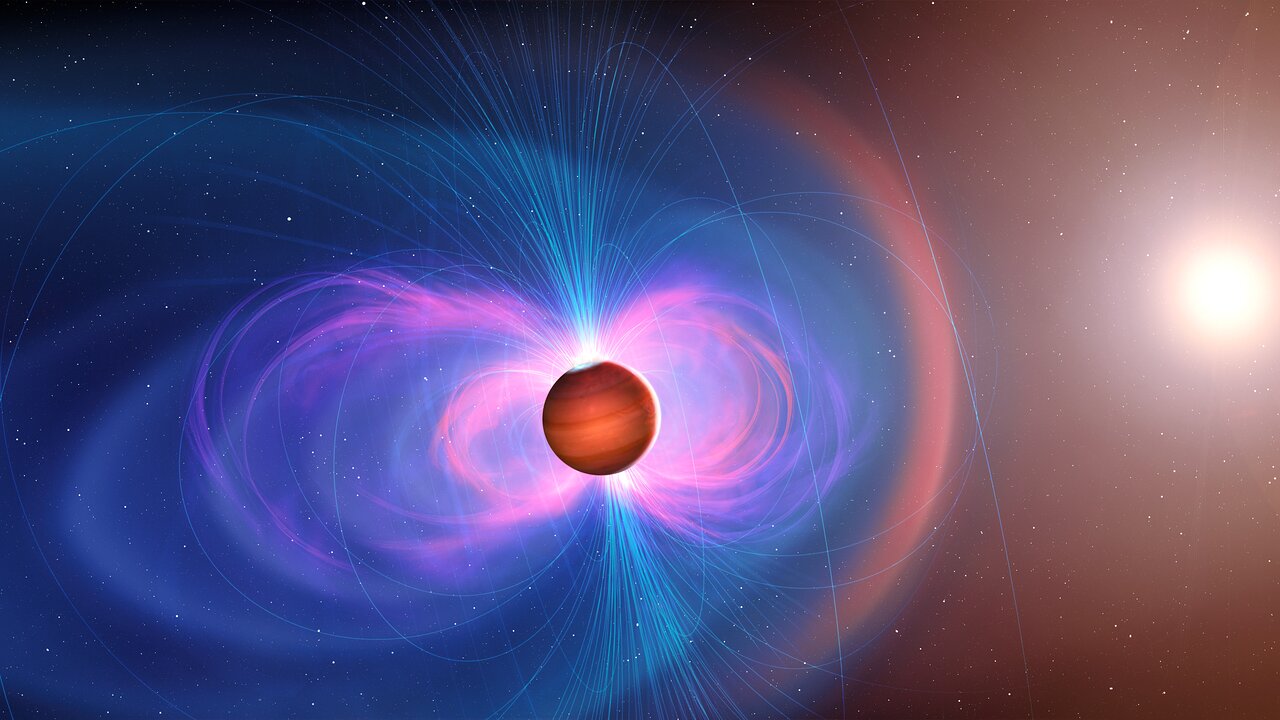
The explanation, the researchers argue, is magnetism. At extreme temperatures, the atmospheric gas becomes partially ionized — its atoms stripped of electrons and turned electrically charged. A planetary magnetic field tugging on that ionized flow produces a braking effect known as magnetohydrodynamic drag, slowing the winds exactly where the gas is hottest and most charged. The neat match between the observed slowdown and the predictions of magnetic drag is what makes the case so compelling.
If confirmed, the finding opens a powerful new window on exoplanets. Magnetic fields are thought to help shield atmospheres from being stripped away by stellar radiation, a factor that could prove crucial in assessing whether smaller, cooler, potentially habitable worlds can hold onto the air — and water — that life would need. For now, the scorching hot Jupiters serve as cosmic laboratories, revealing that the weather on alien planets can be governed by forces invisible from the ground but written plainly in the wind.