No Giant Planets Orbit 70 Ophiuchi, a Binary Star 16 Light-Years Away, Study Finds
A search with two ground telescopes rules out Jupiter-sized worlds and blames an old planet-like wobble on the stars themselves.

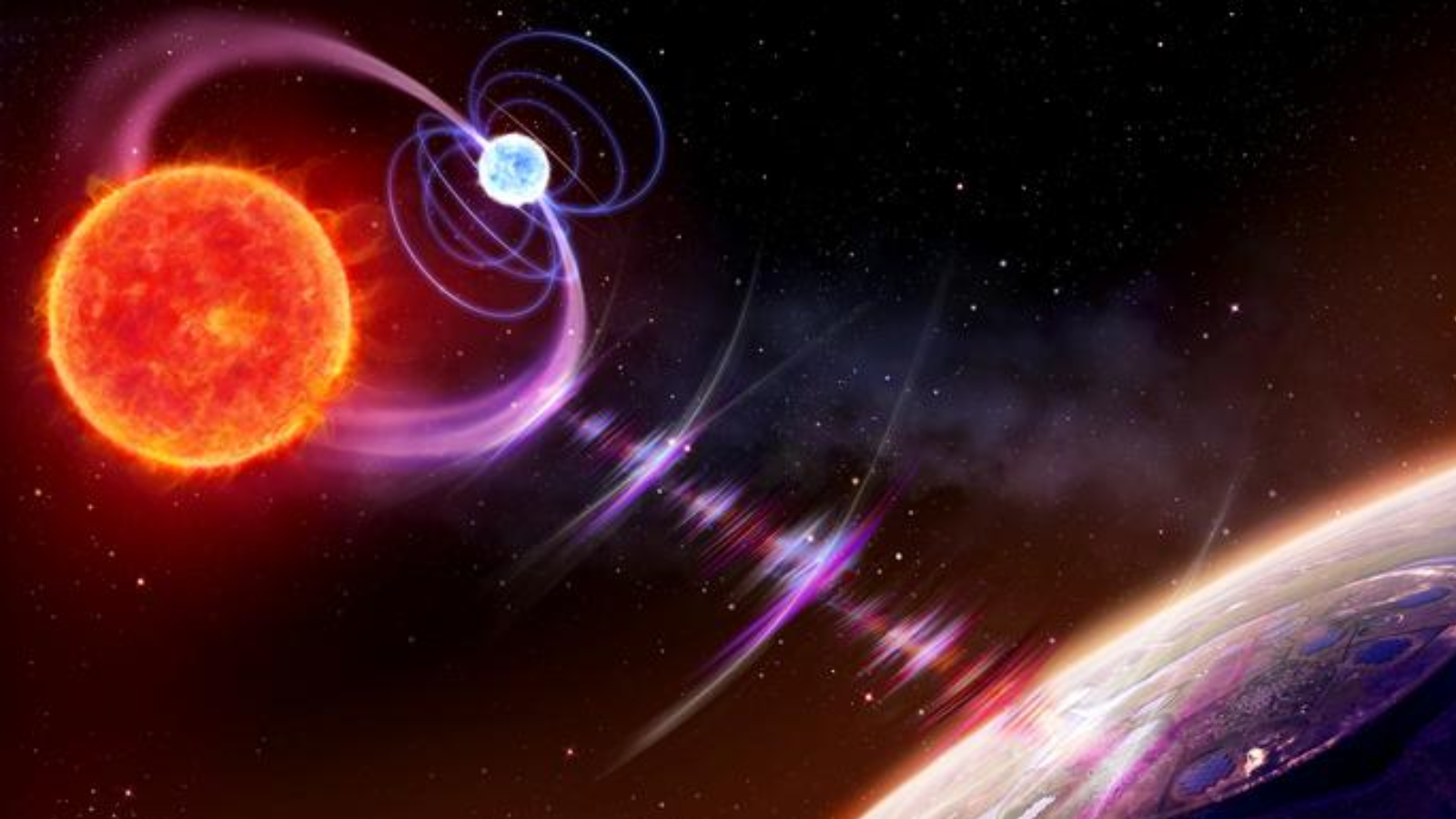
Astronomers have found no Jupiter-sized planets around 70 Ophiuchi, one of the closest star pairs to the Sun, and they say an earlier hint of a giant world was caused by the stars rather than by anything orbiting them. The study, led by the University of Michigan with collaborators at more than a dozen institutions including NASA's Jet Propulsion Laboratory and Caltech's IPAC, is published in The Astrophysical Journal.
The system, known as 70 Oph AB, lies about 16 light-years from Earth. That makes it the third-closest binary system after Alpha Centauri, at 4.2 light-years, and 61 Cygni, at 11.4 light-years. Its two stars are close enough to us that any planets would be prime targets for future telescopes.
The team used two ground-based instruments: the 6.5-meter Magellan Clay Telescope at Las Campanas Observatory in Chile and the 2.7-meter Harlan J. Smith Telescope at McDonald Observatory in Texas. Their measurements ruled out planets as massive as Jupiter or larger within 5 astronomical units of star 70 Oph A, and within 0.5 astronomical units of star 70 Oph B. One astronomical unit is the distance from Earth to the Sun.
The result settles a puzzle. Earlier observations had seen a radial-velocity wobble, a periodic shift in a star's light that can signal a planet's gravitational tug. The new analysis found that the wobble came from variations on the stars' surfaces, such as magnetic activity, and not from planetary orbits. It is a reminder that stellar noise can mimic planets, especially in busy binary systems.
Smaller worlds are not excluded. Planets the size of Saturn or less remain possible, particularly in the habitable zone, the range of distances where liquid water could exist on a surface. Detecting such planets is much harder, but the new limits tell future surveys where not to look.
Postdoctoral researcher Yiting Li described the result as bittersweet. "It's a mix of disappointment and excitement," Li said. "We're finding out that there isn't a Jupiter-sized planet, but we're also opening the latest chapter."
The finding also feeds a wider question about how planets form around binary stars, where two suns can stir the disk of gas and dust from which planets grow. Nearby pairs are the best laboratories for that question because they can be studied in detail. If giant planets are absent here, it adds one more data point on how often such systems produce them. Upcoming instruments, including next-generation space telescopes designed to image small rocky planets, will be able to probe the region the current study could not reach.