'You Are What You Eat': Astronomers Catch a Sun-Like Star That Appears to Have Swallowed One of Its Planets
A telltale surge of lithium in the star TOI-5882, some 1,300 light-years away, points to a planet consumed whole — possibly nudged to its doom by a hidden brown-dwarf companion.
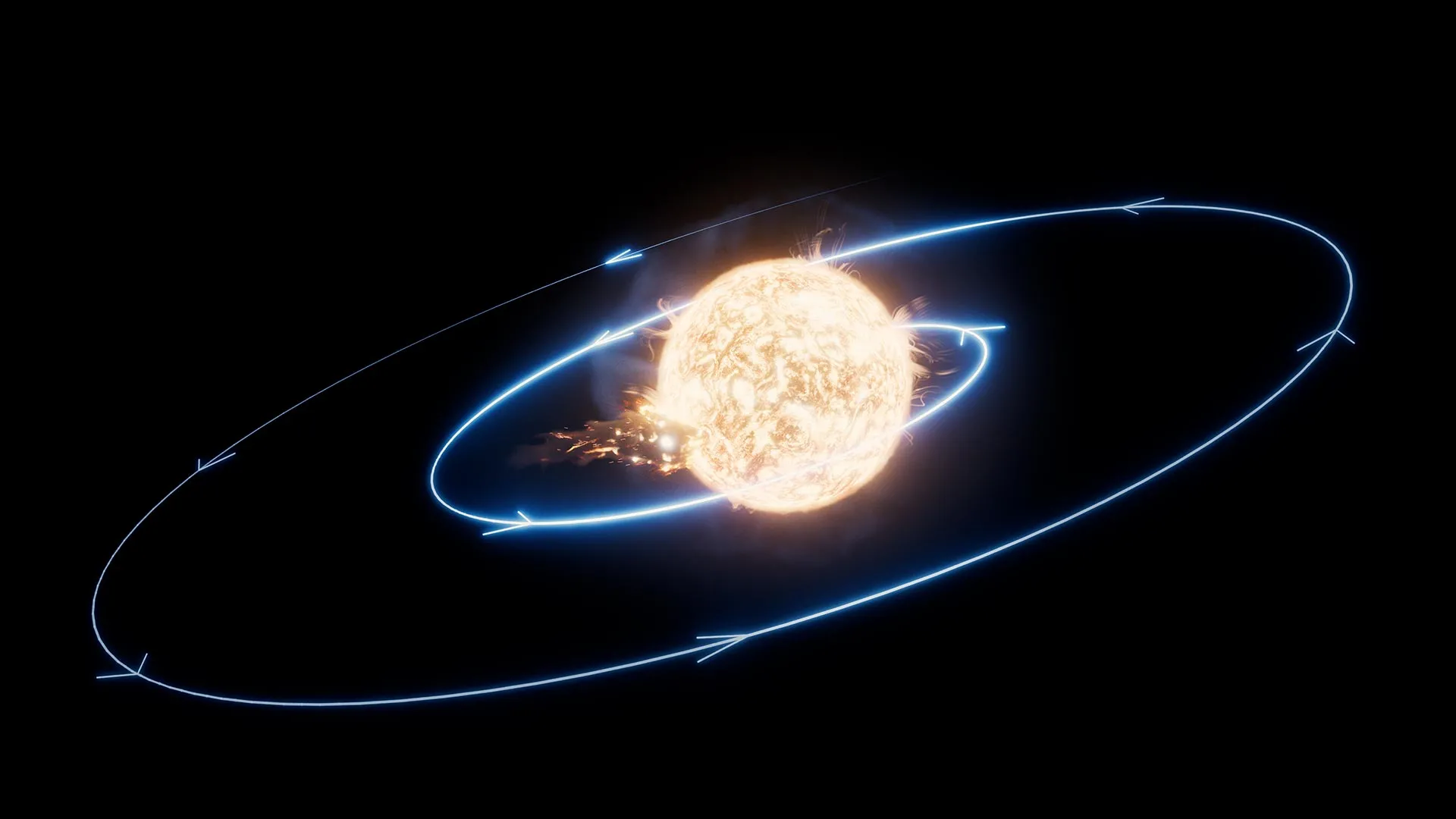
Astronomers say they have caught a distant, Sun-like star in the act of cosmic cannibalism — or at least the chemical aftermath of it. New research suggests that TOI-5882, a star roughly 1,300 light-years from Earth, likely devoured one of its own planets, a violent episode betrayed by an unusual chemical signature.
The clue is lithium. Stars destroy lithium in their interiors over time, so an old star should show relatively little of it. But TOI-5882 is brimming with the element, ranking at least in the 97th percentile compared with similar stars. That anomaly is exactly what astronomers would expect if the star had recently ingested planetary material, which is far richer in lithium than a star is.
“You are what you eat, right?” said Brooke Kotten, a graduate student researcher at the University of Michigan and lead author of the report in The Astrophysical Journal. “We know that there's much more lithium in planetary material than there is in stars. So if a star eats a planet, it's going to take on a bunch of lithium.”
Astronomers call the phenomenon “engulfment,” and it happens fast — sometimes over just days or weeks on cosmic timescales. That brevity means scientists are unlikely to witness a planet's destruction directly and must instead read the chemical traces left behind. “We can't just watch the crime happen, so we have to work with all the clues we're given to figure out whodunit,” Kotten said, describing the work as forensic detective story.
The team also identified a possible accomplice: a massive brown dwarf companion — a failed star more than 20 times the mass of Jupiter — whose gravity may have destabilized the doomed planet's orbit and sent it spiraling inward. If confirmed, the scenario would show how a distant, unseen partner can help drive a planet to a fiery end.
The findings, supported in part by NASA and the National Science Foundation, do more than explain one strange star. Learning to recognize the fingerprints of planetary engulfment could help astronomers gauge how often stars consume their worlds — a fate that, billions of years from now, may await planets in our own solar system as the aging Sun expands.
The formal report, titled “Lithium Enrichment in a Subgiant Star with a Brown Dwarf Companion: A Planetary Engulfment Candidate,” adds TOI-5882 to a small but growing catalog of stars suspected of eating their planets. Each such discovery helps astronomers calibrate how frequently these violent mergers occur and what orbital circumstances tip a planet toward its star. Kotten, who began the work as an undergraduate through the Lamat Program at the University of California, Santa Cruz, said the appeal lies in reconstructing an event no telescope could have watched unfold. Piecing together the chemistry, she said, is like solving a crime scene where the culprit and victim have already vanished.