A Black Hole Fired Its Jets Four Separate Times, the First Galaxy Ever Caught Doing So
Astronomers in India found four nested pairs of radio hotspots around a galaxy 3.9 million light-years across, each one older the farther it sits from the core. The jets' direction has also swung by 24 degrees, a sign the black hole's spin axis is wobbling.

Astronomers say they have found the first galaxy whose central black hole has switched its jets on four separate times, leaving a record of each outburst stacked in space like the rings of a tree.
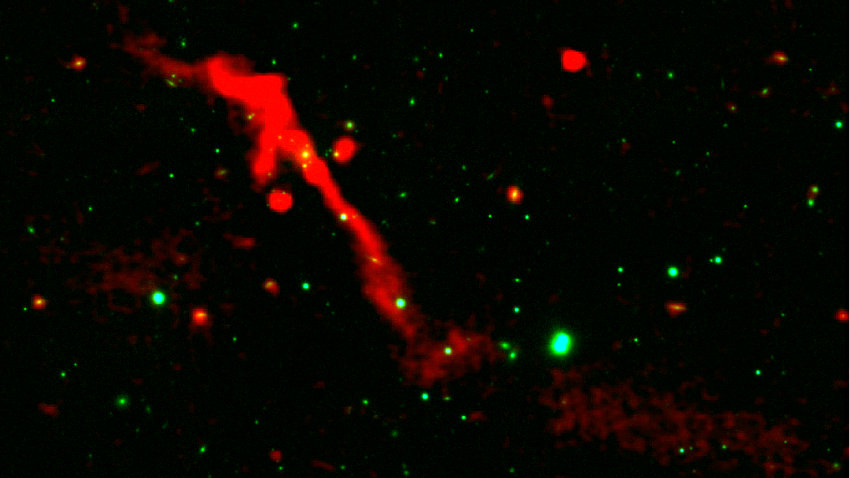
The object, a radio source called J023721.13-010528.5, sits in a massive elliptical galaxy at a redshift of 0.372, or roughly 4 billion light-years away. A team led by Pavan Vijay Khadekar of the Indian Institute of Science Education and Research in Pune studied it with India's upgraded Giant Metrewave Radio Telescope, South Africa's MeerKAT and the Very Large Array in New Mexico, observing at frequencies from 400 megahertz to 3 gigahertz. The combined images show four pairs of bright radio hotspots arranged symmetrically on either side of the galaxy, labeled N1 through N4 and S1 through S4. The paper was posted to the arXiv preprint server on Sept. 8.
Radio galaxies are powered by supermassive black holes that launch narrow jets of particles traveling close to the speed of light. In the most powerful class, called FR II, the jets slam into surrounding gas and create hotspots that can sit millions of light-years from the galaxy. In a small number of these systems the black hole goes quiet and then restarts, and each episode leaves its own pair of hotspots, with older ones pushed farther out. About 192 "double-double" radio galaxies with two episodes are known. Only seven known or candidate "triple-doubles" have been found. No galaxy had ever been confirmed with four.
To show the four pairs are truly separate outbursts rather than bright knots inside one continuous jet, the team measured how the radio "color" of each hotspot has faded with time, which gives a spectral age. Knots in a single jet should all be about the same age. Instead, the hotspot pairs range from about 4.5 million to 20.5 million years old, and the age rises steadily with distance from the core, which is the pattern expected if the black hole fired in sequence. A statistical symmetry test found the four-episode explanation about 3 million times more likely than the knots model. "We conclude that J023721.13-010528.5 exhibits four distinct episodes of jet activity, i.e., a quadruple-double radio galaxy," the authors wrote. They note that data on the fainter southern side, particularly the S3 hotspot, are noisier and carry larger uncertainties.
The hotspots also reveal something about the black hole itself. Each successive pair of hotspots is rotated a little further counterclockwise, by 7 degrees for the second pair, 16 degrees for the third and 24 degrees for the fourth, relative to the innermost set. The researchers say this means the black hole's spin axis has been slowly wobbling, or precessing, over roughly 20 million years, dragging the jets' aim with it.
That wobble also explains the source's overall shape. The radio emission forms a giant S-shape spanning about 3.9 million light-years, making it the second-largest S-shaped radio source known. The team suggests that other giant S-shaped radio galaxies may be the best places to look for more black holes that have turned on and off repeatedly, which could help astronomers work out how often supermassive black holes feed, stall and restart over cosmic time.