Twelve Dead Radio Galaxies Faded in About 12 Million Years. Astronomers Expected Far Longer
When a supermassive black hole switches its jets off, the leftover lobes were thought to glow for a long, slow stretch. A survey with MeerKAT found the afterlife is short — and earlier searches were looking for the wrong thing.

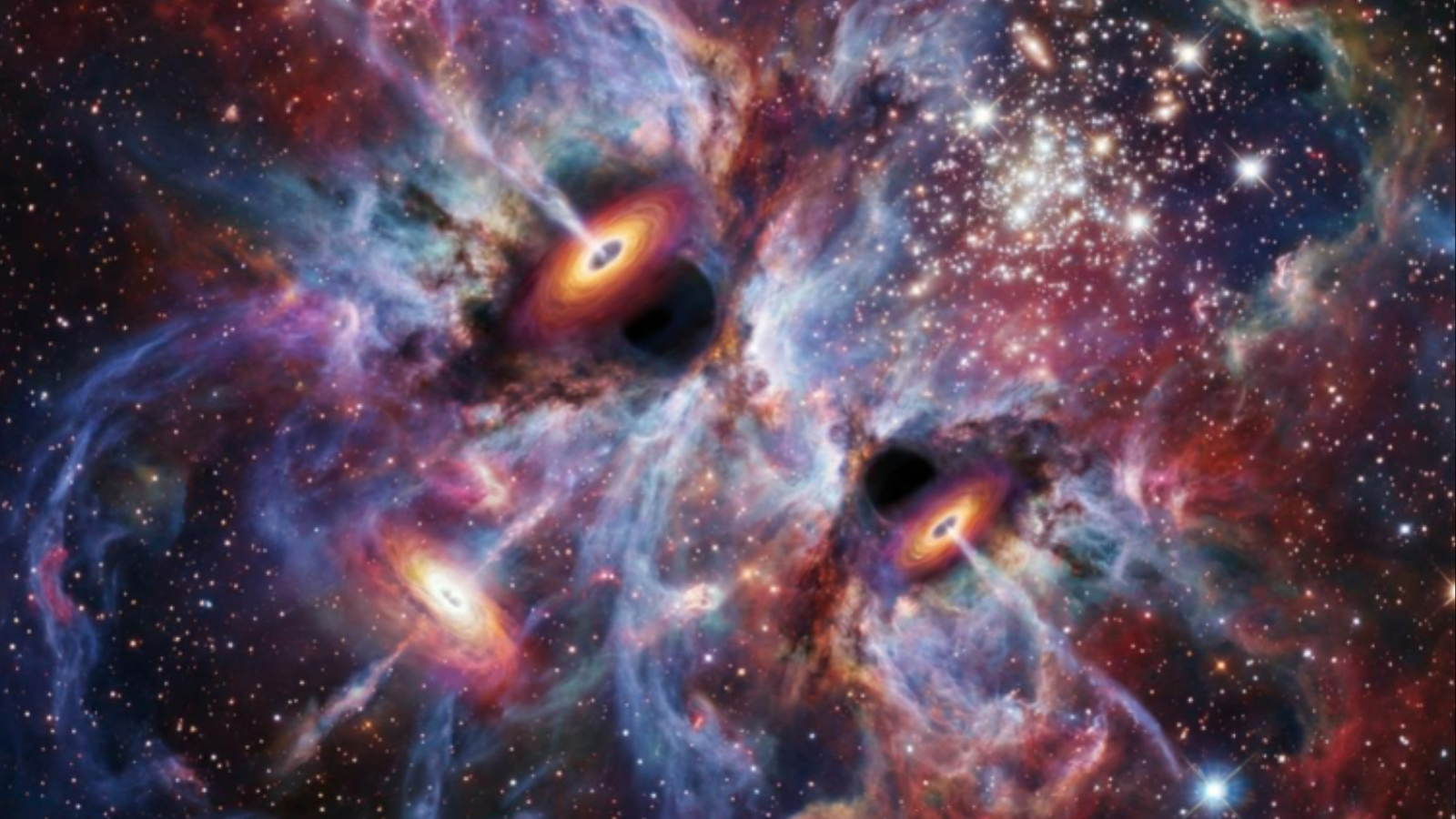
A supermassive black hole that has been firing jets for tens of millions of years eventually stops. What it leaves behind are two enormous lobes of energetic particles, no longer fed, cooling and dimming into the dark. Astronomers call these remnant radio galaxies, and until now the assumption was that they linger — that the fading phase is long, slow and comparatively easy to catch. A survey led from the University of Cape Town has found the opposite.
Sushant Dutta and colleagues at UCT and the Inter-University Institute for Data Intensive Astronomy examined 14 candidate remnants in the XMM-Newton Large-Scale Structure field, a patch of sky covered by unusually deep radio observations. Detailed spectral modeling confirmed 12 of the 14 as genuine remnants. Their spectral ages ran from 8 to 42 million years, with a median near 12 million. By the standards of galaxy evolution, that is a blink.
The measurement leans on a straightforward piece of physics. Once the jets shut off, the highest-energy electrons in the lobes lose energy fastest, so the radio spectrum steepens from the top down in a predictable way. Fit the curvature across enough frequencies and the spectrum reports how long the source has been coasting. The team combined MeerKAT and uGMRT data from the superMIGHTEE survey with LOFAR, GMRT and Jansky Very Large Array observations, spanning 144 megahertz to 1.5 gigahertz — a wide enough baseline to pin the steepening rather than infer it.
The remnants were not caught at the same point in their histories. The jets in these systems switched off anywhere between 4 and 83 percent of the way through the source's total lifetime, which means "remnant" describes a range of states rather than one. Spatially resolved age maps showed something the older picture did not anticipate: the lobes keep evolving structurally after the engine quits, rather than simply dimming in place.
There is also a redshift effect with teeth. In the early universe the cosmic microwave background was denser and hotter, and electrons in distant lobes bleed energy into it through inverse Compton scattering. High-redshift remnants therefore fade faster than nearby ones, which biases every survey conducted so far toward the sources that happen to last longest. The population astronomers have been cataloging is the tail, not the distribution.
That matters for a question well beyond dying galaxies. How often supermassive black holes switch on and off — their duty cycle — sets how much energy they inject into the gas around them, which in turn regulates how many stars their host galaxies can form. Get the fading timescale wrong by a factor of several and every estimate downstream inherits the error. The work appears in Monthly Notices of the Royal Astronomical Society, and the authors frame it as a preview: the Square Kilometre Array's deep continuum surveys should uncover the faint, short-lived, high-redshift remnants that current instruments cannot see at all.