Astronomers Find the Milky Way's First 'Microblazar,' a Black Hole Jet Aimed Straight at Earth
IRAS 18293-0941 pairs a 10-solar-mass black hole with a hot star. Its jet slams into a gas cloud 100 light-years away, where particles may reach energies about 100 times the Large Hadron Collider's.

For about 30 years, astrophysicists have predicted that the Milky Way should contain small-scale versions of blazars, the brilliant galaxies whose giant black holes fire jets of matter straight at Earth. An international team now says it has found the first one.
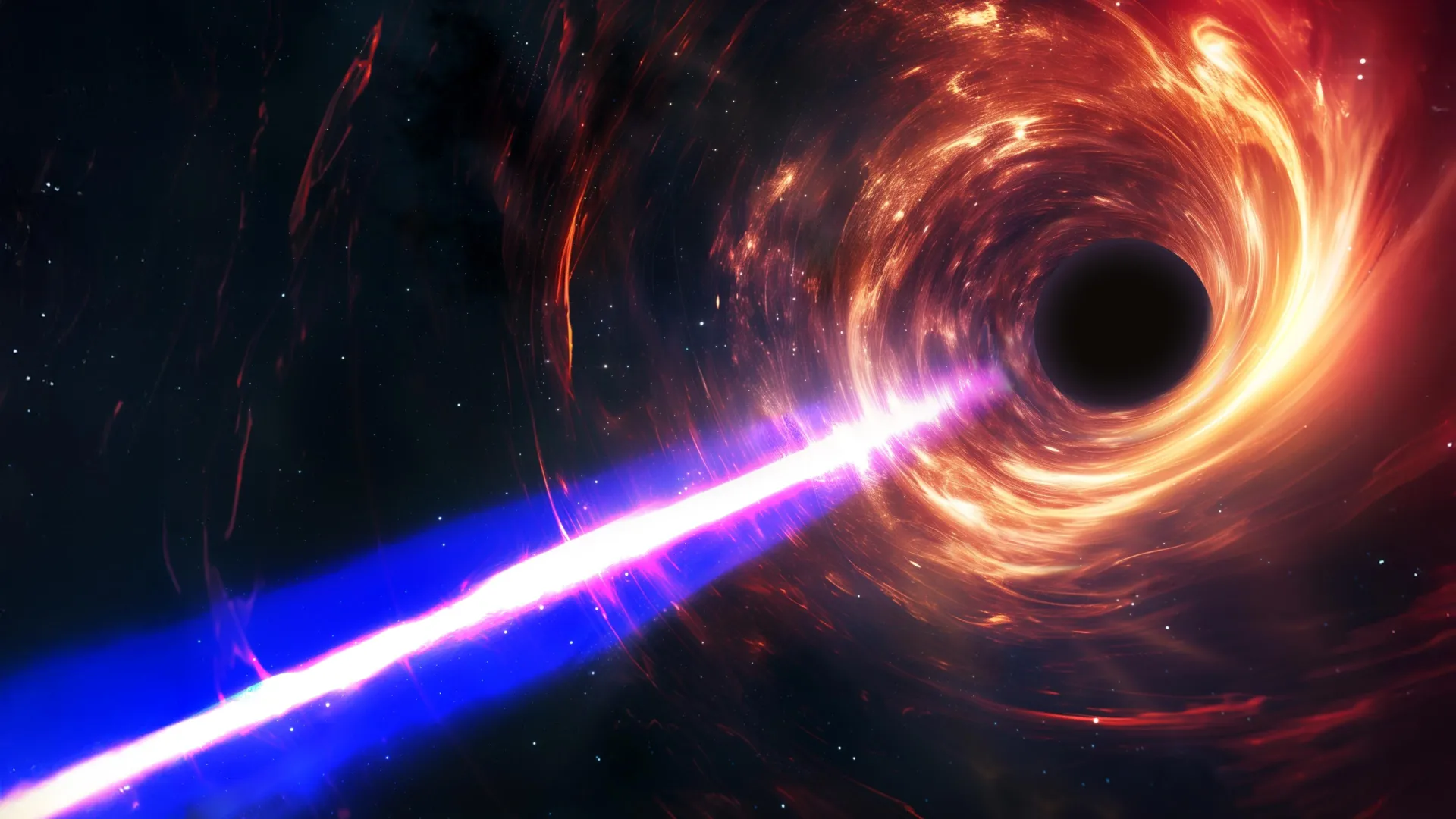
The object, catalogued as IRAS 18293-0941, is a binary system made of a black hole about 10 times the mass of the sun and a hot, massive star that orbit each other every 11 days. The black hole pulls gas off its companion into a spinning disk. Just before that material falls in, part of it is flung out through powerful jets at the black hole's poles. One of those jets points toward Earth, which makes the system appear far brighter than it otherwise would. That orientation is what makes it a "microblazar," the stellar-sized cousin of the blazars powered by supermassive black holes in distant galaxies.
The research, led by Josep Martí with colleagues from ASTRON, the Joint Institute for VLBI ERIC (JIVE), the University of Amsterdam and other institutions, is published in Astronomy & Astrophysics under the title "A Galactic microblazar as a potential accelerator of ultra-high-energy particles." The object is not new to catalogs. The Dutch-American IRAS satellite recorded it in 1983. What drew attention was that radio observations kept showing a bright, compact core with emission on only one side, a hint of a jet aimed nearly along our line of sight.
To confirm it, the team ran what co-author Benito Marcote of ASTRON and JIVE called "a genuinely multiwavelength observational campaign." Radio telescopes produced high-resolution images of the jet and how it interacts with its surroundings. Optical spectra measured motions within the system. X-ray and gamma-ray telescopes probed the hot plasma near the black hole, and infrared images mapped warm dust. The radio images show the jet crossing a region about 100 light-years long, roughly 590 trillion miles, that it has already swept clear of interstellar gas. It then slams into a dense molecular cloud of hydrogen and dust.
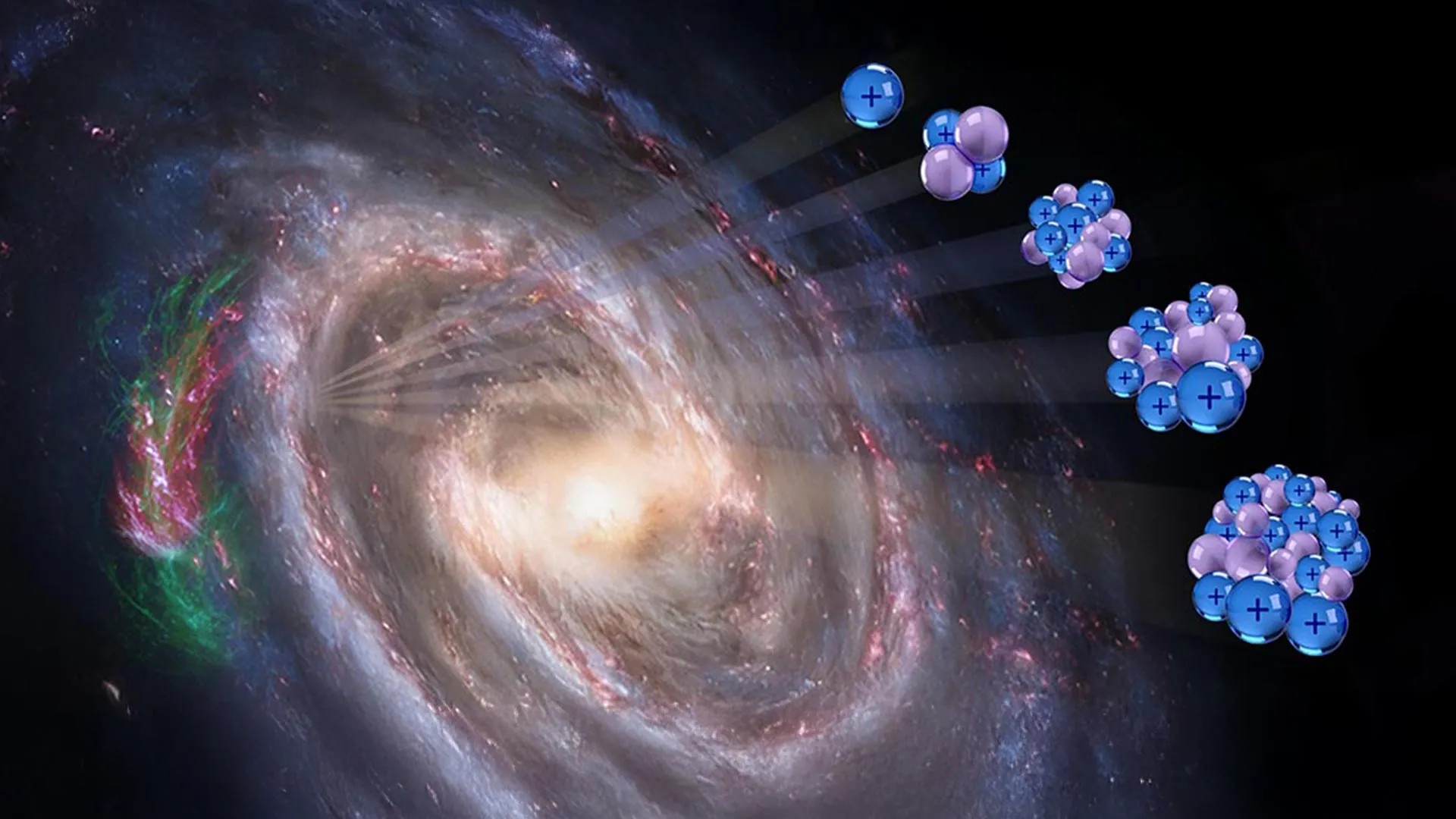
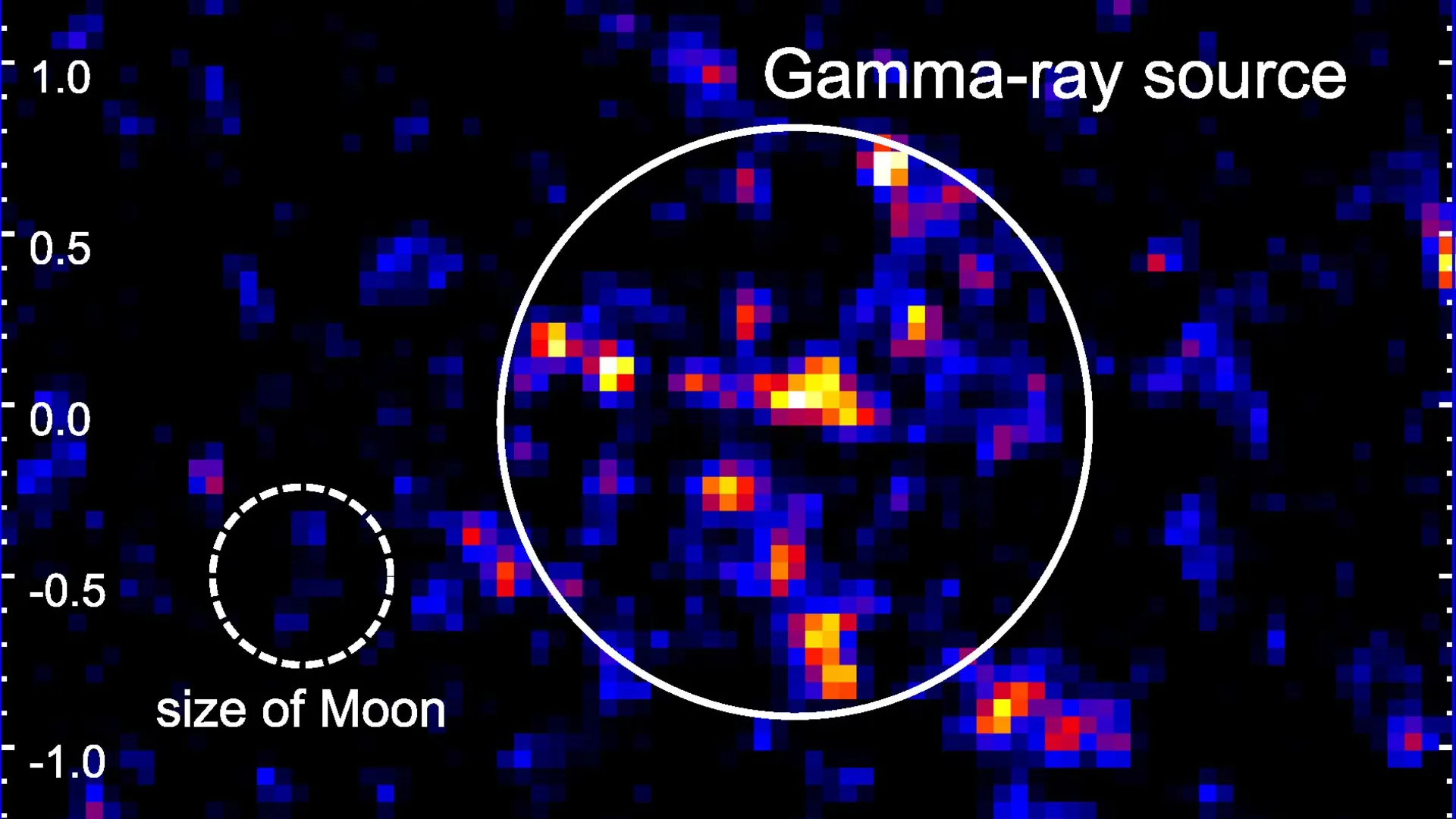
That collision point is the headline result. It creates a bright spot where gas is ionized and dust is heated, and where particles are driven to nearly the speed of light. The team found that the hot spot lines up with a gamma-ray signal from high-energy particles and estimates that particles there reach energies of up to petaelectronvolts, a quadrillion electron volts. That would make the system roughly 100 times more powerful than the Large Hadron Collider and one of the strongest natural particle accelerators in the galaxy. Ground-based observatories have detected cosmic rays at these energies for decades, but where the galaxy makes them has been an open question for more than a century. Jets smashing into interstellar gas have been one leading suspect.
"This discovery allows us to study remote blazars created by distant supermassive black holes," Marcote said. "Those blazars are too remote to be resolved in our images. Having an analog object in our galaxy allows for detailed study of blazar physics." Co-author Jakob van den Eijnden of the University of Amsterdam said it "highlights the power of studying the universe with different kinds of telescopes at the same time, because none of the individual telescopes could have told the entire story."
The team plans more observations of the hot spot. Marcote said understanding how the jet heats and ionizes the cloud could matter for star formation, which takes place in exactly these kinds of molecular clouds, and for how small black-hole systems shape the structure of galaxies like our own. The paper is also available on the arXiv preprint server as 2609.00990.