Scientists Identify Source of Most Powerful Cosmic Neutrino Ever Detected
Researchers trace mysterious 220 PeV particle that slammed through Mediterranean Sea to blazars—supermassive black holes shooting jets directly at Earth.
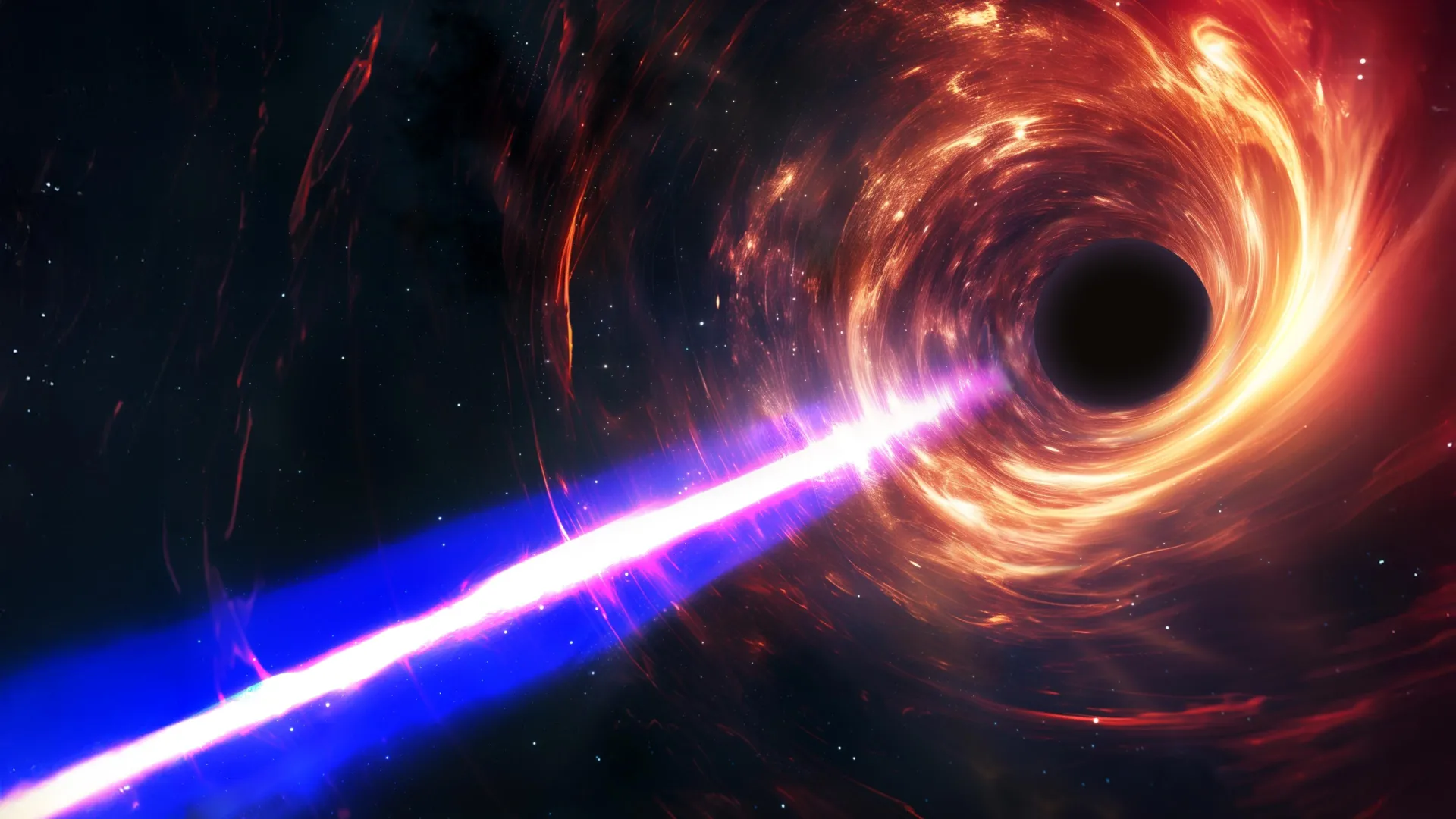
Three years after detecting the most energetic cosmic neutrino ever observed, scientists believe they have identified its cosmic origin: blazars, some of the universe's most extreme objects powered by supermassive black holes that shoot enormous jets of plasma directly toward Earth. The discovery offers new insights into how the most violent processes in the universe accelerate particles to incredible energies.
The record-breaking neutrino was detected on February 13, 2023, by the KM3NeT/ARCA observatory located deep beneath the Mediterranean Sea off the coast of Sicily. The particle carried an astonishing energy of around 220 petaelectron volts (PeV), more than ten times greater than previously detected high-energy neutrinos. Even more remarkable, the detection was made while the observatory was still under construction, with only 21 of its planned 200+ detection lines operational.
Researchers approached the mystery like forensic investigators, creating detailed simulations and comparing them with actual observations. The team, led by scientists from INFN Naples and involving hundreds of contributors from the KM3NeT collaboration, focused on blazars as the most likely culprits. These objects are active galactic nuclei where supermassive black holes accelerate jets of matter to near light-speed, with some jets pointed directly at Earth like cosmic searchlights.
"There are several possible explanations for the origin of this particle," explains Meriem Bendahman, a researcher at INFN Naples. "For example, it has been proposed that such neutrinos are generated when ultra-high-energy cosmic rays interact with the cosmic microwave background radiation. But there is also the possibility that the neutrino originates from a diffuse flux produced by a population of extreme accelerators, such as blazars." The lack of electromagnetic counterparts—no matching radio waves, visible light, or gamma rays—suggests the particle came from a diffuse background of multiple sources rather than a single dramatic event.
The research team used sophisticated simulation tools to model realistic blazar populations across the universe. Their analysis indicates that rather than originating from one spectacular cosmic explosion, the ultra-high-energy neutrino likely emerged from the collective activity of numerous blazars throughout the cosmos. This finding helps scientists better understand how the universe's most powerful accelerators work together to create the highest-energy particles ever detected, opening new windows into the extreme physics of supermassive black holes and the jets they produce.

