Scientists May Have Found Source of Most Powerful Neutrino Ever Detected
Researchers point to blazars—supermassive black holes shooting plasma jets toward Earth—as likely origin of record-breaking 220 PeV particle.
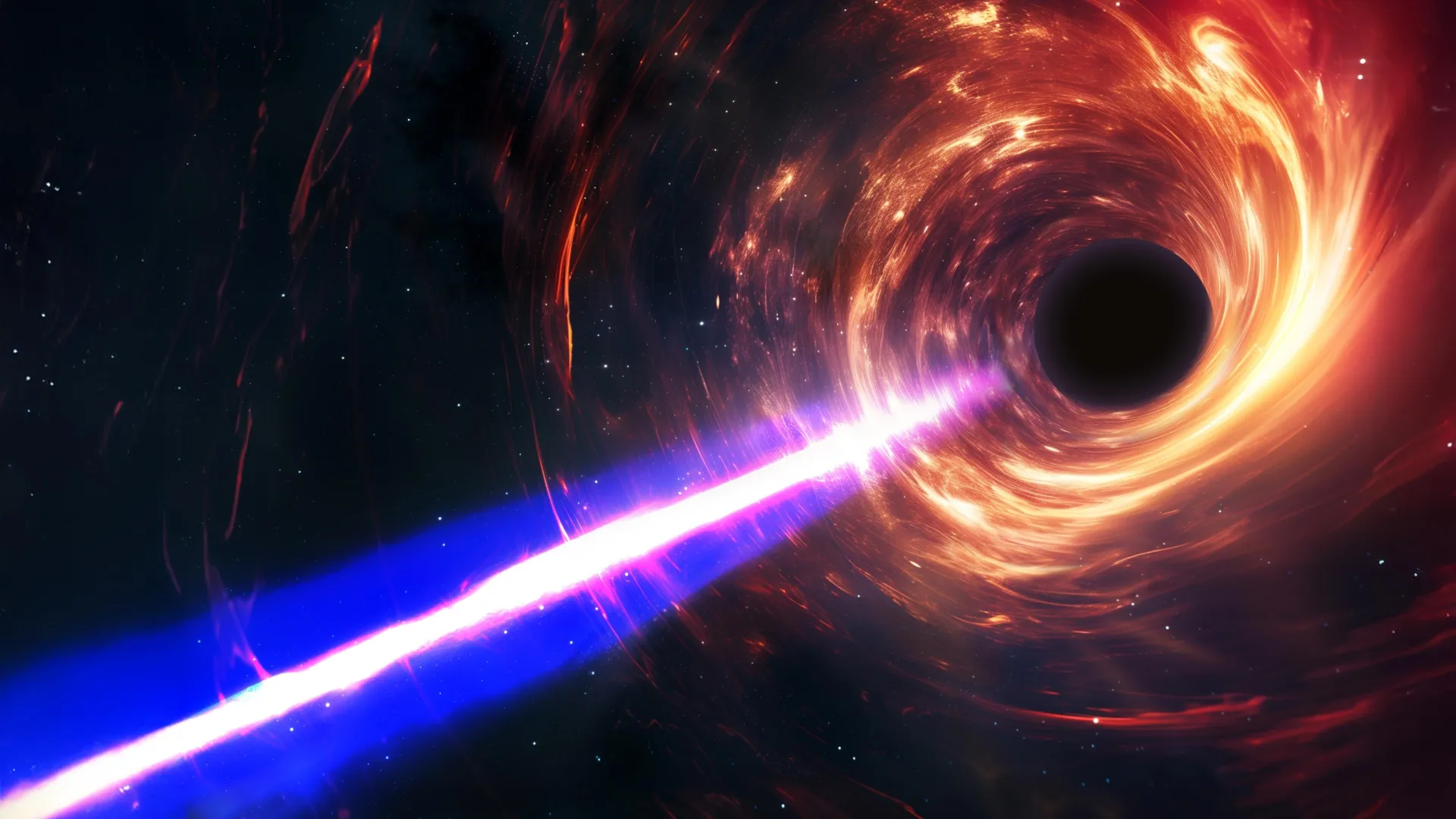
Three years after scientists detected the most energetic cosmic neutrino ever observed, researchers believe they have identified the likely source: blazars, among the universe's most extreme objects powered by supermassive black holes. The particle, detected in February 2023, carried an astonishing energy of around 220 PeV—more than ten times greater than previously detected high-energy neutrinos.
The record-breaking neutrino was captured by KM3NeT/ARCA, a massive neutrino observatory located deep beneath the Mediterranean Sea off the coast of Sicily. Remarkably, the detector was still under construction at the time, with only 21 detection lines operational—representing just 10% of the observatory's planned final configuration. Even in this partial state, the instrument managed to capture a signal unlike anything scientists had seen before.
Researchers approached the mystery like forensic investigators examining clues from a crime scene, creating detailed simulations to compare with actual observations. A new study published in the Journal of Cosmology and Astroparticle Physics suggests the neutrino originated from blazars—active galactic nuclei that shoot enormous jets of plasma directly toward Earth at nearly the speed of light.
Unlike many cosmic events where astronomers detect matching electromagnetic signals like radio waves or gamma rays, this neutrino arrived without any accompanying light signatures. According to Meriem Bendahman, a researcher at INFN Naples and study co-author, this absence doesn't rule out a point source but suggests the particle may have emerged from a diffuse background created by multiple blazar sources rather than a single dramatic event.
The team used open-source simulation tools to model realistic blazar populations, investigating whether these extreme accelerators could produce neutrinos with such unprecedented energies. The discovery provides new insights into how the universe's most powerful objects accelerate particles to energies far beyond what any human-made accelerator can achieve, potentially reshaping our understanding of cosmic ray production and high-energy astrophysics.

