A Supermassive Black Hole Is Fleeing Its Galaxy at 1,000 Kilometers a Second
Physicists Reconstructed the Kick.
RBH-1 left a trail of newborn stars 202,000 light-years long. A Santa Barbara team worked backward to the merger that threw it out, about 70 million years ago.

In 2022 astronomers found something that should not exist: a thin, straight line of light stretching more than 202,000 light-years out of a galaxy roughly 7.5 billion light-years away, with a starless object at the far end plowing through intergalactic space at close to 1,000 kilometers per second. The line was not a jet. It was a wake of new stars, ignited in gas that the object had compressed as it passed.
Now a team at the Kavli Institute for Theoretical Physics at the University of California, Santa Barbara, working with colleagues at the University of Texas at Austin, has reconstructed the event that launched it.
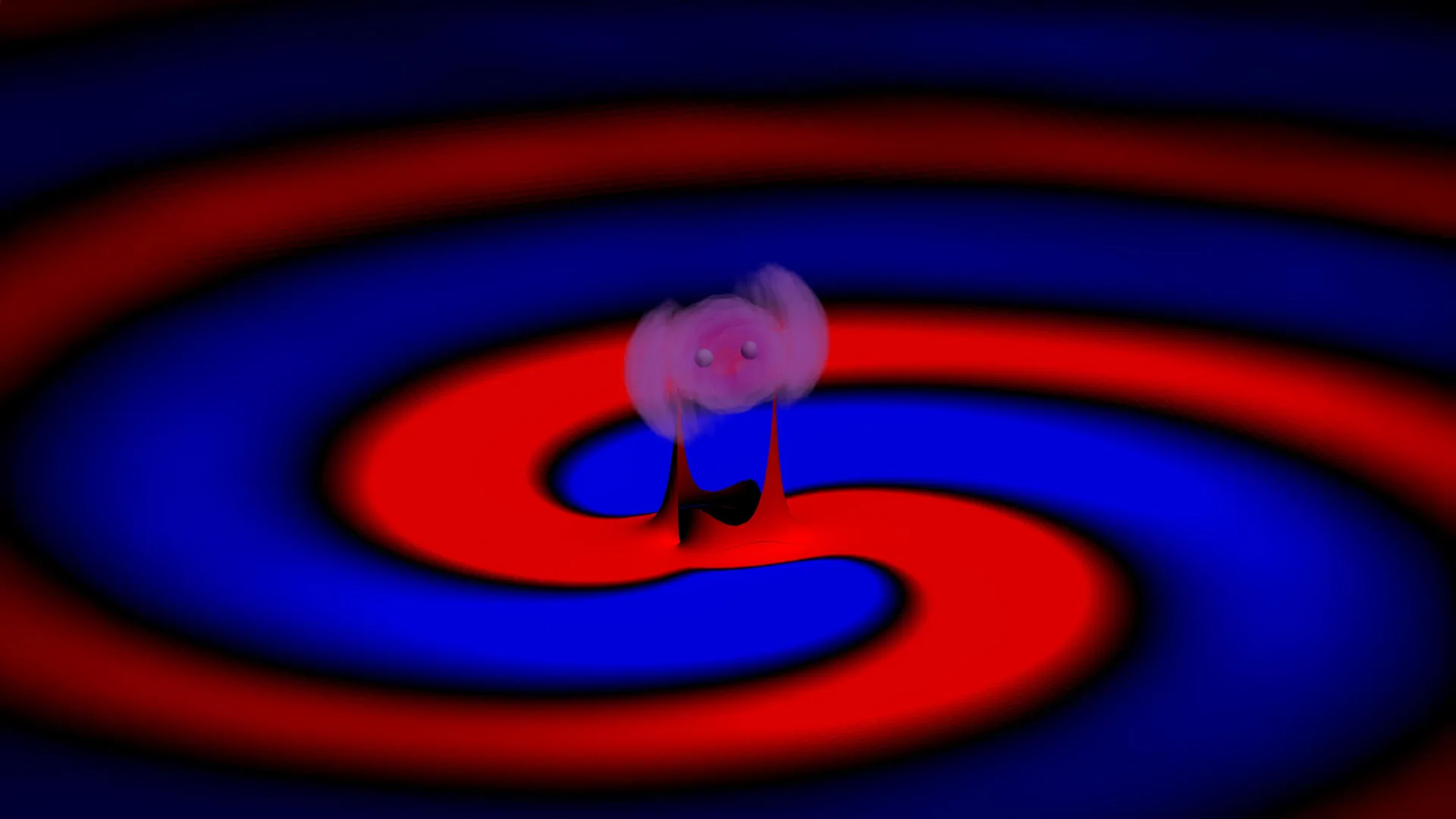
The object, designated RBH-1, is a supermassive black hole, and it was thrown out of its galaxy's center by the merger of two smaller supermassive black holes. When two black holes spiral together, they radiate gravitational waves. If the pair is lopsided in mass or its spins are misaligned with the orbit, that radiation comes out unevenly, and the merged remnant recoils in the opposite direction — the same principle as a rifle's kick, carried by ripples in spacetime rather than gunpowder.
"RBH-1 is the first convincing example of a supermassive black hole ejected from galaxy center, likely from gravitational-wave recoil following two supermassive black hole merger," said Tousif Islam, the study's lead author.
Getting a kick of nearly 1,000 kilometers per second out of a merger is not easy. Islam, with Tejaswi Venumadhav and Digvijay Wadekar, ran the recoil calculation backward from the observed speed and geometry and found that the progenitors had to be close in mass — a ratio below roughly six to one — with the heavier one spinning rapidly and the binary's orbital plane precessing before the two objects met. They date the merger to about 70 million years ago. Images from the James Webb Space Telescope and the Hubble Space Telescope supplied the constraints on the trail and the galaxy it came from.
The result was published in Physical Review Letters on Aug. 5 under DOI 10.1103/fm3n-sy3f, with a preprint at arXiv:2601.18986.
The significance runs past this one object. Gravitational-wave detectors on Earth can only hear black holes of stellar mass; supermassive mergers ring at frequencies far too low for LIGO or Virgo. The proposed space-based observatory LISA is designed to hear them, but it will not fly until the 2030s. RBH-1 is a merger nobody heard, whose parameters can nevertheless be read off the debris — a class of event general relativity has predicted for decades and astronomers had never been able to point to.
It also implies that these ejections happen. A galaxy that loses its central black hole loses the object that regulates star formation in its core, and the black hole itself is left drifting through empty space with no fuel to accrete and no way to announce itself except the trail behind it. There may be many more of them, visible only when they happen to be crossing gas dense enough to light up.