The Low Hum Running Through the Galaxy's Pulsars May Be the Echo of Stars Made of Dark Matter
Colgate physicists calculate that the remnants of hypothetical 'Dark Stars' from cosmic dawn could dominate the gravitational-wave background that pulsar timing arrays have been measuring.
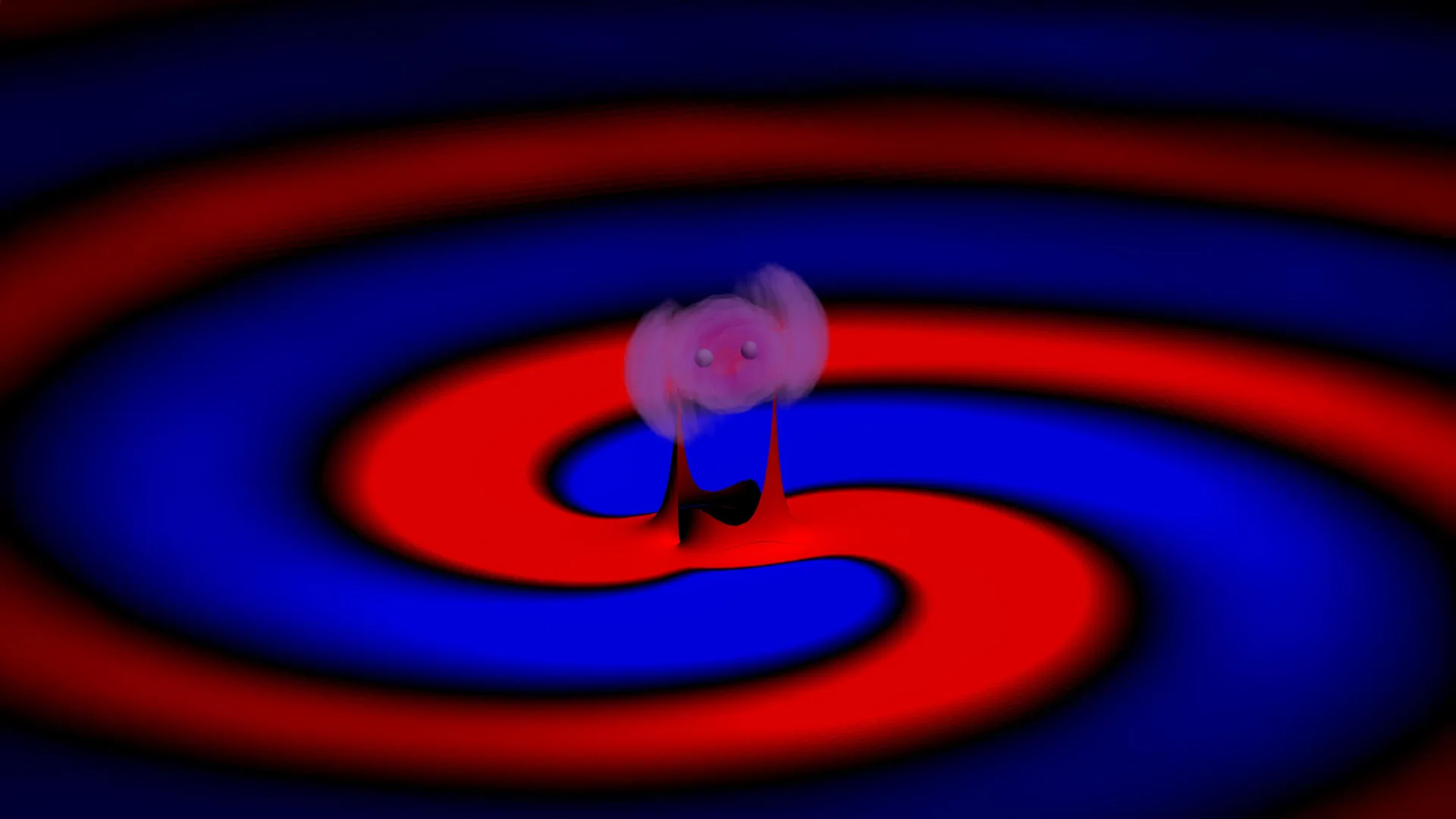
Astronomers have spent years listening to a faint, low-frequency rumble in the fabric of space, detected by watching pulsars — dead stars that flash with clockwork regularity — and measuring the tiny, correlated hiccups in when their pulses arrive. The standard explanation is that the hum comes from pairs of supermassive black holes at the centers of merging galaxies, slowly spiraling together. A new calculation says the signal may also be carrying a message from 13 billion years ago.
Sohan Ghodla and Cosmin Ilie of Colgate University asked what would happen to that background if some of today's supermassive black holes descended not from ordinary collapsed stars but from Dark Stars — a hypothetical class of enormous early objects powered by dark matter annihilation rather than nuclear fusion. Their results were published in Physical Review D.
Dark Stars were proposed to explain an awkward observation: black holes weighing hundreds of millions of suns already existed when the universe was only a few hundred million years old, which is not enough time to grow one from a normal stellar corpse by ordinary accretion. A Dark Star sidesteps the problem by starting enormous. If such objects existed at cosmic dawn and collapsed, they would seed heavy black holes immediately, and those seeds would eventually find each other as their host galaxies merged.
The Colgate calculation follows that lineage forward to the present and asks how loud the resulting gravitational-wave background would be. The answer is that it can be loud enough to matter. If supermassive Dark Star remnants existed at a number density of roughly 10⁻³ per cubic megaparsec — about one per thousand cubic megaparsecs, an enormous but not absurd volume of space — their descendants could supply a dominant share of the signal pulsar timing arrays are already measuring.
"Pulsar timing arrays are usually thought of as probes of supermassive black-hole binaries in the relatively recent universe," the authors note. "What our work shows is that the signal may also contain information about how the ancestors of those black holes formed at cosmic dawn."
That reframes what the experiments are for. Searches for Dark Stars have concentrated on trying to see one directly, which means catching a specific spectral signature in the earliest galaxies with an instrument like the James Webb Space Telescope — a difficult and so far inconclusive hunt. "Dark Stars were originally proposed as objects that might be seen directly at cosmic dawn," the researchers write. "This work points to a completely different way of testing their possible role in cosmic history."
The test is indirect but tractable. Different seed populations produce backgrounds with different shapes across frequency, and pulsar timing arrays keep improving their sensitivity as they accumulate more years of data on more pulsars. If the hum's spectrum eventually refuses to match what ordinary galaxy mergers predict, the mismatch itself becomes evidence about what the universe's first heavy objects were made of.