A Blurry Blob in Aquila Is Flinging Protons Past a Quadrillion Electron Volts
Astronomers have confirmed LHAASO J1912+1014u as a proton PeVatron, the kind of natural accelerator that has been hunted for decades as the source of the galaxy's highest-energy cosmic rays.
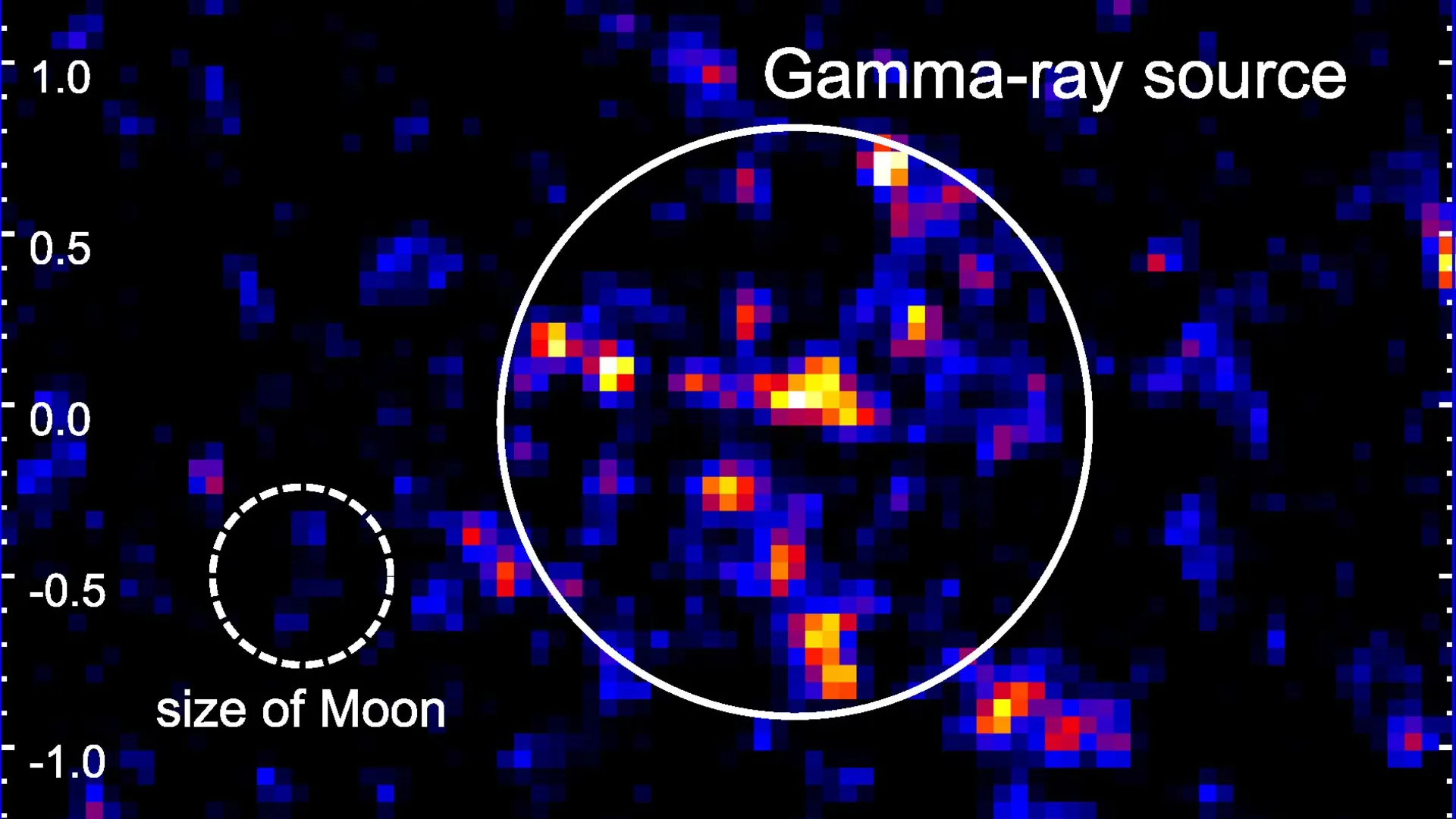
Somewhere in the constellation Aquila, near the bright star Altair, something is accelerating protons to more than a quadrillion electron volts — energies about a hundred times higher than the Large Hadron Collider achieves in a 17-mile ring of superconducting magnets. An international team led by Hiroshima University has now identified the source, and it belongs to a class of object astrophysicists have spent decades trying to find.
The object is catalogued as LHAASO J1912+1014u. It was discovered in 2024 and initially filed away as a supernova remnant. The new analysis, published in The Astrophysical Journal, reclassifies it as a proton PeVatron: a cosmic accelerator capable of pushing protons past the PeV threshold, 10^15 electron volts.
"Finding a cosmic-ray proton accelerator above that PeV level, called a proton PeVatron, is one of the most exciting topics in modern astrophysics," said lead author Tsunefumi Mizuno, an associate professor at the Hiroshima Astrophysical Science Center. The interest is not academic bookkeeping. Cosmic rays arriving at Earth carry energies extending well into the PeV range, but they are electrically charged, so galactic magnetic fields scramble their paths and erase any memory of where they came from. Identifying the machines that make them requires catching a neutral messenger instead.
That messenger is gamma radiation. When accelerated protons collide with ambient gas, they produce neutral pions that decay into gamma rays, and gamma rays travel in straight lines. The team assembled a spectrum for this source spanning an extraordinary range — from above 100 trillion electron volts down to 400 million electron volts — using the Fermi Large Area Telescope, the Chandra X-ray Observatory, the FUGIN radio survey in Japan, the Tibet AS gamma experiment and the LHAASO array in China. The lower-energy Fermi data matter most for the identification, because the characteristic shape of the pion-decay spectrum at those energies distinguishes protons from fast electrons, which can mimic the high-energy signal by other means.
The source is large and diffuse, spanning more than a degree on the sky — roughly twice the width of the full moon. That extension is itself a clue. A compact point source suggests a single engine still actively accelerating particles; a sprawling one suggests protons that escaped their birthplace some time ago and are now illuminating whatever gas clouds they run into. Radio observations of the surrounding molecular gas help pin down where those collisions are occurring.
Only a handful of PeVatron candidates have been established, and most rest on high-energy gamma-ray data alone, leaving the proton-versus-electron ambiguity unresolved. Building the case down to 400 million electron volts is what makes this identification unusually solid, and it gives the field something it has been short of: a confirmed address for the particles that arrive at Earth carrying more energy than any human machine can impart.
Originally reported by ScienceDaily.