Scientists Solve Mystery of Ultra-High Energy Cosmic Rays With Ultraheavy Particle Theory
New research suggests the mysterious Amaterasu particle and similar cosmic rays may be atomic nuclei heavier than iron that retain energy across vast distances.

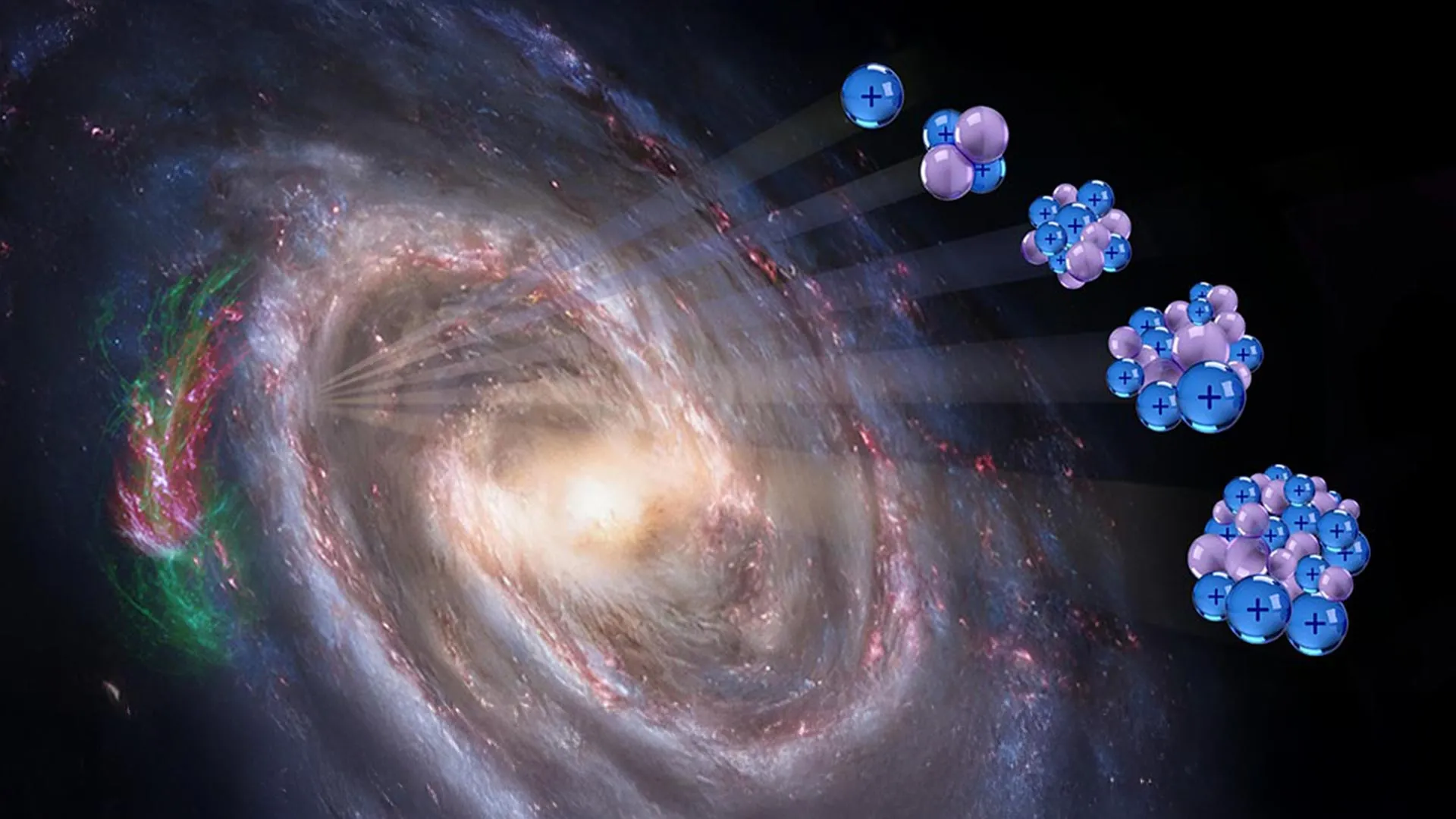
The mysterious Amaterasu particle, one of the most energetic cosmic rays ever detected, may not be a proton as previously assumed, according to groundbreaking new research led by Penn State scientists. The study suggests that some of the most extreme cosmic rays could be ultraheavy atomic nuclei that are better able to retain their enormous energies while traveling through intergalactic space.
The Amaterasu particle, detected by the Telescope Array in Utah in 2021, carried approximately 240 exa-electron volts of energy—roughly equivalent to the kinetic energy of a fast-moving tennis ball concentrated in a single subatomic particle. This makes it about 10 million times more energetic than particles produced in the Large Hadron Collider and places it among the most powerful cosmic-ray events ever recorded.
According to the research published in Physical Review Letters, ultraheavy nuclei—atomic centers containing protons and neutrons that are heavier than iron—may lose energy more slowly than lighter particles during their journey across cosmic distances. This finding could help explain how these rare particles maintain their extreme energies long enough to reach Earth from their distant cosmic origins.
"Ultrahigh-energy cosmic rays can only be accelerated by some of the most powerful sources in the universe," said Kohta Murase, professor of physics and astronomy at Penn State and leader of the research team. "When we detect individual cosmic-ray particles such as the Amaterasu particle here on Earth, we can often use their energies, arrival directions and expected magnetic deflections to infer their possible cosmic sources."
The Amaterasu particle has proven particularly puzzling because its estimated arrival direction traces back to a cosmic void—a region of space with no obvious source capable of producing such high-energy particles. The new ultraheavy nucleus theory could provide crucial insights into both the nature of these mysterious particles and the extreme cosmic phenomena that create them, potentially revolutionizing our understanding of the universe's most powerful energy sources.