Scientists Think They Solved the Mystery of the Amaterasu Particle
New research suggests the most extreme cosmic rays could be ultraheavy atomic nuclei from distant explosions, not protons as previously thought.

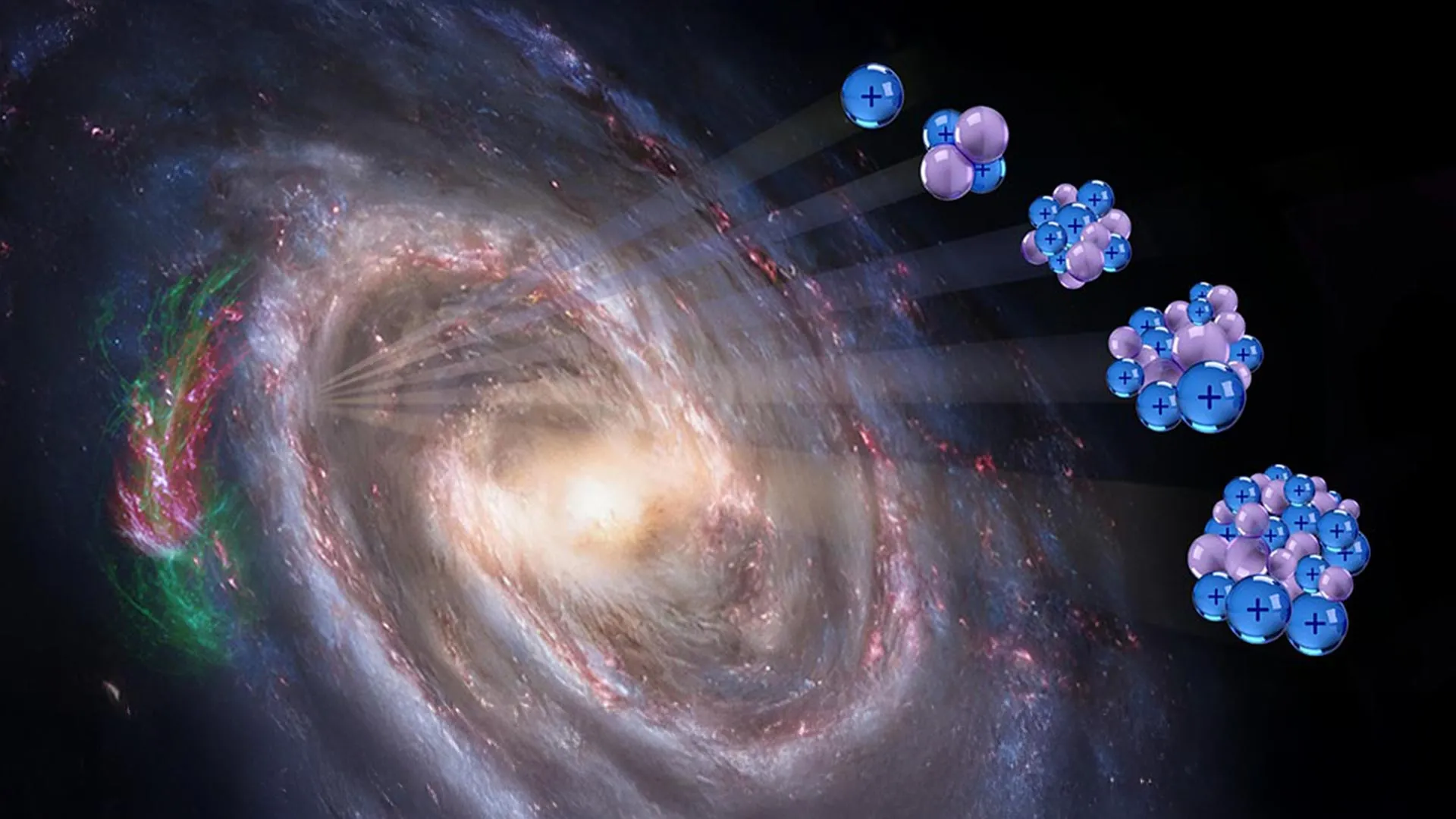
The mysterious Amaterasu particle, one of the most energetic cosmic rays ever detected, may not be a proton at all, according to groundbreaking new research published in Physical Review Letters. Scientists at Penn State University, working with collaborators from the Yukawa Institute for Theoretical Physics in Japan, Virginia Tech, and other institutions, propose that some of the most extreme cosmic rays could be ultraheavy atomic nuclei heavier than iron. This discovery could revolutionize our understanding of how these rare, incredibly energetic particles reach Earth from the depths of space.
The Amaterasu particle was detected by the Telescope Array in Utah in 2021 and named after the sun goddess in Japanese mythology. With an energy of approximately 240 exa-electron volts, it ranks among the most powerful cosmic-ray events ever observed, placing it in the same extraordinary category as the famous "Oh-My-God particle" recorded in 1991. These ultrahigh-energy cosmic rays carry roughly the kinetic energy of a fast-moving tennis ball compressed into a single subatomic particle, making them about 10 million times more energetic than particles accelerated in the Large Hadron Collider.
According to the team's calculations, ultraheavy atomic nuclei may lose energy more slowly than protons or lighter nuclei while crossing intergalactic space, allowing them to survive the journey to Earth while retaining extreme amounts of energy. Professor Kohta Murase from Penn State's Eberly College of Science explained that ultrahigh-energy cosmic rays can only be accelerated by some of the most powerful sources in the universe. The research suggests these particles interact with naturally occurring energy waves in materials, creating resonance effects that help preserve their incredible energies during transit.
The Amaterasu particle has been particularly puzzling because its estimated arrival direction traces back to a cosmic void, a region of space with no clear source capable of producing ultrahigh-energy cosmic rays. This mystery has challenged scientists for years, as conventional models struggle to explain how such energetic particles could originate from apparently empty regions of space. The new ultraheavy nucleus theory could help resolve this paradox by suggesting that these particles can travel much farther from their sources than previously thought possible.
The findings may help scientists identify the types of cosmic objects powerful enough to launch such particles and provide new insights into some of the universe's most extreme phenomena. Understanding the origins and acceleration mechanisms of ultrahigh-energy cosmic rays has been one of the biggest mysteries in astrophysics for more than 60 years. This research opens new avenues for investigating cosmic accelerators and could lead to discoveries about the most violent events in the universe, from supermassive black holes to colliding galaxies and other exotic cosmic phenomena.