Scientists Crack 100-Year Mystery Behind Cosmic Ray Behavior
DAMPE space telescope reveals universal pattern governing mysterious high-energy particles from across the galaxy.
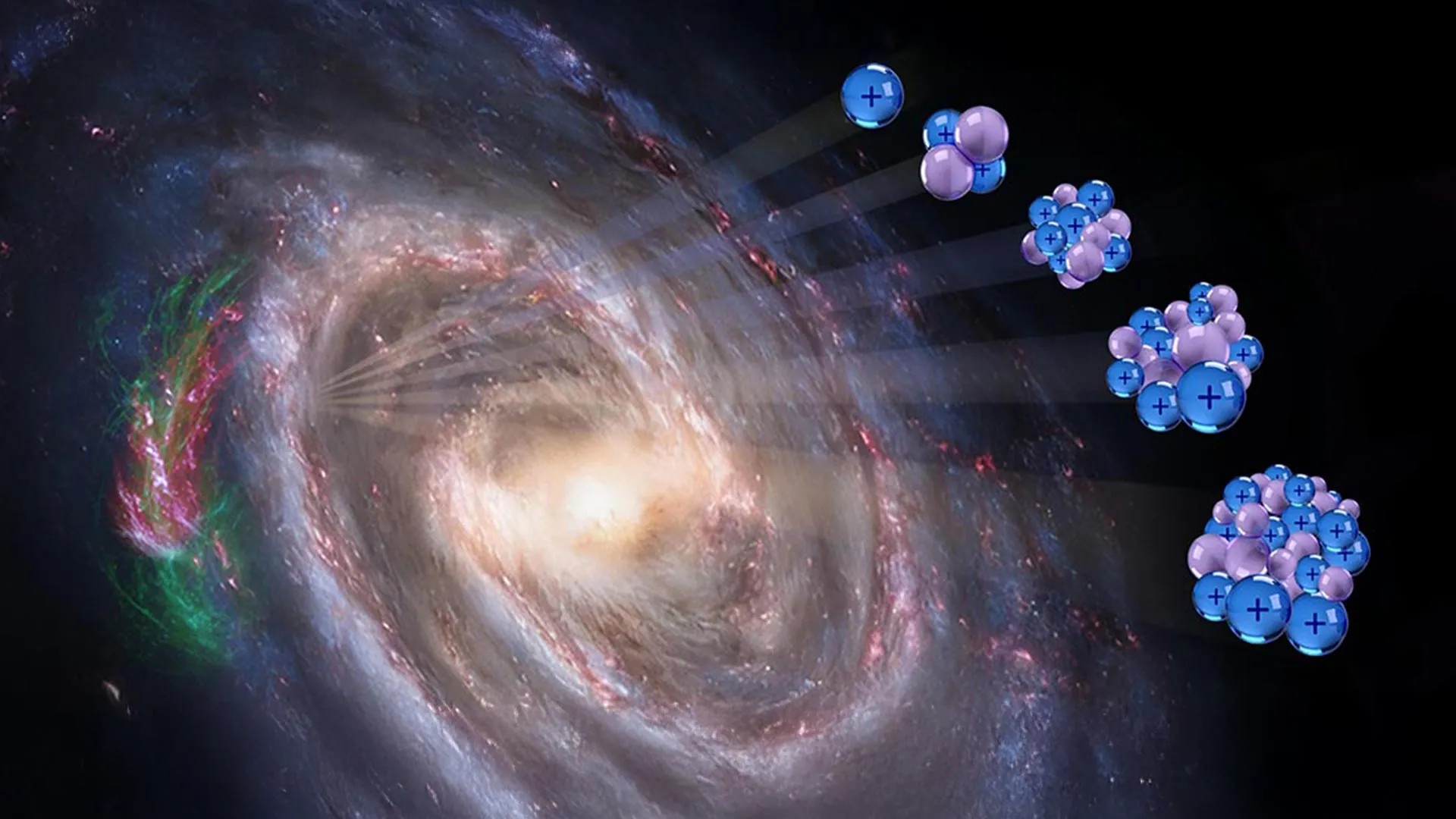
After more than a century of scientific investigation, researchers have finally uncovered a fundamental rule governing cosmic rays, the mysterious ultra-high-energy particles that bombard Earth from deep space. Using data from the DAMPE space telescope, scientists discovered that cosmic ray particles ranging from simple protons to heavy iron nuclei all exhibit the same dramatic behavioral change at a specific energy threshold, providing the first universal pattern observed in these enigmatic cosmic messengers.
Cosmic rays represent some of the highest energy particles ever detected in nature, carrying far more energy than anything produced by Earth's most powerful particle accelerators. Scientists believe these particles originate from the universe's most violent events, including supernova explosions, black hole jets, and rapidly spinning neutron stars called pulsars. Despite decades of study, the exact mechanisms behind their acceleration and the sources of the highest energy cosmic rays have remained largely mysterious.
The breakthrough came from analyzing highly precise measurements collected by the Dark Matter Particle Explorer, launched in December 2015 with significant contributions from the University of Geneva's astrophysics group. Researchers discovered that for every type of cosmic ray nucleus studied, the number of particles begins declining much more rapidly after reaching a rigidity of approximately 15 teraelectron volts. This phenomenon, known as "spectral softening," appears consistently across all particle types from lightweight protons to heavy iron nuclei.
"Cosmic rays are primarily composed of protons, but also of helium, carbon, oxygen, and iron nuclei," explains University of Geneva associate professor Andrii Tykhonov, a co-author of the study published in Nature. "These particles are also categorised according to their energy: low, up to a few billion electron-volts; intermediate, from a few billion to several hundred billion electron-volts; and high, from 1,000 billion electron-volts and beyond." The universal nature of this spectral softening strongly supports theories that cosmic ray behavior is governed by rigidity rather than energy per nucleon.
The discovery has major implications for understanding how cosmic rays propagate through the galaxy and interact with magnetic fields during their journey to Earth. The research team's findings rule out alternative explanations based on energy per nucleon with a confidence level reaching 99.999 percent, providing scientists with their strongest evidence yet for the physical processes that control these cosmic particles as they travel across vast distances through interstellar space.