After 100 Years, Scientists Finally Uncover Hidden Rule Behind Cosmic Rays
DAMPE space telescope reveals universal pattern governing mysterious ultra-powerful particles traveling across the galaxy.
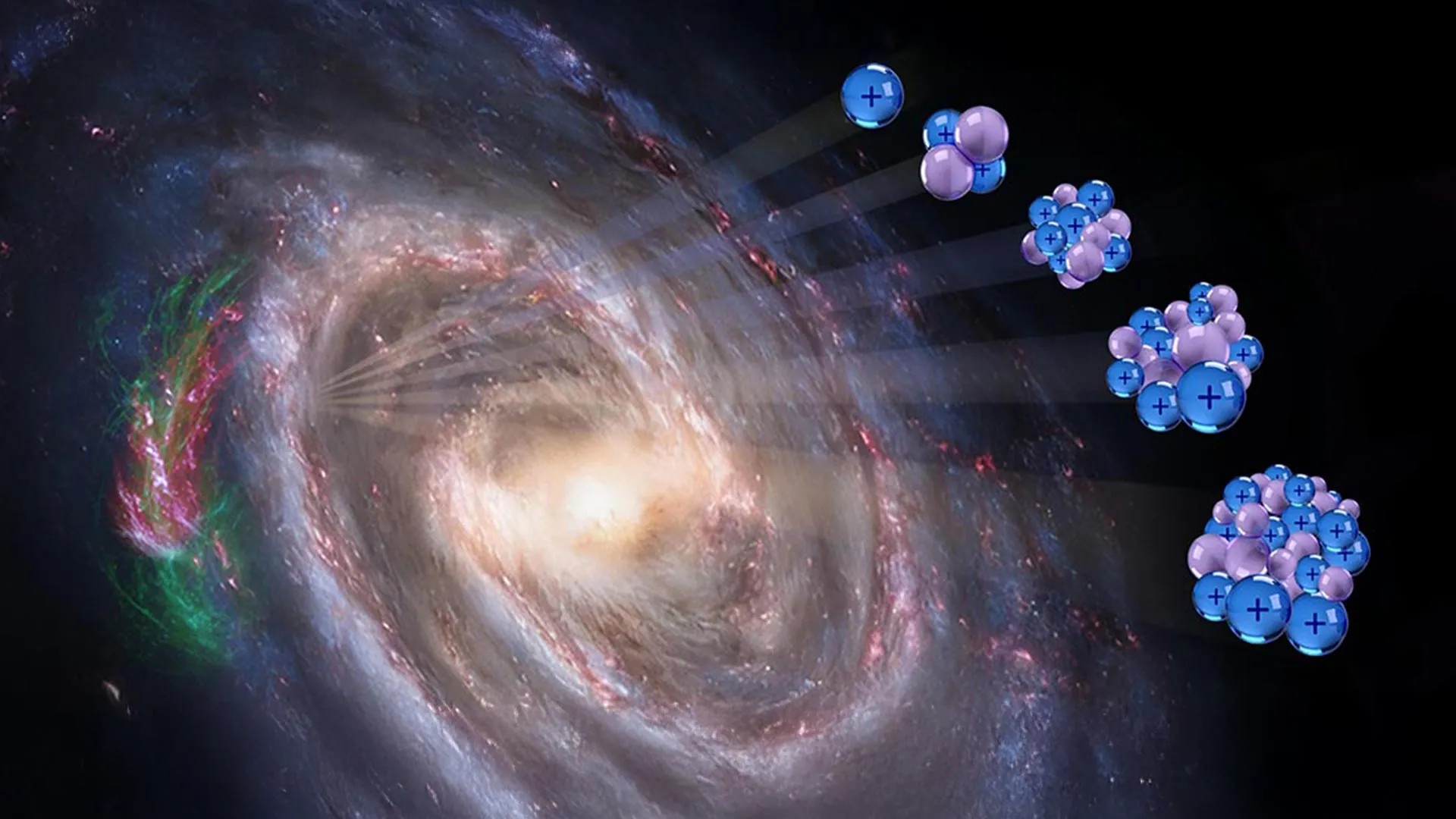
Scientists studying mysterious ultra-powerful cosmic rays have uncovered a surprising hidden pattern that could finally help explain where these particles come from. Using the DAMPE space telescope, researchers found that cosmic ray particles—from tiny protons to heavy iron nuclei—all begin fading away more sharply at the exact same point, hinting at a universal rule governing their behavior across the galaxy.
For more than 100 years, scientists have been trying to understand cosmic rays, incredibly powerful particles that travel across the universe at extreme energies. Despite decades of research, many questions about where they come from and how they are accelerated remain unanswered. These particles carry far more energy than those produced by even the most advanced accelerators on Earth, leading scientists to believe they are created by some of the universe's most violent events, including supernova explosions, jets from black holes, and pulsars.
Launched in December 2015, the DAMPE (Dark Matter Particle Explorer) space telescope was designed to investigate the nature of cosmic rays and explore possible connections to dark matter. The mission includes major contributions from the astrophysics group at the University of Geneva. By examining highly precise data collected by DAMPE, researchers discovered a universal pattern in the energy spectra of primary cosmic ray nuclei, ranging from lightweight protons to much heavier iron nuclei.
The research showed that for every type of nucleus studied, the number of particles begins dropping much faster after reaching a certain threshold. Scientists refer to this effect as "spectral softening." The DAMPE observations revealed that the decline becomes dramatically steeper beyond a rigidity of roughly 15 TV (teraelectron-volts). Rigidity describes how strongly a particle's path resists being bent by magnetic fields.
Because this same feature appears across many different types of particles, the findings strongly support theories suggesting that cosmic ray acceleration and movement through space are controlled by rigidity. The data largely rules out competing explanations based on energy per nucleon, with the confidence level against those alternative models reaching 99.999%. The discovery represents a major breakthrough in understanding these cosmic messengers that have puzzled scientists for over a century.