Scientists Discover Ultraheavy Cosmic Ray Particles May Solve Amaterasu Particle Mystery
New research suggests the most powerful cosmic rays could be atomic nuclei heavier than iron, potentially explaining how these extreme particles reach Earth with unprecedented energies.

Scientists may have solved one of astrophysics' most perplexing mysteries by identifying what could be responsible for the most energetic particles ever detected reaching Earth from deep space. New research led by Penn State University suggests that ultrahigh-energy cosmic rays, including the enigmatic "Amaterasu particle" detected in 2021, may actually be ultraheavy atomic nuclei rather than protons, providing a potential explanation for how these extraordinary particles maintain their extreme energies during intergalactic journeys. The findings, published in Physical Review Letters, could reshape understanding of the most powerful phenomena in the universe.
The Amaterasu particle, named after the Japanese sun goddess and detected by the Telescope Array in Utah, ranks among the most powerful cosmic-ray events ever observed alongside the famous "Oh-My-God particle" from 1991. With an estimated energy of about 240 exa-electron volts, the single particle carried roughly the kinetic energy of a fast-moving tennis ball, making it about 10 million times more energetic than particles produced by the Large Hadron Collider. Yet despite its incredible power, scientists have struggled to identify its source, as its estimated arrival direction traces back to a cosmic void with no obvious energy source.
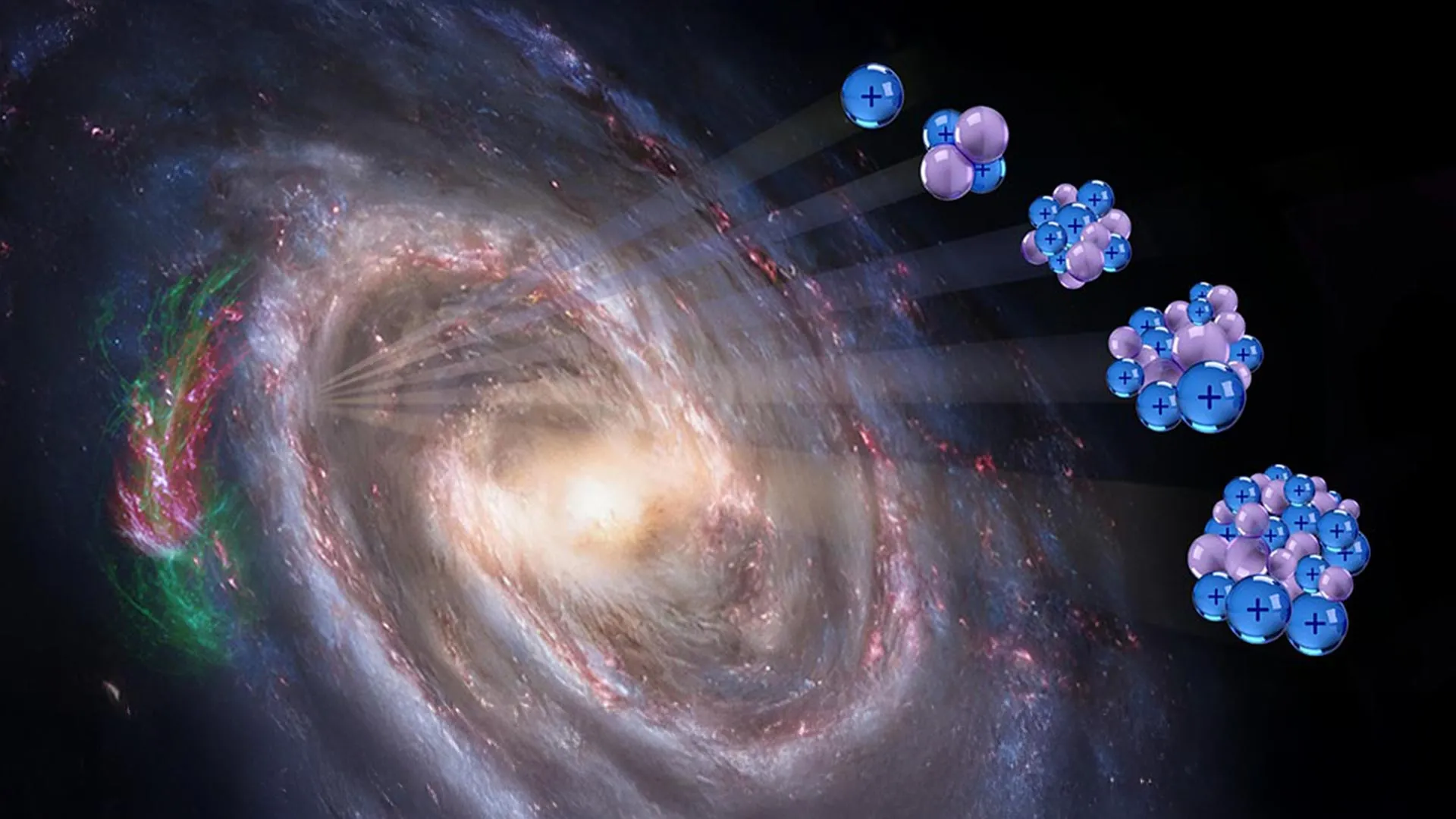
"Ultrahigh-energy cosmic rays can only be accelerated by some of the most powerful sources in the universe," explains Kohta Murase, Penn State professor of physics and astronomy who led the research team. "When we detect individual cosmic-ray particles such as the Amaterasu particle here on Earth, we can often use their energies, arrival directions and expected magnetic deflections to infer their possible cosmic sources." The new research suggests these particles may be atomic nuclei heavier than iron, which could lose energy more slowly than protons while crossing intergalactic space.
The team's calculations, conducted with collaborators at institutions including the Yukawa Institute for Theoretical Physics in Japan and Virginia Tech, indicate that ultraheavy nuclei might survive the journey to Earth while retaining extreme amounts of energy. This discovery could explain the long-standing puzzle of how particles maintain such extraordinary energies over cosmic distances. Traditional models assuming these cosmic rays are primarily protons have struggled to account for both their extreme energies and their apparent origins from regions of space lacking obvious accelerating mechanisms.
The implications extend beyond solving individual cosmic ray mysteries to potentially identifying new types of cosmic accelerators capable of launching such particles. "The origins and acceleration mechanisms of ultrahigh-energy cosmic rays have been among the biggest mysteries in the field for more than 60 years, since the first example was reported," Murase noted. Understanding whether these particles are ultraheavy nuclei could help scientists identify previously unknown classes of cosmic phenomena and provide new insights into the most energetic processes occurring throughout the universe.