Campaigns Are Texting Voters With AI Chatbots This Midterm, and Few States Require Disclosure
Firms say AI agents can hold thousands of conversations a day, and research suggests they can sway opinions, but accuracy and privacy rules lag behind.
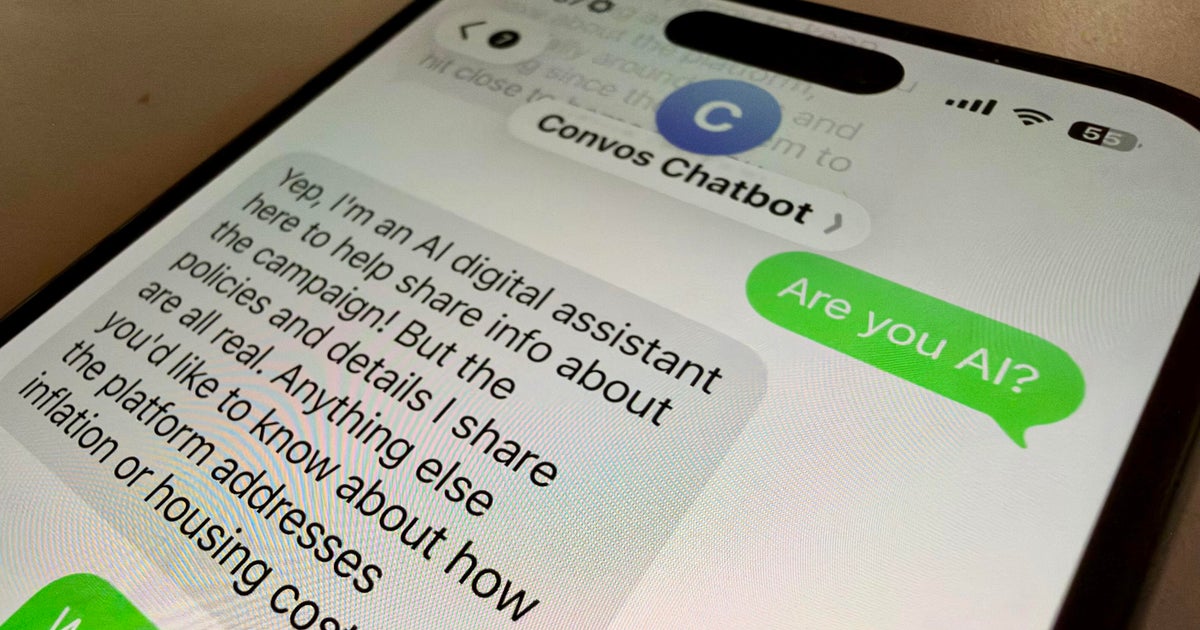
A growing number of campaigns are using AI chatbots to text voters in the final stretch before the midterm elections, a new kind of canvassing that lets a campaign talk with far more people than its staff and volunteers could reach on foot. In most states, nothing requires the campaign to tell voters they are texting with a machine.
Ace Parsi describes himself as "personally pretty against AI." The Democrat is running an uphill race against Republican Rep. Riley Moore in West Virginia and has drafted a legislative proposal to block new data centers that lack buy-in from constituents. But after what he called probably the most complicated decision of his campaign, Parsi and his team are using AI chatbots to text voters. "We center so much of our conversation on making sure that people feel seen and listened to, and so we thought, 'OK, well, this is another tool to be able to do that,'" he told CBS News.
The agents run on large language models, the same kind of technology behind Claude, Gemini or ChatGPT. They are loaded with campaign-approved material and told how to engage voters. They can hold thousands of conversations in a single day, record what voters care about and, in some cases, try to change their minds.
Marty Santalucia, a partner at the Democratic firm Vector Political, trains AI agents to work for campaigns and analyzes what they collect. He said the firm has sent more than 3 million text messages this cycle, leading to more than 35,000 individual conversations with voters. "What we found really incredibly is that people engage," he said. His firm has trained its AI to "deep canvass," a technique built on long, empathetic listening, and it can also be set to persuade.
Tom Carroll, founder of Convos.ai, said campaigns supply the material the agent draws on, such as their websites, speeches and press releases, rather than letting it roam the open web. "Then our agent will only ever discuss that information," he said. That is meant to reduce the chance a conversation goes off the rails.
Early research suggests the approach works. One recent study in the journal Nature found that short conversations with AI chatbots in controlled experiments shifted voters' views more than political ads typically do. But another study, published in the journal Science, found that the harder chatbots push, the less accurate their claims become. Campaigns can also receive full transcripts of voters' conversations, which raises new privacy questions.
Katie Harbath, CEO of the technology-focused political consulting firm Anchor Change, who previously worked in Republican politics and at Facebook, said campaigns remain "still very much in the experimental stage" with the technology. The technology, in other words, is moving faster than the rules around it. With Election Day days away, voters may be answering a text from a campaign and never know whether a person or a program is on the other end.