Scientists Measure Black Hole Jets for the First Time — They Pack Power of 10,000 Suns
Using a planet-spanning network of radio telescopes to track how stellar winds bent the jets of Cygnus X-1, researchers calculated that roughly 10% of all infalling energy escapes as jets traveling at half light speed — confirming a key assumption of astrophysics.

For the first time in the history of astronomy, scientists have directly measured the instantaneous power of jets blasting out from a black hole — and the results are staggering. The jets from Cygnus X-1, the first confirmed black hole ever identified, carry energy equivalent to the output of 10,000 suns, travel at half the speed of light, and funnel roughly 10 percent of all the energy released as matter falls into the black hole. The findings, published April 16 in the journal Nature Astronomy, resolve a long-standing uncertainty at the heart of astrophysics and lay the groundwork for understanding how black holes help shape entire galaxies.
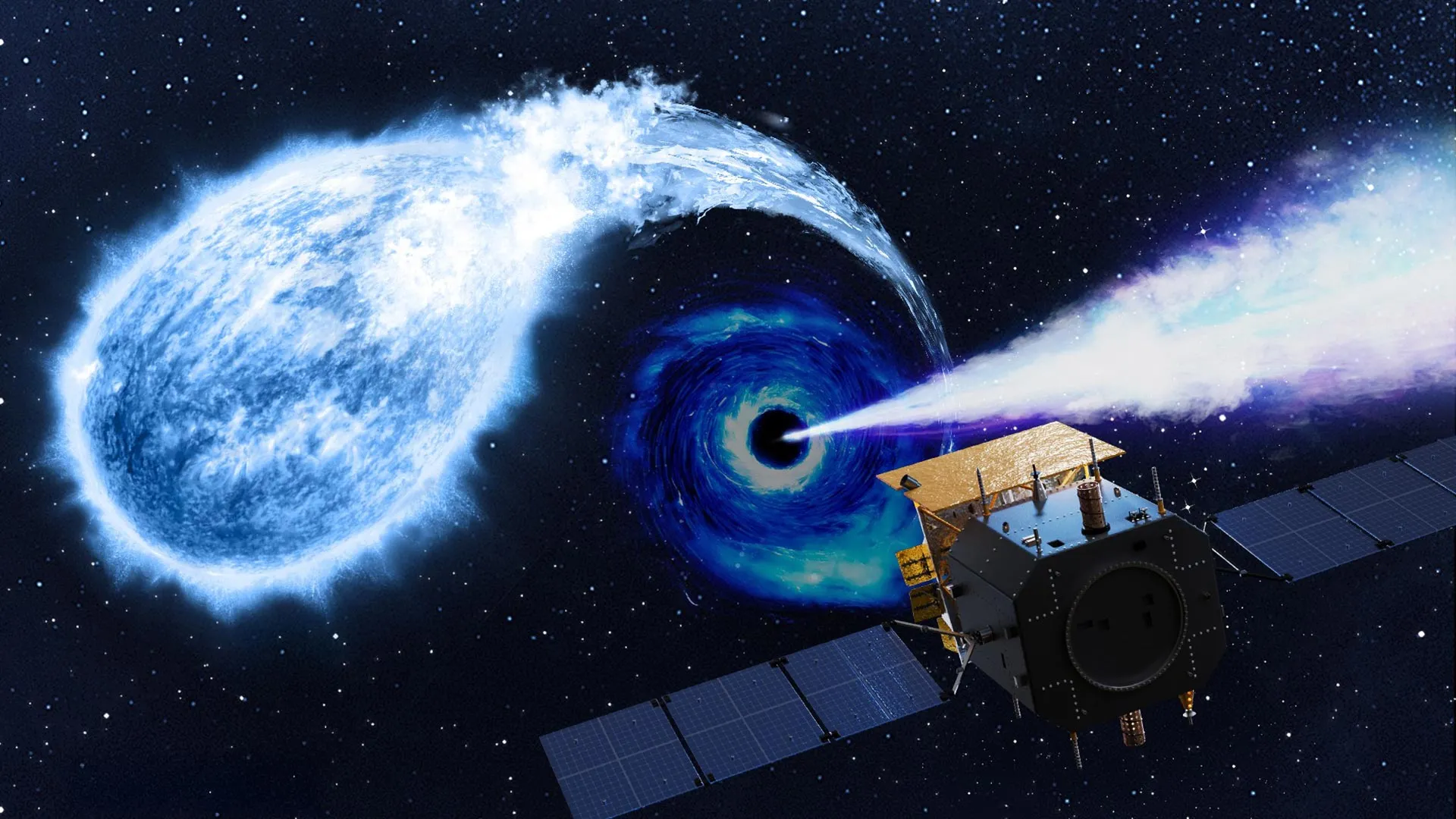
The research was led by Dr. Steve Prabu at Curtin University's Institute of Radio Astronomy in Perth, Australia, working with collaborators at Oxford University, the International Centre for Radio Astronomy Research, and institutions across Europe and North America. The team used a planet-spanning network of linked radio telescopes — instruments separated by thousands of kilometers whose signals are combined to achieve extraordinary angular resolution — to observe Cygnus X-1 with unprecedented precision. Cygnus X-1 is a binary system: the black hole orbits a blue supergiant companion star approximately 25 times the mass of the sun, and as they orbit each other, the companion star constantly streams stellar wind past the black hole.
That stellar wind turned out to be the key to the measurement. Black hole jets are notoriously difficult to characterize because their power cannot be inferred directly from their brightness alone — you need an independent check. Prabu's team realized that as the jets shot outward at half light speed, the powerful stellar wind from the companion star would deflect them, causing the jets to visibly "dance" in the radio images. By calculating how much force would be needed to bend the jets by the observed amount — using the known properties of the stellar wind — the researchers could work backward to determine the jets' power. The technique is analogous to measuring the force of a river by watching how it bends a reed.
The result — that roughly 10 percent of the infalling energy goes into the jets — confirms what theorists had long assumed but never been able to verify. This fraction, known as the jet efficiency, is a fundamental parameter in models of how black holes interact with their surroundings. When supermassive black holes at the centers of galaxies launch jets, those jets can pump enormous amounts of energy into the surrounding gas, suppressing star formation and shaping the galaxy's evolution over billions of years. Knowing that 10 percent efficiency is real rather than theoretical allows astronomers to calibrate those galaxy-scale models with far greater confidence.
Cygnus X-1, located about 7,200 light-years from Earth in the constellation Cygnus, was discovered in 1964 and confirmed as a black hole in the early 1970s. It has been one of the most intensively studied objects in the sky for more than half a century, yet this basic property of its jets had never been directly measured. The success of the radio telescope network technique also demonstrates a method that researchers hope to apply to other black hole systems, including some of the more distant and energetic objects being targeted by the Square Kilometre Array Observatory (SKAO), the massive international radio telescope project currently under construction in South Africa and Australia. When SKAO comes fully online in the late 2020s, it will have the sensitivity to apply the same technique to far more distant black holes, opening a new era in measuring the mechanical power of the universe's most extreme objects.