Radio Telescope Image Reveals 63,000 Sources, Sharpest Low-Frequency View of the Sky Ever
A Leiden-led team used LOFAR to image one patch of sky 20 times more sharply than before, and processed 400 terabytes of data in just a few months.
Topic
10 stories from Planck Standard. Latest: November 10, 2026.

A Leiden-led team used LOFAR to image one patch of sky 20 times more sharply than before, and processed 400 terabytes of data in just a few months.

A paper led by Andrea Botteon of Italy's INAF finds the clef-shaped radio structure sits inside two merging galaxy clusters hidden behind the Milky Way's plane.

For the first time the radio telescope detected the cosmic hydrogen signal using only its own data. That opens a cheaper, faster route to testing what dark energy really is.

South Africa's MeerKAT telescope traced repeating radio bursts to the giant planet Beta Pictoris b, 64 light-years away. The signal shows its magnetic field is at least 1,250 gauss, far stronger than Jupiter's.

Tidal disruption events compress a supermassive black hole's feeding cycle from millennia into years. A Curtin-IAS team found the delayed radio jets, arriving hundreds to thousands of days after a star is torn apart, switch on at the same threshold known from X-ray binaries in our galaxy. 'The physics does not seem to care how big they are.'

VT J1906+0849 is the brightest transient in the entire VLA Sky Survey. Its brightness temperature is up to 10 billion kelvin, gas near it moves at thousands of kilometers per second, and it flared again in late 2025. Nothing in the catalog of known galactic sources fits.

PSR J1637-4642 was quiet through ten years of monitoring at Australia's Murriyang telescope. Fifteen and a half years of data now show three sudden spin-ups, and the biggest of them jumped the star's rotation by 2.7 parts per million.

A Manchester researcher dug into archived ALMA data and searched millimeter frequencies almost nobody has checked for alien signals. No technosignatures — but far more stars surveyed than anyone counted.

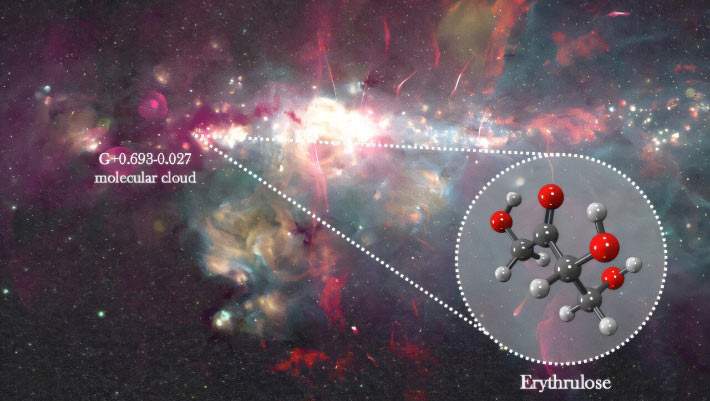
Erythrulose, a four-carbon sugar found in raspberries, was spotted in a cloud near the galaxy's center — and may have rained down on the early Earth by the millions of tons.

Astronomers using LOFAR and India's uGMRT radio telescopes documented the dramatic reawakening of a dormant black hole in galaxy J1007+3540, with new plasma jets stretching nearly one million light-years.