A Pulsar Sat Silent for a Decade. Then It Glitched Three Times in Six Years
PSR J1637-4642 was quiet through ten years of monitoring at Australia's Murriyang telescope. Fifteen and a half years of data now show three sudden spin-ups, and the biggest of them jumped the star's rotation by 2.7 parts per million.

A neutron star that astronomers had written down as unremarkable has turned out to be one of the more informative objects in the sky, and it took fifteen and a half years of patient monitoring to find out.
PSR J1637-4642 is a young pulsar — roughly 41,000 years old, which for a neutron star is close to newborn. A team led by Zhaoyi Wang of Xiamen University went through observations collected between February 2009 and October 2024 with Murriyang, the 64-metre radio telescope at Parkes in New South Wales. For the first decade of that record the pulsar did nothing interesting. It spun, it pulsed, its rotation slowed at the steady rate every young pulsar's does.
Then it glitched. A pulsar glitch is a sudden increase in spin rate, the opposite of what a star that is continuously losing rotational energy should do. The first and largest event, around 2018, raised the rotation frequency by about 17.54 microhertz — a fractional jump of 2.7 parts per million. Three years later a second, far smaller glitch shifted the frequency by roughly 14 nanohertz. Two years and eight months after that, a third glitch of intermediate size added about 179 nanohertz.
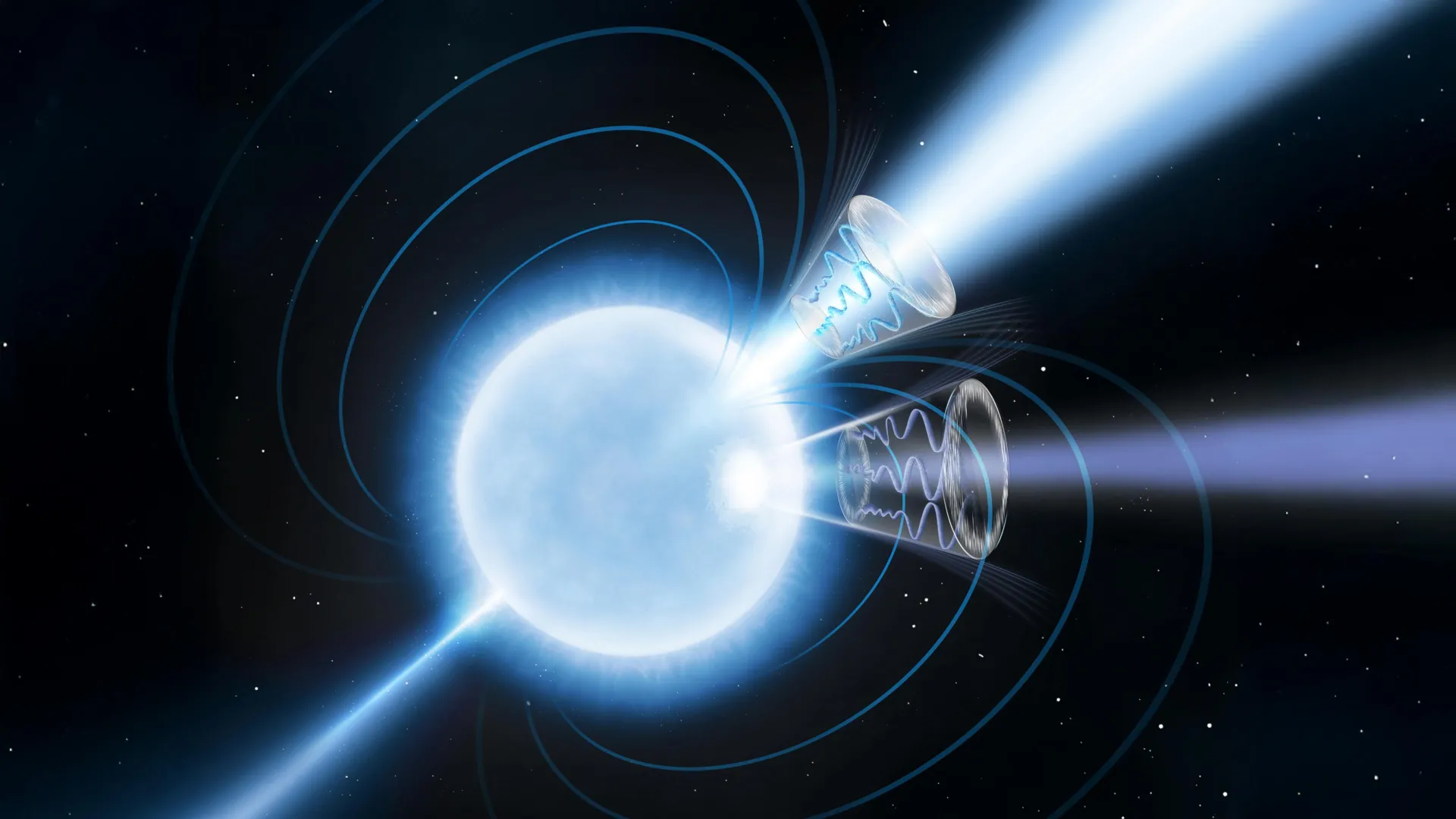
The standard explanation is that a neutron star is not one object but two coupled ones. The rigid outer crust slows down under magnetic braking, while a superfluid interior — a fluid with literally zero viscosity — keeps spinning at its old rate because it stores angular momentum in quantized vortices that get pinned to the crust's lattice. Stress builds. When enough vortices unpin at once, angular momentum dumps into the crust and the whole star's observed spin lurches upward.
That model makes measurable predictions about the aftermath, and this is where a three-glitch record earns its value. From the way the pulsar relaxed after each event, the team calculated that about 1.9% of the star's moment of inertia sits in superfluid in the inner crust, and that the coupling between that superfluid and the crust plays out over a relaxation timescale of roughly 102 days. Both numbers are constraints on the state of matter at densities no laboratory on Earth can reach.
The work has been accepted for publication in the Astrophysical Journal Letters, with a preprint posted to the arXiv on August 20, 2026.
The broader point is about survey design. PSR J1637-4642 joins a growing class of young pulsars that produce large glitches only after long stretches of silence — which means a decade of null results is not evidence that a pulsar is boring. It is just a decade of data you need before the interesting part starts.