To See Empty Space Bend Light You Need a Magnet 100 Million Times Stronger Than Any on Earth
Astronomers Found One.
A magnetar called 1E 1547.0-5408 produced X-rays polarized so strongly that researchers say it may be the first solid evidence of vacuum birefringence, an effect Heisenberg predicted almost 90 years ago.
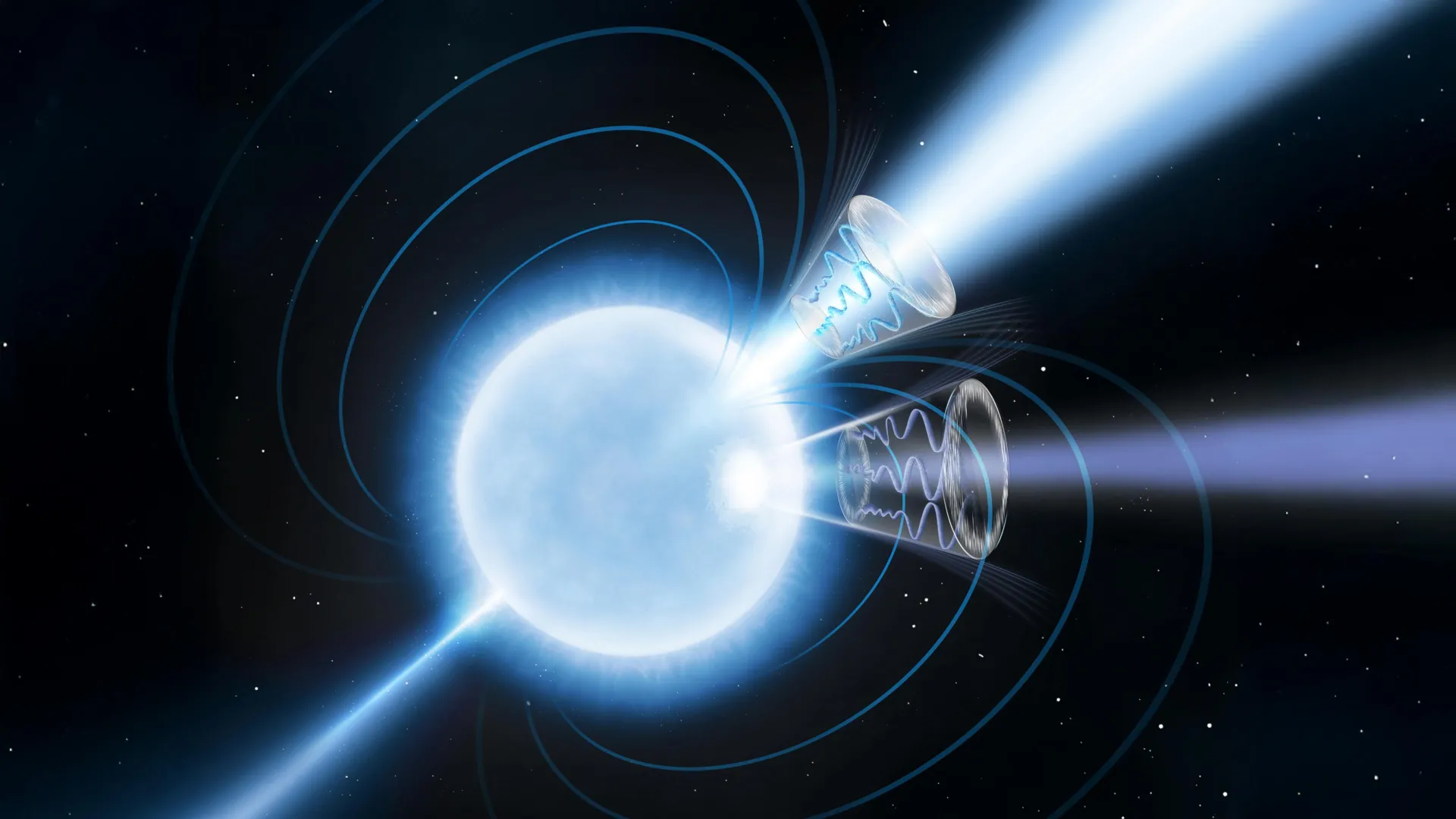
Quantum electrodynamics says the vacuum is not empty. Pairs of virtual particles flicker in and out of existence everywhere, all the time, and in a sufficiently strong magnetic field those particles should give the vacuum a structure, splitting light into two components that travel at slightly different speeds depending on how they are polarized. Werner Heisenberg and Hans Euler worked out the prediction in 1936. Nobody has ever built a magnet strong enough to test it.
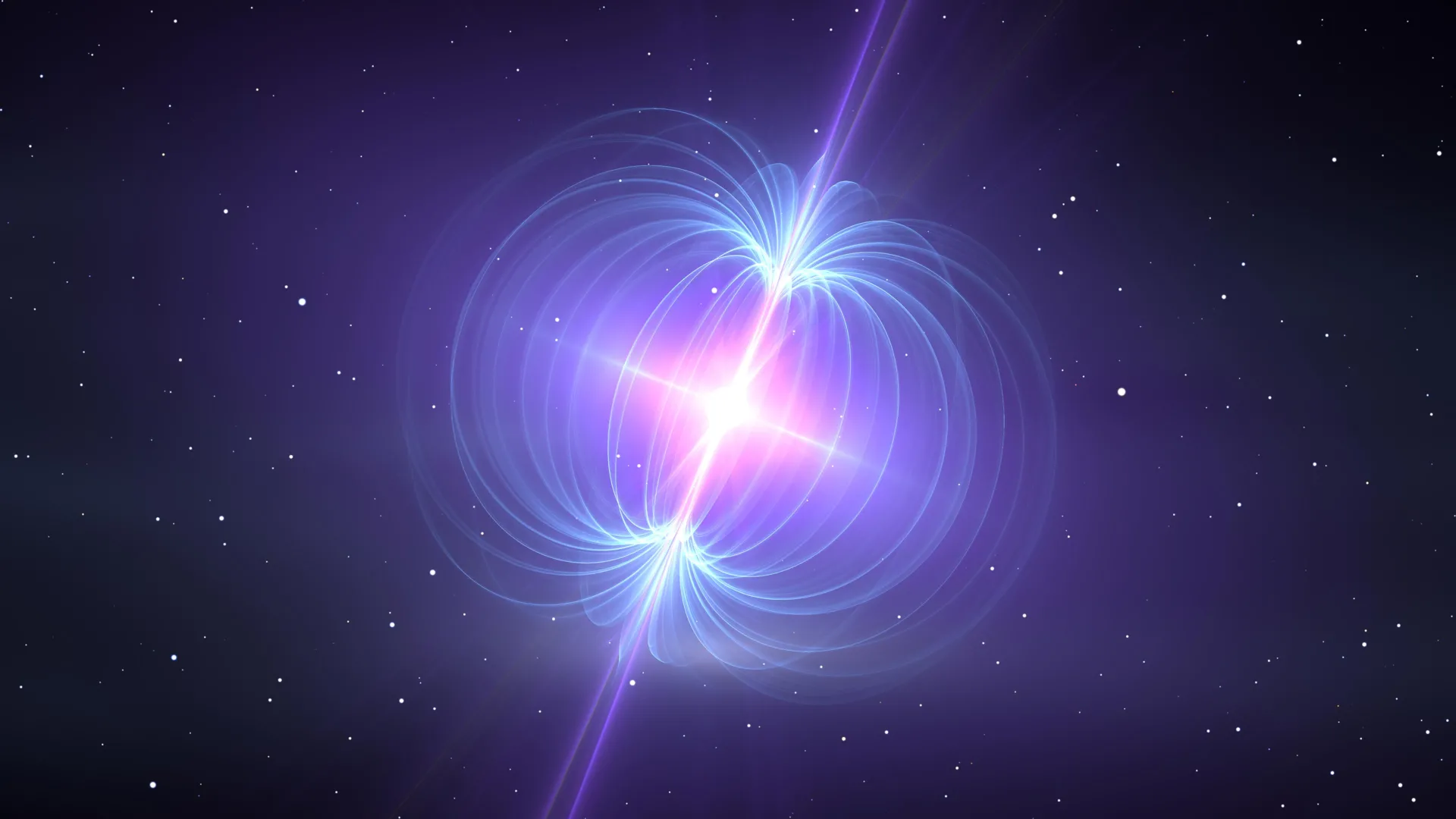
A team led by Rachael E. Stewart, a graduate student at George Washington University, has now reported what may be the clearest observational evidence yet, published in Nature. The magnet in question is a magnetar, a neutron star with a magnetic field so extreme that laboratory physics offers no comparison.
"Detecting vacuum birefringence requires a magnetic field that is over 100 million times stronger than any we've ever made" on Earth, said Dr. Marcus Lower, one of the researchers. The strongest sustained laboratory fields are measured in tens of teslas. Magnetar fields run to a hundred billion teslas or more.
The target was 1E 1547.0-5408, a magnetar that has flared repeatedly since its discovery. Getting a usable measurement required stitching together instruments that do very different jobs. NASA's Imaging X-ray Polarimetry Explorer, or IXPE, measured the polarization of the star's X-rays, which is the actual signature of the effect. NICER, the X-ray telescope mounted on the International Space Station, tracked the star's timing and spectrum. CSIRO's Murriyang radio telescope at Parkes in Australia pinned down the orientation and geometry of the magnetic field from the radio side, which is what makes the X-ray polarization interpretable rather than just a number. The modeling ran on Swinburne University's Ngarrgu Tindebeek supercomputer.
The result is that the X-rays emerge extremely highly polarized, and the polarization is aligned with the magnetic field in the way the quantum prediction requires. Light leaving the star's surface passes through a region where the field is strong enough to reorganize the vacuum itself, and the radiation carries that reorganization outward as an imprint.
The collaboration spans George Washington University, the Center for Space Sciences and Technology, the South African Radio Astronomy Observatory, Los Alamos National Laboratory, NASA's Marshall and Goddard space flight centers, and Swinburne University of Technology.
The caution worth stating is the one that applies to every astrophysical test of fundamental physics: the researchers did not control the experiment. They inferred an effect from a source whose surface emission and magnetic geometry both have to be modeled, and a different model of how the X-rays are produced could in principle reproduce the polarization without invoking the vacuum at all. What makes the result compelling is that the combination of radio geometry and X-ray polarization constrains those alternatives more tightly than any previous attempt.
If it holds, an 89-year-old prediction about the structure of nothing has finally been observed.