Record 10-Minute X-Ray Flash Points to Colliding Neutron Stars Giving Birth to a Magnetar
The Einstein Probe saw bright X-rays for about ten minutes after a half-second gamma-ray burst from over 6 billion years away, with no supernova to explain it.
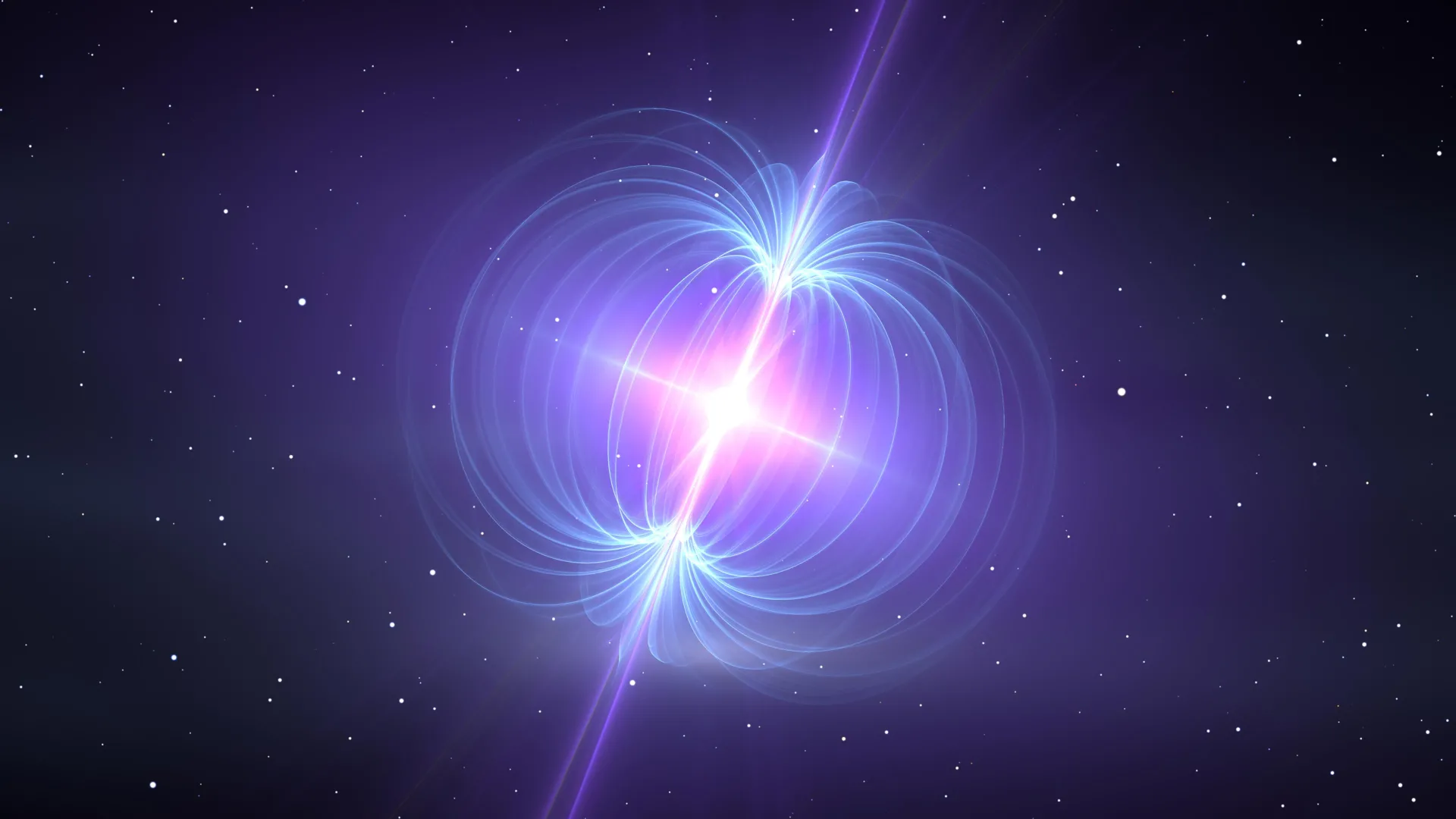
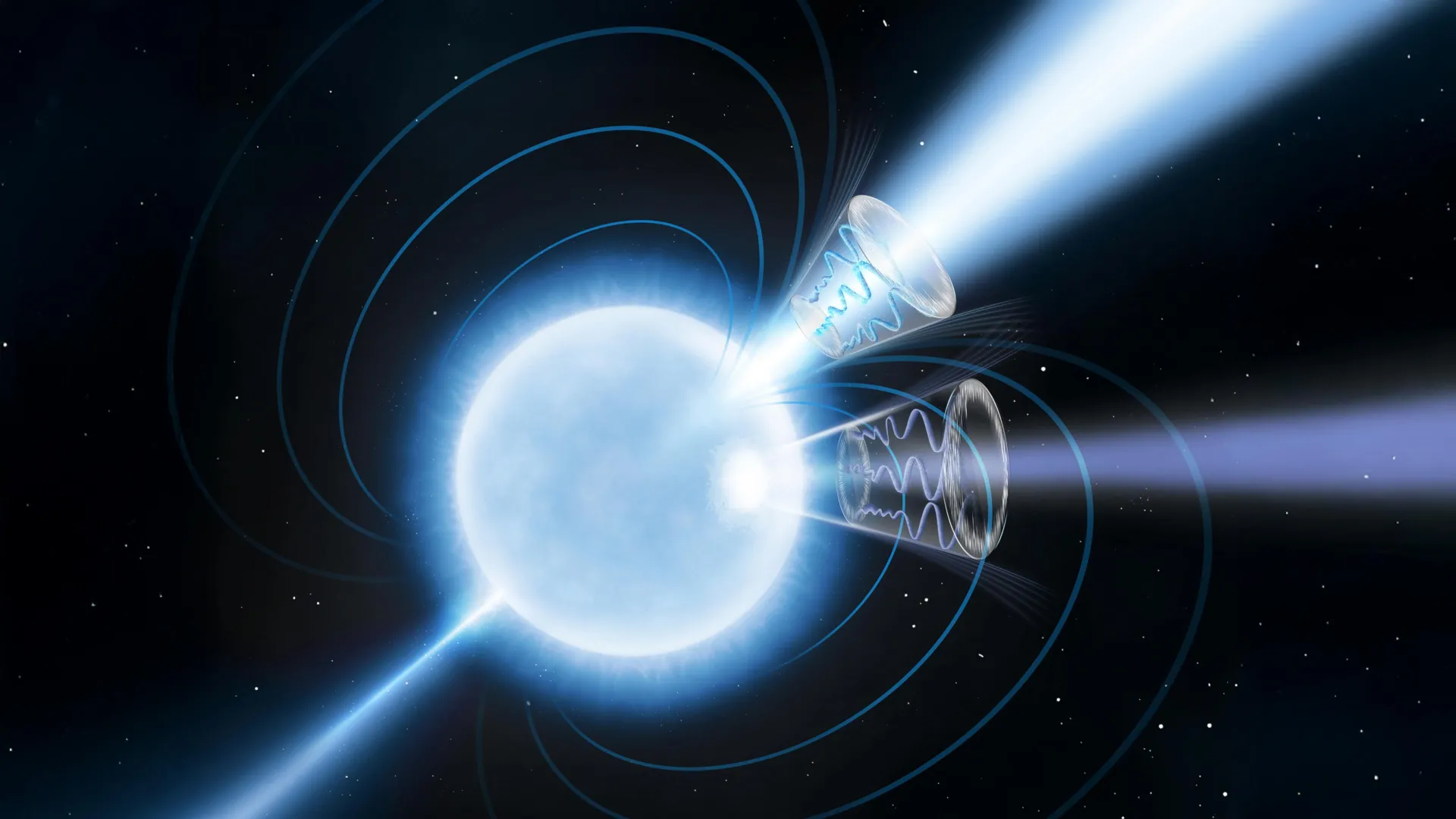
Astronomers have found strong evidence that some mysterious, minutes-long X-ray flashes come from two neutron stars colliding and producing a magnetar, a rapidly spinning neutron star with an extraordinarily strong magnetic field. The evidence comes from a record-setting event that glowed in X-rays for nearly ten minutes.
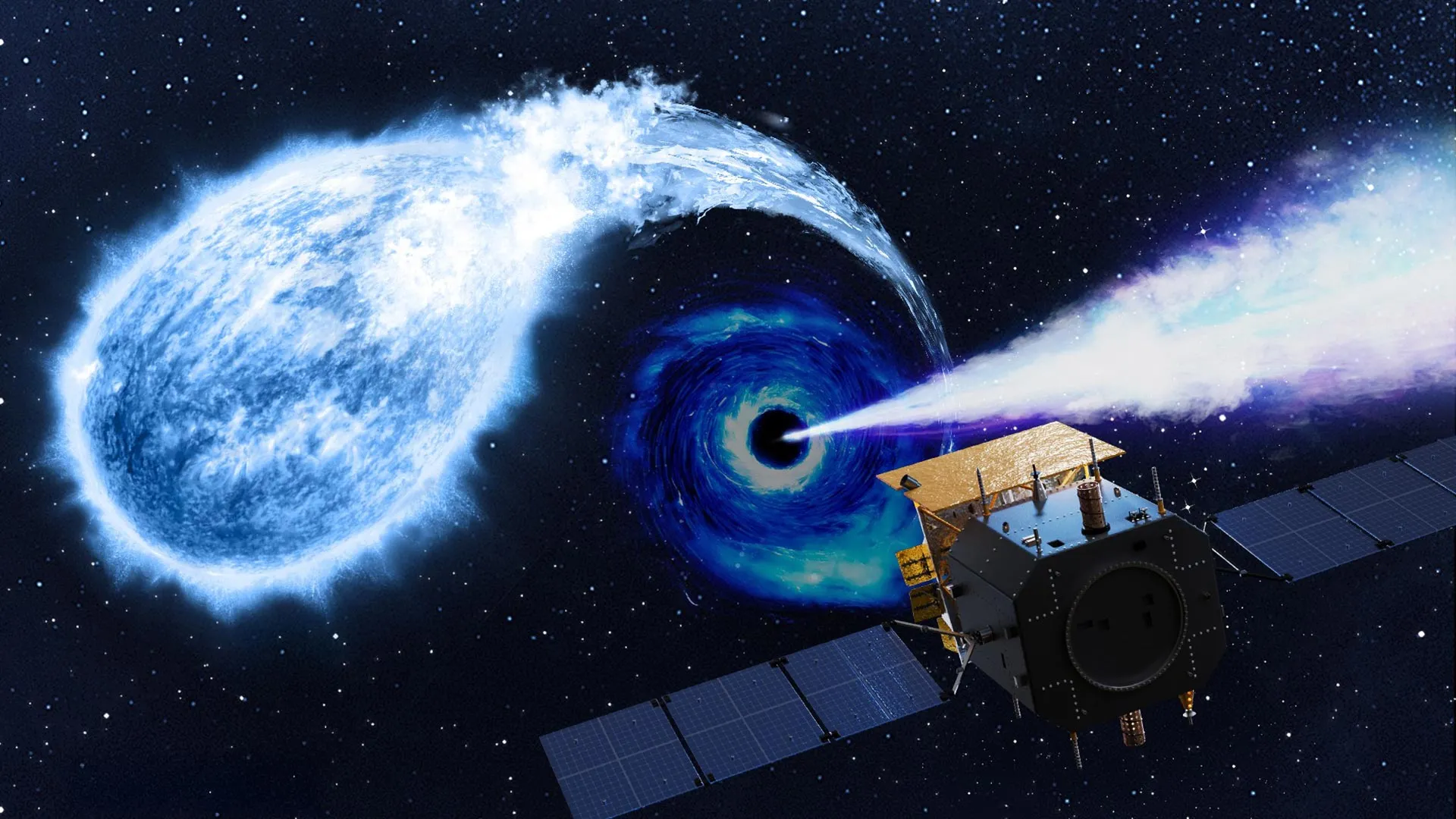
The event is cataloged as EP250704a, also known as GRB 250704B, and was detected on July 4, 2025. Its gamma-ray burst lasted only about half a second, the signature of a short burst. But the Einstein Probe satellite recorded bright X-rays for roughly ten minutes afterward, far longer than the usual afterglow from a merger.
Graduate student Niccolò Passaleva led rapid follow-up observations with the Very Large Telescope in Chile, which allowed detailed study while the event was still bright. The team measured a redshift of 0.6610, meaning the explosion happened more than 6 billion years ago. Deep observations found no accompanying supernova. A supernova would be expected if the burst had come from the collapse of a massive star, so its absence points toward a merger instead.
The long X-ray glow is the key clue. According to Prof. Eleonora Troja, one of the researchers, "Magnetars are rapidly spinning neutron stars with huge magnetic fields. When they damp their magnetic power into the surroundings, they can make any explosion brighter and longer-lasting." In this picture, the merger does not collapse promptly into a black hole. It leaves behind a magnetar that keeps pumping energy into the debris for minutes.
The international collaboration was led by researchers at Beijing Normal University, the Chinese Academy of Sciences and the University of Rome Tor Vergata, and the results appeared in Science Bulletin in 2026.
The observation also shows why fast follow-up matters. The Very Large Telescope could study the source only because the team reacted quickly while it was still bright, and the ability to rule out a supernova depended on deep imaging afterward. Teams working with wide-field X-ray satellites say that kind of rapid coordination between space and ground telescopes is what turns a strange flash into a classification.
The finding matters because neutron star mergers are among the universe's main factories of heavy elements such as gold, and they are also sources of gravitational waves. If extended X-ray flashes reliably mark magnetar births, wide-field X-ray telescopes like the Einstein Probe could become a new way to find these mergers, including ones that gravitational-wave detectors miss. One event is not a population, and the team's conclusion rests on a single unusually well-observed case, so more flashes with similar profiles will be needed to confirm the link.