Physicists Spin Molecules Inside a Frictionless Superfluid for the First Time
A new 'optical centrifuge' built at the University of British Columbia can grab molecules floating in ultracold helium and set them twirling on command, opening a window into one of matter's strangest states.
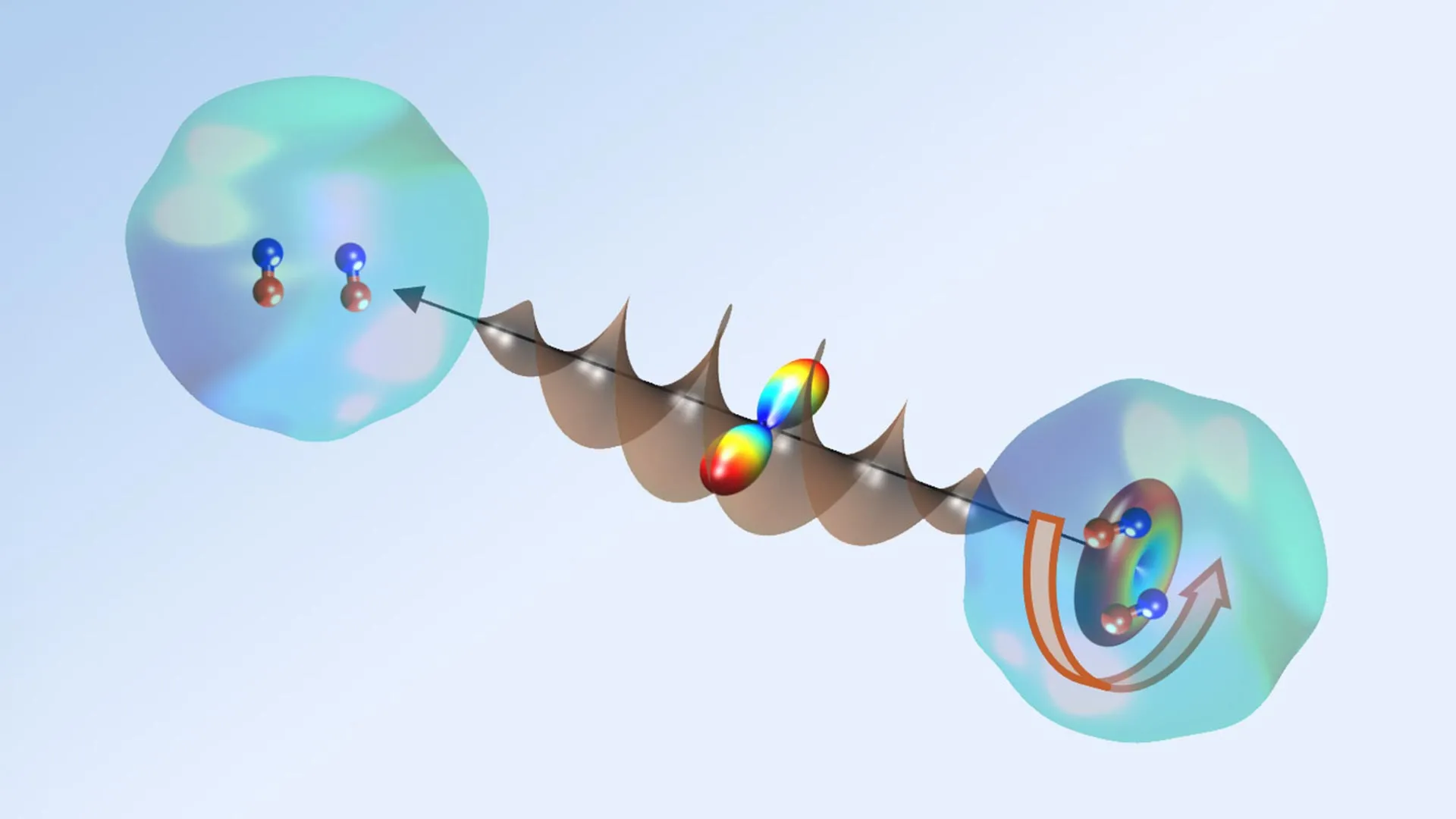
Physicists have, for the first time, taken direct control of molecules spinning inside a superfluid — a bizarre, frictionless state of matter — using a device called an optical centrifuge. The feat, reported by researchers at the University of British Columbia and the University of Freiburg in the journal Physical Review Letters, offers a new tool to probe one of the deepest mysteries in physics: how a fluid can flow with absolutely no resistance.
Superfluids form when certain liquids are chilled to within a whisker of absolute zero. In that regime, quantum mechanics takes over on a macroscopic scale, and the liquid loses all internal friction — it can climb the walls of its container and flow forever without slowing down. Helium is the classic example, and understanding exactly how and why superfluidity breaks down at the atomic scale has challenged physicists for the better part of a century.
To get a handle on it, the UBC-led team fired the beam of an optical centrifuge — essentially a laser engineered to act like a corkscrew of light — into tiny droplets of superfluid helium that had been "doped" with dimers of nitric oxide, pairs of molecules embedded inside each droplet. The twisting laser grabbed those molecules and set them rotating, allowing the researchers to dial in the direction and frequency of the spin at will. It was the first demonstration of such controlled rotation inside a superfluid.
That control is the whole point. By spinning the embedded molecules at chosen rates and watching how the surrounding quantum liquid responds, physicists can study how molecular rotors interact with the superfluid environment across a range of speeds. The molecules effectively become probes lowered into an otherwise inscrutable medium, reporting back on the forces and disturbances they encounter as they turn.
The researchers say the technique could shed new light on how superfluidity itself unravels — how a frictionless flow starts to feel drag when confronted with defects or fast-moving objects at the atomic level. The work, titled "Control of Molecular Rotation in Helium Nanodroplets with an Optical Centrifuge," pairs a decades-old puzzle with a strikingly precise new instrument, and its authors hope it will help unlock secrets of quantum liquids that have stayed hidden since superfluidity was first discovered.