James Webb Telescope Finds Largest Superheated Gas Stream Ever Seen, Driven by a Wobbling Black Hole
A precessing black hole jet in galaxy VV 340a is sweeping hot plasma across its entire host galaxy like a cosmic sprinkler, stripping star-forming gas at a rate equivalent to 19 suns per year.

Astronomers using NASA's James Webb Space Telescope have discovered the largest known stream of superheated coronal gas in the observable universe, a colossal structure erupting from the galaxy VV 340a that stretches at least three kiloparsecs — roughly 10,000 light-years — on each side of its host galaxy. The discovery, published in the journal Science, reveals that a precessing, or wobbling, jet from the galaxy's supermassive black hole is acting like a cosmic sprinkler, sweeping superheated plasma across the entire galaxy in a process that is fundamentally reshaping how it evolves.
The research was led by Justin Kader, a postdoctoral researcher at the UC Irvine Department of Physics and Astronomy, with senior co-author Vivian U, now an associate scientist at Caltech's IPAC. The team combined JWST observations with optical data from the W. M. Keck Observatory in Hawaii to build a detailed picture of the gas streams emanating from VV 340a, a galaxy located hundreds of millions of light-years from Earth. The scale of the superheated gas structure they found is more than 30 times larger than similar structures previously observed around other galaxies.
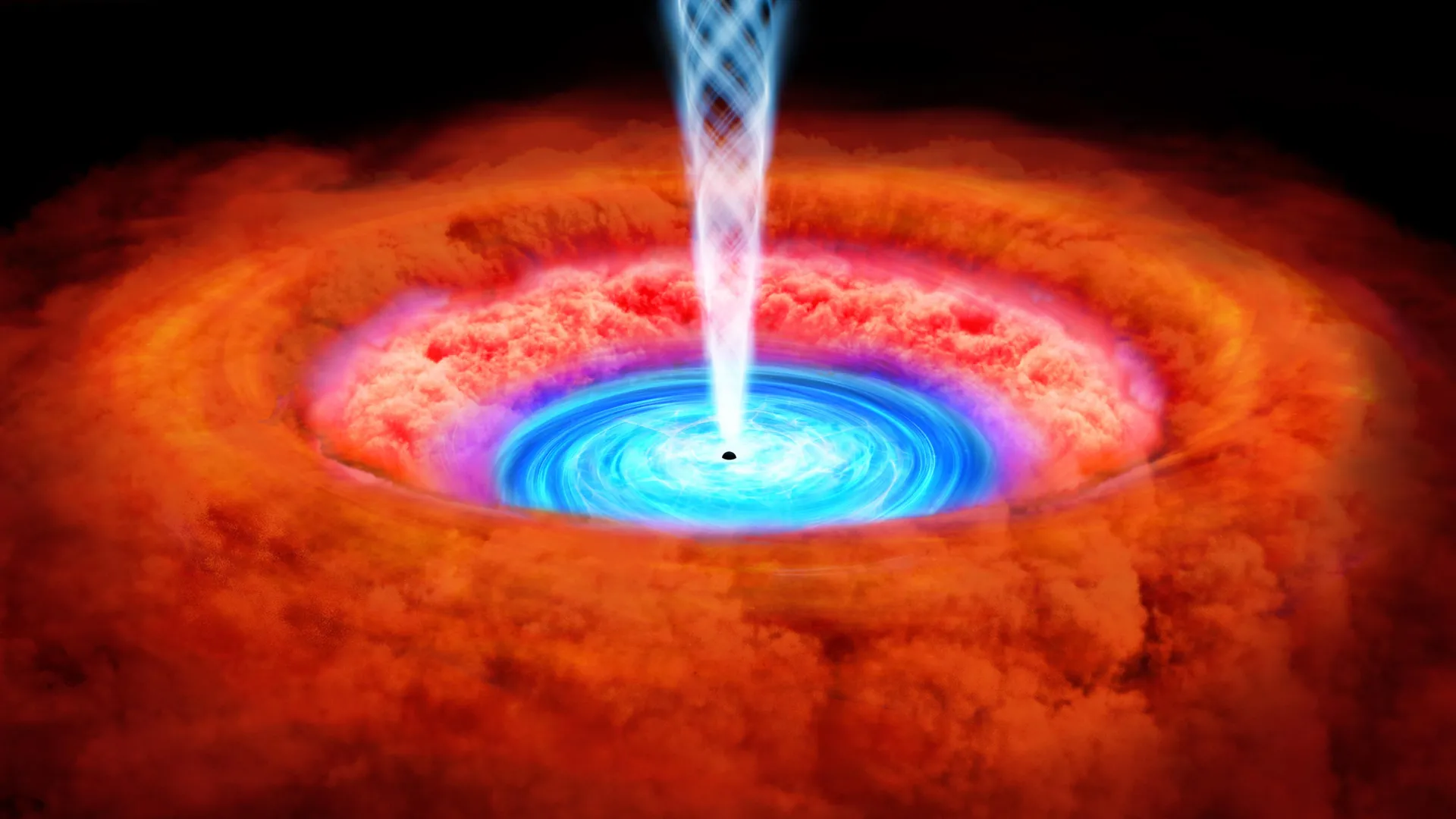
The driving mechanism is the black hole jet's precession — a slow, gyroscope-like wobble in the direction the jet is pointing. As the jet sweeps around, it heats and accelerates gas in a spiral pattern, like water from a rotating sprinkler head, pushing the material outward across the galaxy's disk rather than expelling it in a single narrow beam. The team calculated that the precessing jet is stripping enough gas from VV 340a every year to form approximately 19 stars the size of our Sun. Over millions of years, that amounts to an enormous suppression of the galaxy's star-forming capacity — a process astronomers call 'quenching.'
This is the first confirmed case of galaxy-wide quenching driven by a wobbling black hole jet in a disk galaxy — the most common type of large galaxy in the universe, including our own Milky Way. Previous models of how supermassive black holes suppress star formation had focused primarily on outflows directed outward from the galactic core. The new findings suggest that precessing jets can distribute their energy far more efficiently across the whole galaxy, heating gas that would otherwise cool and collapse to form new stars. 'The scale of what we're seeing here is genuinely unprecedented,' Kader said in a statement from UC Irvine. 'We've known that black holes can influence galaxy evolution, but finding a single jet that can affect the entire disk of a galaxy — not just the core — changes how we have to think about this process.'
The discovery has significant implications for models of galaxy evolution over cosmic time. A large fraction of the most massive galaxies in the universe appear to have 'quenched' their star formation at some point in the past, transitioning from active, star-forming spirals to relatively inert elliptical galaxies. The mechanism by which that happens has been one of the central open questions in extragalactic astronomy. The VV 340a finding, combined with similar observations made possible by JWST's extraordinary sensitivity to infrared emission from hot gas, suggests that precessing black hole jets may be one of the primary agents responsible for switching off star formation in galaxies across cosmic history.