They Pointed One of the World's Largest Telescopes at a Gas Cloud for Two Nights and Found No Stars at All
It May Be the First Dark Galaxy.
Ultra-deep imaging of Cloud-9 with the Gran Telescopio Canarias reached 31.4 magnitudes per square arcsecond and caps any stellar mass at 16,000 suns, against a million suns' worth of hydrogen.

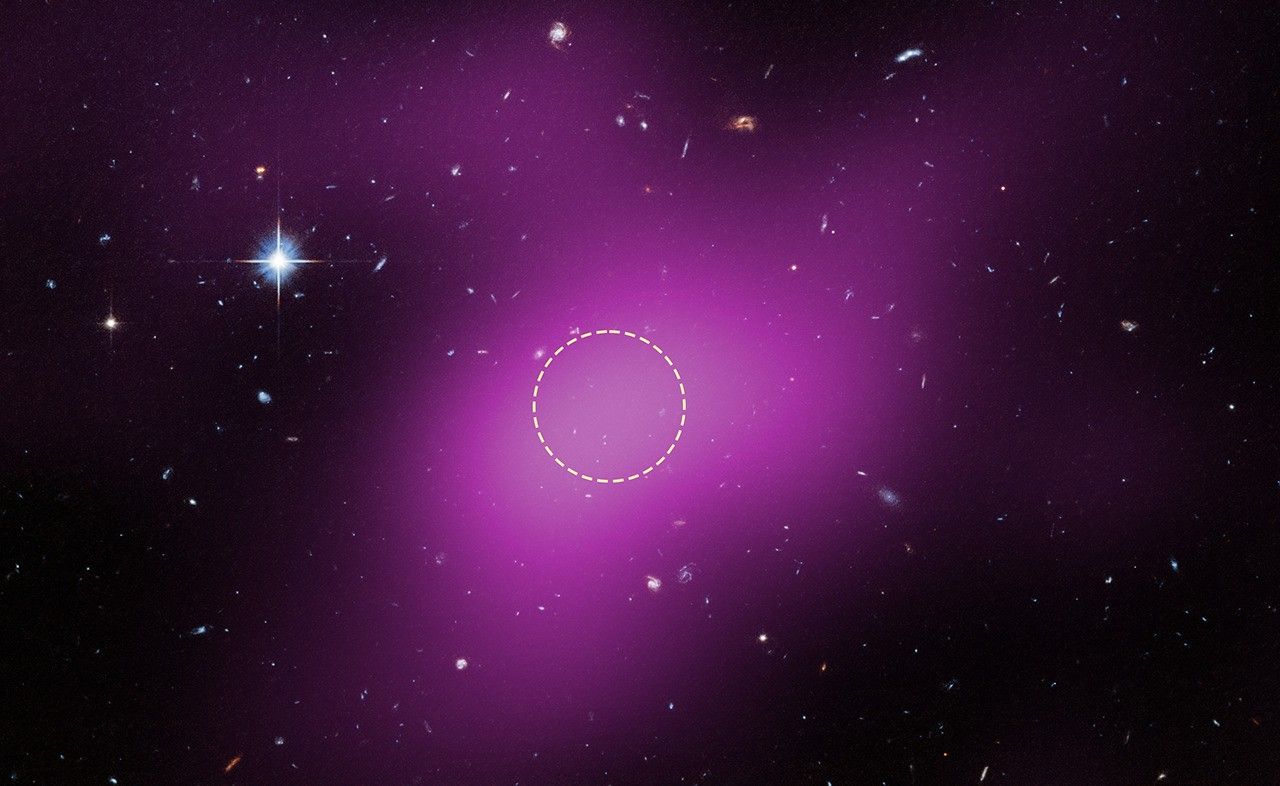
Astronomers have taken the deepest look yet at Cloud-9, a cloud of hydrogen gas about 15 million light-years away, and found nothing shining inside it. No stars, no faint smear of old starlight, nothing above the noise. The result, posted to the arXiv preprint server on Aug. 21 by a team led by Ignacio Trujillo of the Institute of Astrophysics of the Canary Islands, strengthens the case that Cloud-9 is a "dark galaxy": a clump of dark matter and gas that has all the properties of a small galaxy except the one everyone uses to define a galaxy.
The standard cosmological model, Lambda Cold Dark Matter, says such objects should exist in large numbers. Dark matter should have collapsed into countless small halos, and the smallest of them should have pulled in gas but never made stars, because the ultraviolet glow from quasars and galaxies across the universe keeps that gas too warm to collapse. Finding one would confirm a prediction the model has made for decades. Cloud-9, which sits near the spiral galaxy M94 at a distance of about 4.66 megaparsecs, has been the leading candidate since it turned up in radio surveys holding roughly a million solar masses of hydrogen with no obvious optical counterpart.
The problem has been ruling out the alternatives. Starless hydrogen clouds can be tidal debris ripped from a nearby galaxy, high-velocity clouds in our own halo or transient gas structures, and some of those could hide a very faint population of stars that shallow surveys would miss. Trujillo's team went after that faint light directly with HiPERCAM, a high-speed camera on the 10.4-meter Gran Telescopio Canarias, imaging Cloud-9 in five filters at once over two nights in June 2026. They shifted the telescope's pointing between exposures and masked the region around Cloud-9 before subtracting the sky background, so that any real diffuse glow would survive the processing rather than be scrubbed away as noise.
The images reached a limiting surface brightness of 31.4 magnitudes per square arcsecond in the g band, deep enough to see stellar populations far fainter than anything previous surveys could detect. Across Cloud-9's central region, about 4,200 light-years wide, there was no starlight. That non-detection puts an upper limit of 16,000 solar masses on any stars present, meaning the object holds at least 60 times as much gas as stars, and possibly no stars at all. "Alternative interpretations have been proposed for starless HI clouds, including tidal debris, high-velocity clouds, and transient gaseous structures," the team writes, but the new data leave little room for a hidden stellar component.
The result lands between two earlier estimates: a survey-based limit that the authors say was "not designed to preserve the low surface brightness signal," and a Hubble star-counting analysis that leaned on a comparison galaxy that may have been too compact to be a fair match. The GTC measurement is independent of both. The team concludes the observations "support the idea that Cloud-9 is an excellent candidate for a starless galaxy." If that holds, it would be the first direct confirmation of the dark, gas-rich halos that cold dark matter theory has long said must be out there, hidden in plain sight.