Hubble Confirms 'Cloud-9': A Galaxy That Formed No Stars, Made Almost Entirely of Dark Matter
Fourteen million light-years away, astronomers have confirmed the first Reionization-Limited H I Cloud — a relic of the early universe containing five billion solar masses of dark matter and not a single star.
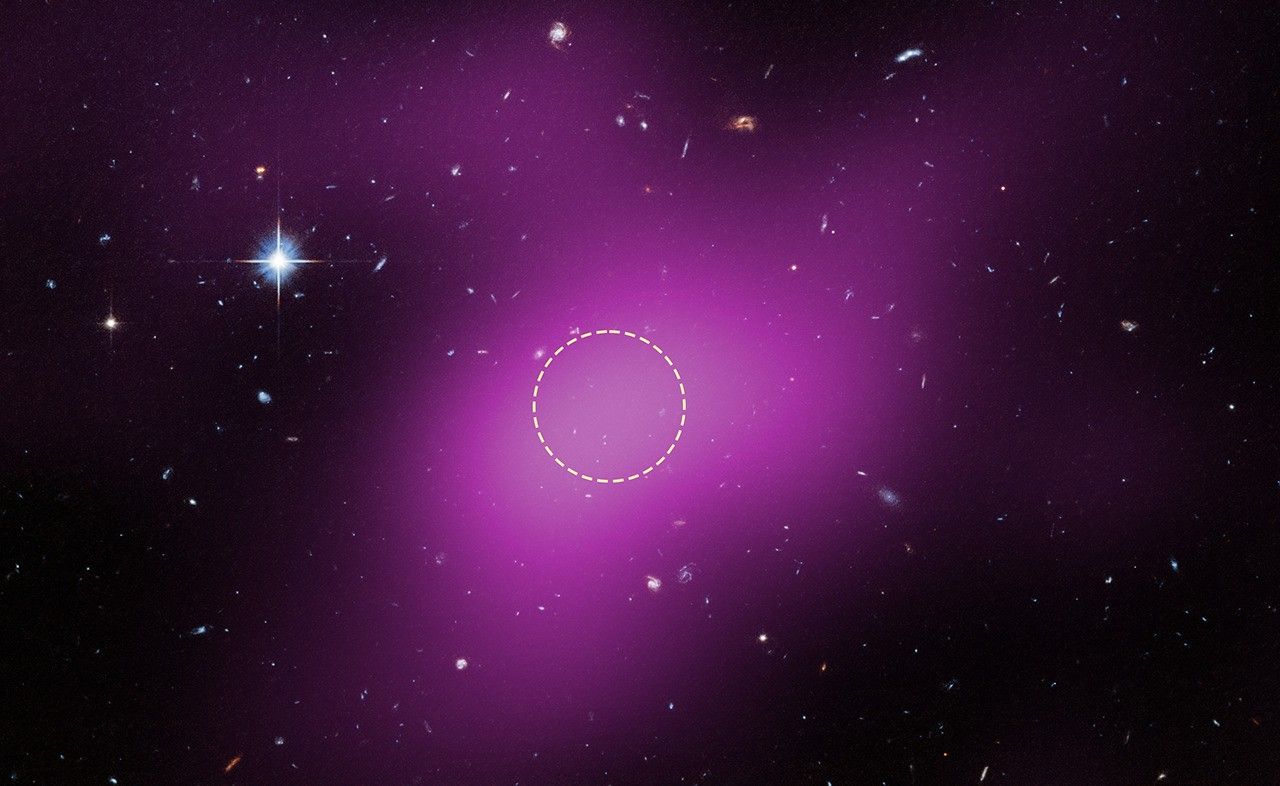
Astronomers using the Hubble Space Telescope have confirmed the existence of a remarkable cosmic object 14 million light-years from Earth: a galaxy-sized concentration of dark matter containing approximately five billion solar masses of hydrogen gas that somehow never managed to form a single star. The object, called Cloud-9, has been confirmed as the first known example of a newly defined class of cosmic object called a Reionization-Limited H I Cloud, or RELHIC — a relic of the universe's earliest epochs that has persisted essentially unchanged for more than 13 billion years.
Cloud-9 was first detected as an anomalous cloud of neutral hydrogen by radio telescopes, but its nature was unclear until Hubble observations revealed that the object has no stellar component whatsoever — a discovery that surprised astronomers accustomed to thinking of galaxies as systems defined by their stars. Without stars, Cloud-9 emits no visible light of its own, making it detectable only through its hydrogen radio emissions and its gravitational effects on surrounding space, which reveal the presence of a massive dark matter halo.
The leading theory for why Cloud-9 never formed stars involves the intense ultraviolet radiation that flooded the universe during a period called the Epoch of Reionization, roughly 400 million to one billion years after the Big Bang. During this period, the first stars and quasars pumped enormous amounts of ultraviolet light into space, ionizing hydrogen gas throughout the cosmos. Objects below a certain mass threshold — including the progenitor of Cloud-9 — would have had their gas photoionized and heated to temperatures too high for gravitational collapse into stars. The dark matter halo continued to grow, but the gas within it could never cool sufficiently to form stellar nurseries.
The confirmation of Cloud-9 as a RELHIC provides direct observational evidence for a theoretical prediction that such objects should exist as fossils of the reionization epoch. Cosmological simulations have long suggested that the universe should be full of dark matter halos below the stellar formation threshold, but detecting objects that contain no stars is extraordinarily difficult. Cloud-9 represents the first confirmed case of a galaxy-scale dark matter structure that completely failed to convert any of its gas into stars.
The discovery has significant implications for our understanding of the relationship between dark matter and ordinary matter in the early universe. It demonstrates that dark matter halos do not inevitably lead to galaxy formation — the conversion of gas into stars is a threshold phenomenon that depends critically on the mass of the halo and the radiation environment. Future radio telescope surveys are expected to discover many more RELHICs, potentially allowing astronomers to map the population of these invisible relics and use them as tracers of the universe's dark matter distribution.