Astronomers Find a Third Galaxy With No Dark Matter, Strung Along a Mysterious Cosmic Trail
The faint galaxy DF9 joins two earlier oddballs in a straight line of objects that appear to lack the invisible mass thought to bind galaxies together — hinting at a violent birth.
Astronomers have identified a third galaxy that appears to contain little or no dark matter, deepening one of the strangest puzzles in modern cosmology and lending weight to a dramatic theory about how such galaxies are born.
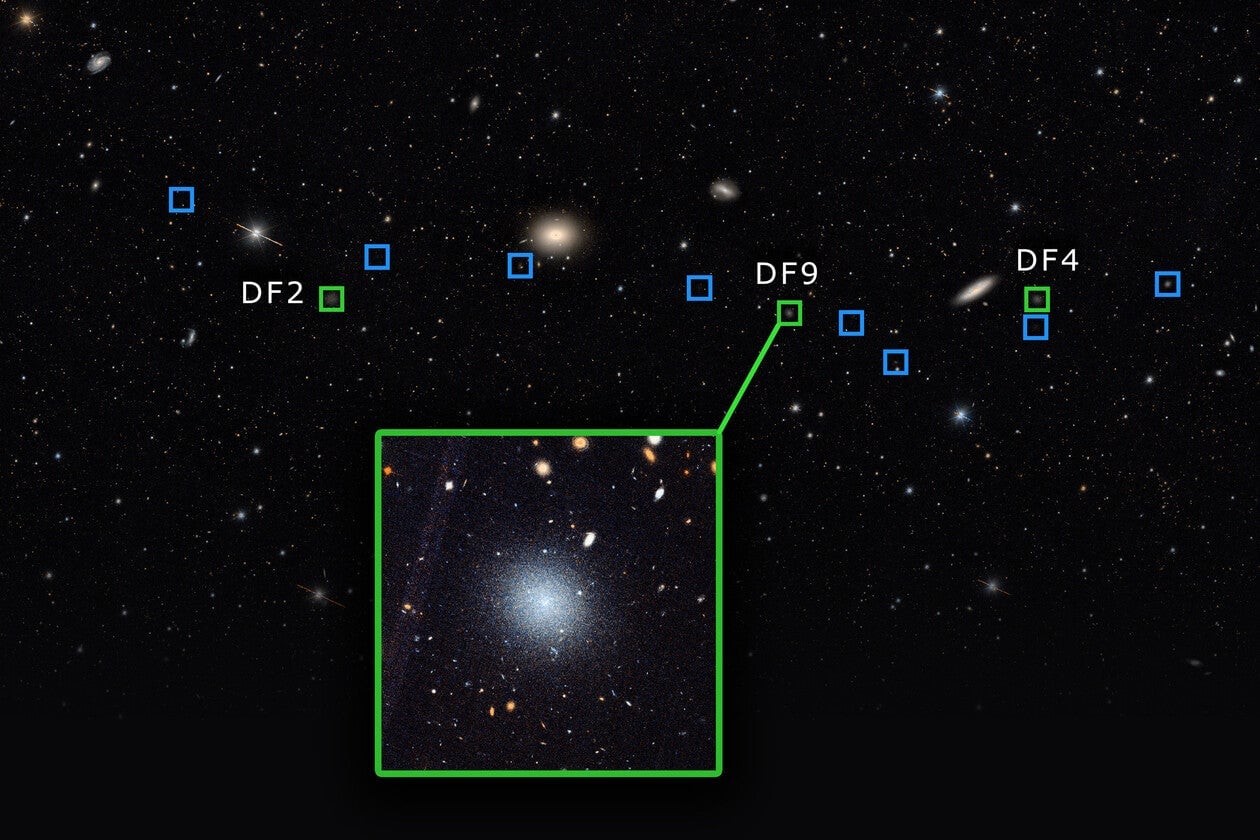
The galaxy, cataloged as DF9, sits about 45 million light-years from Earth in the field of the galaxy NGC 1052. It joins two previously discovered oddballs in the same region, DF2 and DF4, which stunned researchers years ago because their stars moved so slowly that there seemed to be nothing invisible tugging on them. In most galaxies, stars whip around far faster than their visible matter can explain, evidence of an unseen halo of dark matter. In these, that halo appears to be missing.
What makes the new finding especially provocative is that all three galaxies fall along a nearly straight line in space — a cosmic chain that looks anything but random. The discovery, reported in The Astrophysical Journal, was made with the W. M. Keck Observatory atop Maunakea in Hawaii, using its Keck Cosmic Web Imager, an instrument built to tease out the faint light of diffuse and distant structures.
Researchers say the alignment points to a shared and violent origin. The leading idea is that a high-speed collision between two galaxies tore gas away from its dark matter, and that this stripped gas later collapsed into a string of new galaxies made almost entirely of ordinary matter. If correct, the trail of DF2, DF4 and now DF9 would be the wreckage of a single ancient crash, still recognizable across tens of millions of light-years.
The existence of galaxies without dark matter cuts in a surprising direction in the long-running debate over the substance. Some critics of dark matter have argued that galaxy dynamics can be explained by modifying the laws of gravity instead. But under those alternative theories, every galaxy should behave as if dark matter is present — so finding galaxies that lack its gravitational fingerprint is, paradoxically, evidence that dark matter is a real, separable ingredient that can be removed.
Confirming the result will take more observations, and measuring the internal motions of such faint galaxies pushes even the largest telescopes to their limits. But each new member of the NGC 1052 trail makes the coincidence harder to dismiss. What began as a single baffling galaxy is turning into a lineup, and that lineup may be telling astronomers something fundamental about both how galaxies form and what dark matter really is.