James Webb Cracks the 13-Year Mystery of the 'Pink Planet,' Finding Salty Clouds 57 Light-Years Away
After a decade hidden in its star's glare, the giant world GJ 504 b gave up its secrets to Webb in just two hours — revealing water, methane, ammonia and, for the first time, clouds made of salt.
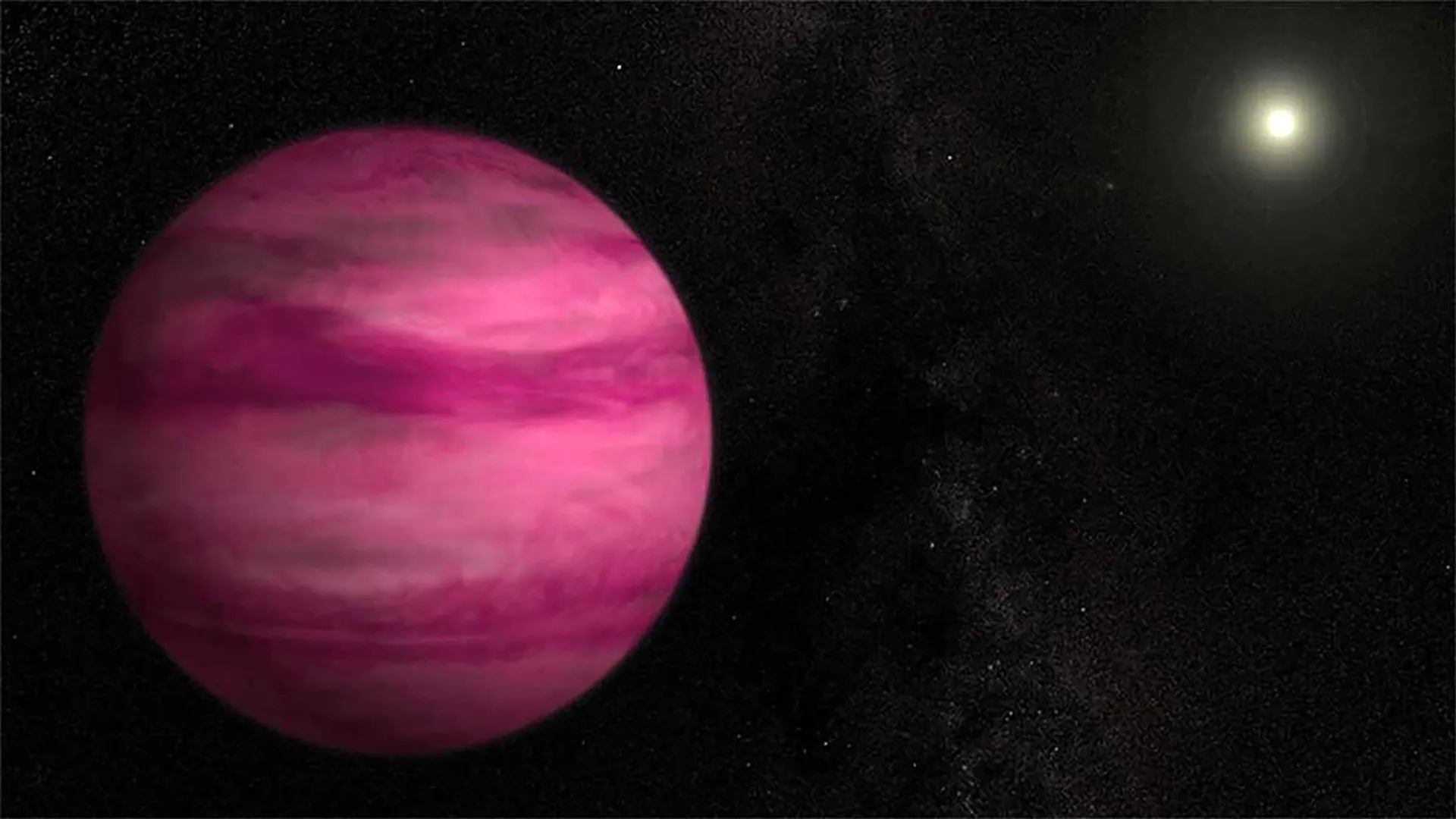
For more than a decade, one of astronomy's most photogenic worlds has also been one of its most frustrating. GJ 504 b — nicknamed the 'Pink Planet' for its distinctive rosy glow — has puzzled scientists since its discovery in 2013, its atmosphere hidden behind the overwhelming glare of its host star. Now the James Webb Space Telescope has finally cracked it open, revealing an exotic world wrapped in salty clouds.
GJ 504 b is a gas giant orbiting a sun-like star roughly 57 light-years from Earth. It is enormous — about 25 times the mass of Jupiter — with a surface temperature near 290 degrees Celsius and an estimated age of between 2.5 and 4 billion years. Its size sits at the blurry boundary between a giant planet and a failed star known as a brown dwarf, which is part of why astronomers have struggled even to agree on how to classify it.
A team led by Aneesh Baburaj of Northwestern University turned Webb's near-infrared spectrograph on the planet and, in just about two hours of observation, achieved what teams using the world's largest ground-based telescopes had failed to do over entire nights. The star's brightness had always drowned out the faint signal from the planet; Webb's sensitivity and vantage point above Earth's atmosphere cut through the noise. The results were published June 18 in The Astronomical Journal.
What they found is a chemically rich and surprising atmosphere. Webb detected water vapor, methane, carbon dioxide and ammonia — and, for the first time directly confirmed in such an object, salty clouds. The planet's air is unusually enriched in elements heavier than hydrogen and helium, what astronomers loosely call 'metals,' offering clues about how and where the world may have formed.
The salt clouds are the headline surprise. Clouds made of salts have long been predicted in the atmospheres of cool giant planets and brown dwarfs, but confirming them directly has been elusive. Their presence helps explain the planet's peculiar color and provides a real-world test for the models scientists use to interpret the atmospheres of distant worlds, from puffy gas giants to potentially habitable planets.
Beyond solving a specific mystery, the observation is a proof of concept for a broader ambition. Being able to characterize the atmosphere of a faint, directly imaged planet so quickly suggests Webb can probe many more such worlds, sharpening the tools astronomers will eventually turn on smaller, rockier planets. For a world that spent 13 years as an enigma, the Pink Planet has quickly become a template for how to read the air of alien skies.