Hubble Marks America's 250th With a 'Stellar Sparkler' — One of the Milky Way's Oldest Star Clusters
NASA released a red, white and blue portrait of the 13-billion-year-old globular cluster NGC 6426, whose ancient stars hold clues to how the universe first forged the ingredients for planets and life.
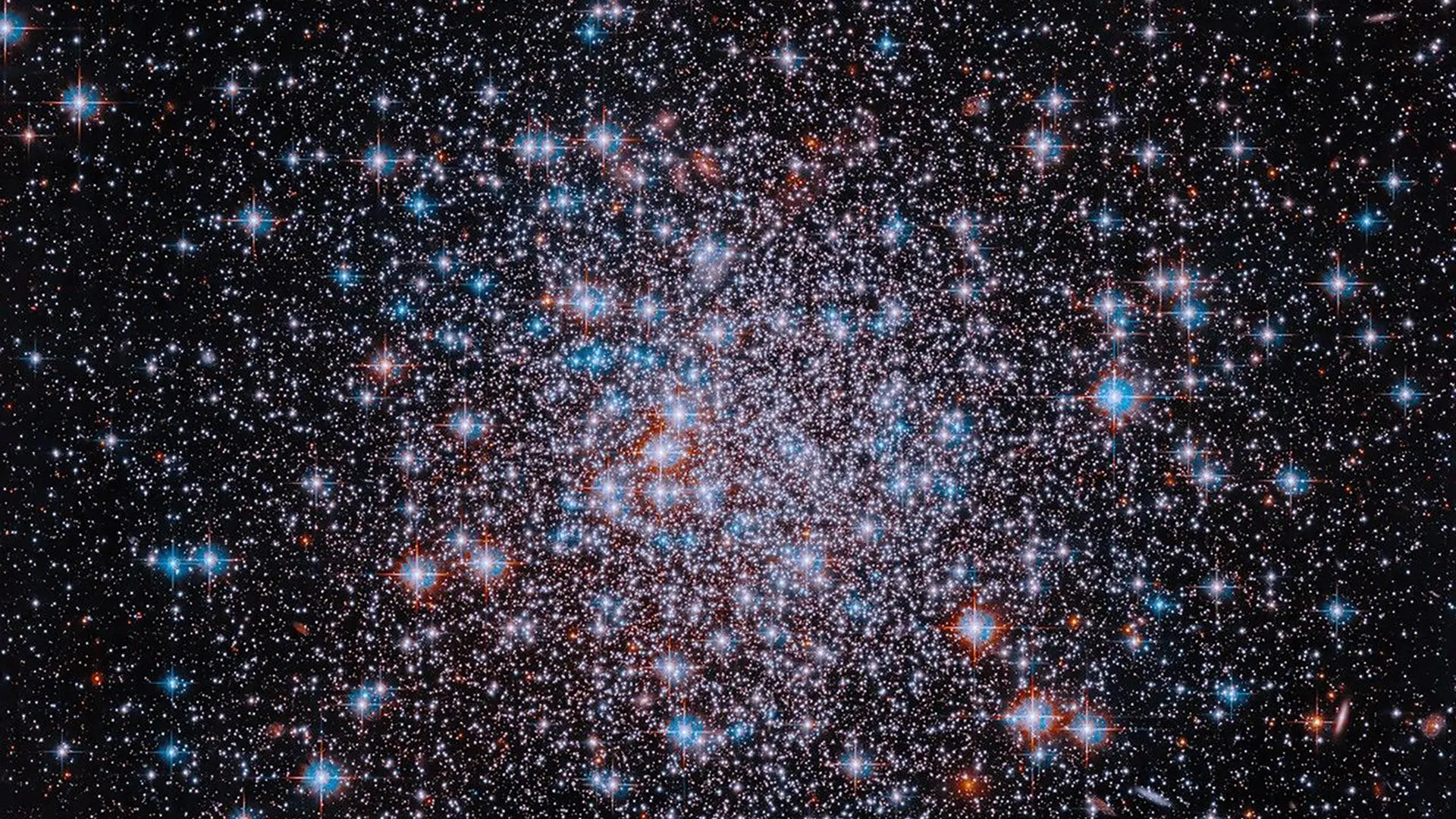
To mark the United States' 250th birthday, NASA turned its Hubble Space Telescope on one of the oldest objects in the Milky Way and came back with a fittingly patriotic image: a glittering, red-white-and-blue swarm of ancient stars the agency dubbed a "stellar sparkler."
The cluster is NGC 6426, a globular cluster tucked in the outer halo of our galaxy. Globular clusters are dense, roughly spherical swarms that can contain hundreds of thousands of stars bound tightly by gravity, and they rank among the most ancient structures in the cosmos. NGC 6426 is estimated to be around 13 billion years old — meaning it has survived through nearly the entire history of the universe, which is about 13.8 billion years old.
What draws astronomers to this particular cluster is its chemistry. NGC 6426 is unusually metal-poor, a term astronomers use for objects containing very little of the elements heavier than hydrogen and helium. Because those heavier elements are forged inside stars and scattered by later generations, a metal-poor cluster is essentially a fossil, preserving the chemical conditions of the early universe when the first stars were only beginning to enrich their surroundings.
Peering into the cluster, researchers have found evidence of two chemically distinct populations of stars. That signature suggests the slightly younger stars formed only after an earlier generation of massive stars had already burned out and detonated as supernovae, seeding the surrounding gas with fresh elements. In other words, the cluster records a hand-off between stellar generations — a snapshot of the very process that gradually stocked the universe with the raw materials for planets and, eventually, life.
The observations were made with the Hubble Space Telescope, which continues to deliver sharp views of crowded star fields more than three decades after its launch. The image and its analysis draw on work from astronomers including A. Dotter of Dartmouth College and Gladys Kober of NASA and the Catholic University of America, who have studied how such ancient clusters trace the assembly history of the Milky Way.
NASA framed the release as a celebration, choosing an object whose naturally red, white and blue-hued stars lent themselves to the Fourth of July theme. But beneath the holiday packaging is a serious scientific point: clusters like NGC 6426 are living records of cosmic history, and studying them helps astronomers reconstruct how a young, near-featureless universe transformed into one capable of building worlds.