Kyushu Physicists Fired the Gekko-XII Laser at Two Spots on a Carbon Target, Slammed the Resulting Plasma Clouds Together and Recreated a Solar Flare on a Tabletop. However They Changed the Inflow, the Magnetic Field Lines Snapped and Reconnected at Nearly the Same Rate.
The result backs a long-suspected 'universal' reconnection rate and says the speed is set inside the thin current sheet, not by the plasma feeding it. Better reconnection models mean better space weather forecasts for satellites and power grids.
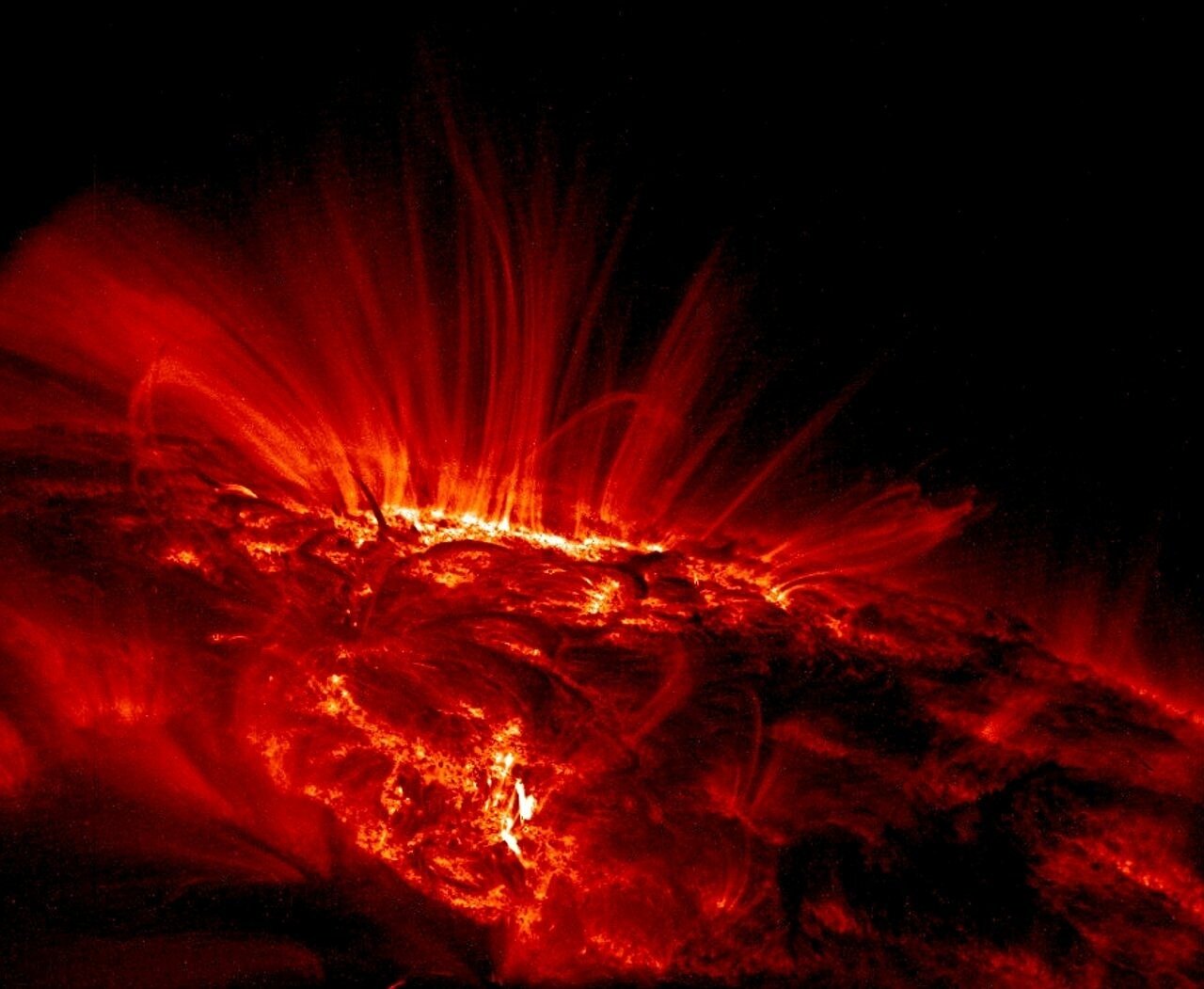
Magnetic reconnection is the process that powers solar flares: magnetic field lines pointing in opposite directions are pushed together inside a hot, electrically conducting plasma, snap, and splice back together in a new configuration, dumping enormous stored magnetic energy into heat and fast-moving jets of particles. It is also thought to drive the substorms that light up Earth's auroras. Space probes have watched it happen and supercomputers have simulated it, but one basic question has resisted both: how much does the speed of reconnection depend on the conditions of the plasma flowing into it? Researchers at Kyushu University now have a laboratory answer, published in Physical Review E.
A team led by Associate Professor Taichi Morita of Kyushu's Faculty of Engineering Sciences, working with colleagues at Osaka University, used the Gekko-XII laser at Osaka's Institute of Laser Engineering to fire high-power beams at two separate spots on a carbon target. Each shot blew off an expanding cloud of plasma carrying its own magnetic field, generated by the so-called Biermann battery effect, in which misaligned temperature and density gradients spontaneously produce a field. Where the two clouds collided, the oppositely directed fields reconnected. By changing the distance between the two laser spots, the researchers could substantially vary the density and magnetic conditions flowing into the reconnection region, the experimental equivalent of changing the weather feeding a flare.
To watch what happened, the team built a two-directional laser Thomson-scattering system, which fires a probe laser into the plasma and reads the temperature, density and flow velocity from how the light scatters. That let them follow the reconnection as it unfolded rather than inferring it afterward.
The headline result is a kind of stubbornness. Even though the expansion and transport histories of the magnetic fields, and the moment at which reconnection kicked in, differed substantially from shot to shot, once a current sheet had formed, the thin layer where the fields meet, the reconnection rates came out strikingly similar. "Our study provides experimental evidence for the robustness of the magnetic reconnection process by demonstrating that fast reconnection can occur at similar rates despite substantially different upstream conditions," Morita said. In plain terms, the speed is set by the local physics of the reconnection layer itself, not by the properties of the plasma feeding it, which helps explain why reconnection rates measured in space so often seem to land on a "universal" value.
The team also measured how the liberated magnetic energy was split between heating the plasma and accelerating it into high-speed outflows. "The measurement techniques established in this study now make it possible to quantitatively evaluate the magnetic reconnection rate and its energy conversion," Morita said, giving theorists and simulation groups hard experimental benchmarks to test against. The next experiments will push toward conditions closer to real space plasmas, including oblique magnetic fields and asymmetric flows. "The improved understanding of magnetic reconnection will aid in predicting space weather events that have an impact on satellites, communications systems, navigation technologies and power infrastructure," Morita said. The paper, "Characterizing the temporal evolution of Biermann-battery-driven magnetic reconnection in laser-ablated plasmas," is also available on arXiv.
Originally reported by Phys.org.